
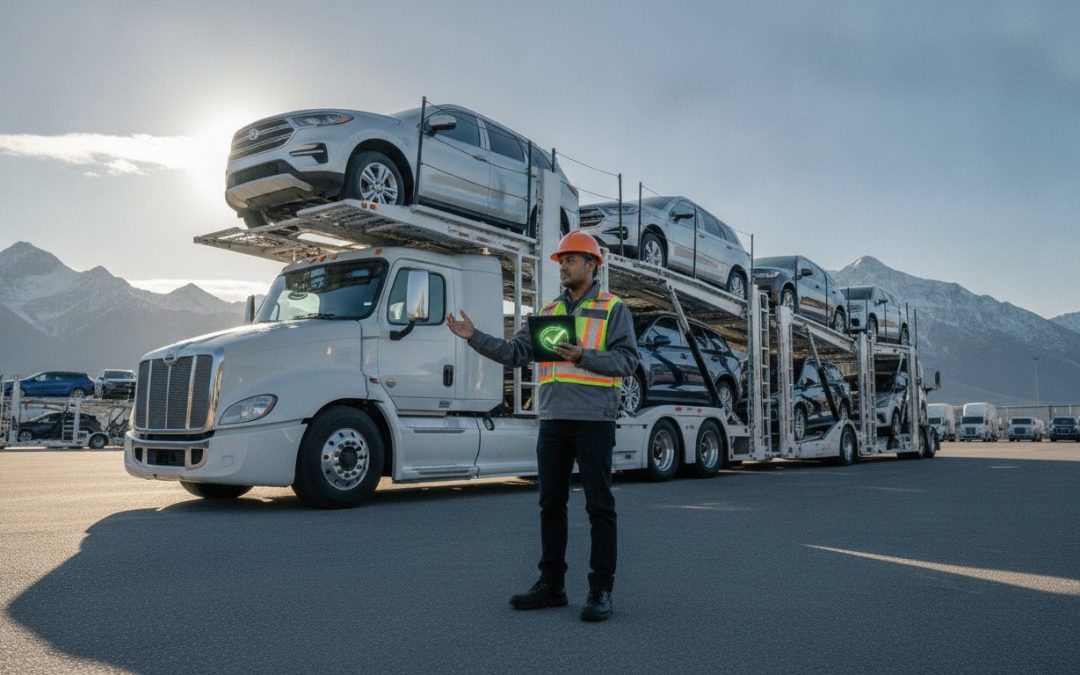
Imagine watching your car pull away on a trailer. You later find out the carrier’s insurance was a lapsed policy and their reviews were fake. It’s a nightmare scenario that happens too often in the logistics industry. You want your vehicle moved safely, but the process of vetting auto transport carriers canada often feels like a confusing gamble. We understand that anxiety. Your car is a major investment. Your car deserves professional care. The maze of provincial regulations can feel overwhelming when you just want a simple, safe delivery.
You’ll learn the rigorous process of verifying insurance, safety ratings, and reliability. This guide provides a clear checklist for credentials. We explain the critical difference between cargo and liability insurance. We also cover 2026 federal ELD mandates and provincial safety requirements. This gives you the peace of mind you deserve. Your vehicle belongs in professional hands. Your vehicle deserves a secure journey. Let’s replace uncertainty with a proven system for safe transport.
Key Takeaways
- Learn how to verify essential credentials like National Safety Code (NSC) numbers and Ontario’s CVOR to ensure your carrier is fully compliant.
- Understand the critical difference between cargo and liability insurance to protect your vehicle against damage or loss during transit.
- Master the process of vetting auto transport carriers canada by identifying red flags like cash-only payments or missing physical addresses.
- Discover why specialized experience with trucks and SUVs is vital for handling the unique challenges of the rugged Canadian landscape.
- See how a professional dispatch service simplifies your workload by handling the complex verification and communication process for you.
Why Vetting Auto Transport Carriers in Canada is Non-Negotiable
Your vehicle represents a significant capital investment. Moving it across thousands of kilometres of highway is a high-stakes operation. A single error in judgment by a driver or a mechanical failure on an unmaintained trailer can lead to total loss. Professional vetting auto transport carriers canada ensures that the company handling your asset has the financial stability and safety record to finish the job. It’s about protecting your bottom line from avoidable disasters. Reliable dispatching removes the guesswork from this equation. You deserve a partner that prioritizes your inventory’s safety above all else.
The Canadian landscape presents unique challenges that test even the most seasoned operators. From steep mountain grades to unpredictable winter storms on open plains, our geography demands top-tier equipment and specialized skills. Carriers must follow strict safety standards set by Transport Canada to operate legally and safely. If you hire a non-compliant carrier, you risk more than just damage. You could face legal complications or insurance denials if an accident occurs while your vehicle is in the hands of an unauthorized operator. Checking a carrier’s safety profile is a critical step in this process that cannot be skipped.
For busy business owners and dealerships, rigorous vetting acts as a vital stress-relief tool. You don’t have the hours to audit every carrier’s safety logs or insurance certificates. Outsourcing this burden allows you to focus on your core operations while knowing the heavy lifting is handled by professionals. It’s a proactive approach that eliminates potential headaches before the truck even arrives at your lot. Efficiency in logistics starts with trust, and trust is built through verification.
The Risks of the “Lowest Quote” Trap
Cut-rate prices are often a red flag for skipped safety inspections or expired insurance policies. When a carrier quotes significantly below the market average, they’re likely cutting costs in areas that directly impact your vehicle’s safety. Cheap transport often leads to frustrating delays, poor communication, and zero recourse when damage occurs. In 2026 logistics, predatory pricing is defined as an unsustainable rate offered by a carrier to secure a contract with the intent of cutting essential safety or insurance costs to maintain a profit. Don’t let a small initial saving turn into a massive future expense.
Protecting Your Inventory During Cross-Province Hauling
Different vehicles require different handling. An SUV has a higher centre of gravity and different tie-down requirements than a low-profile sedan or a heavy-duty truck. Professional vetting auto transport carriers canada ensures your carrier uses the right specialized equipment for your specific inventory. Long-haul routes across provinces require drivers who understand how to manage fatigue and maintain equipment over long distances. To better prepare for your next shipment, review our Vehicle Delivery Logistics in Canada for a strategic approach to moving your fleet safely.
The Canadian Compliance Checklist: NSC, CVOR, and Insurance
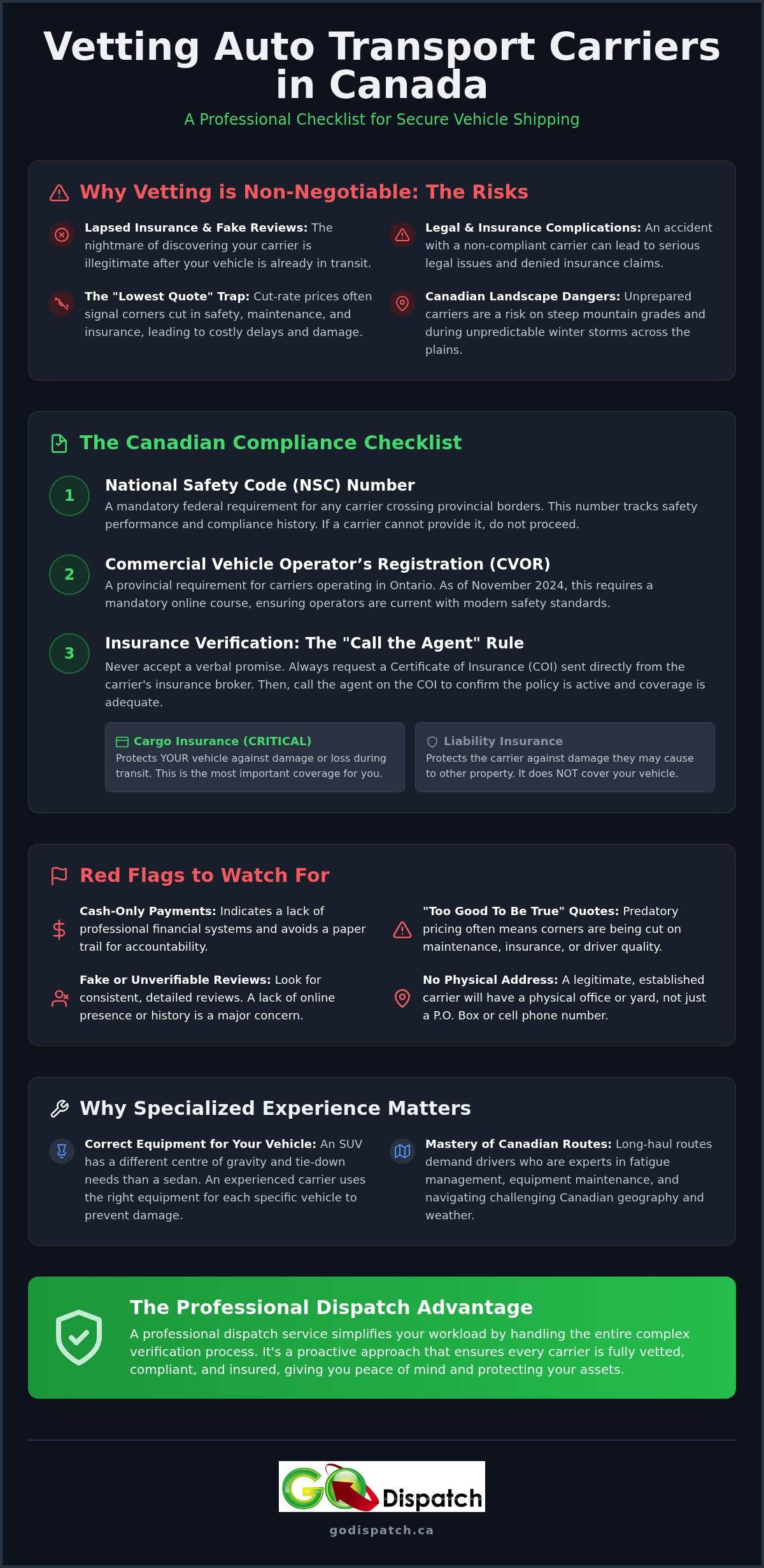
Compliance is the legal bedrock of a safe shipment. Every carrier operating across provincial borders must maintain a valid National Safety Code (NSC) number. This number is more than just a registration. It’s a tracking tool for the carrier’s safety performance and regulatory history. If a carrier cannot provide this number immediately, they aren’t worth your time. When vetting auto transport carriers canada, verifying this credential is your first line of defence against unauthorized operators.
Provincial requirements add another layer of security. In Ontario, for instance, carriers must hold a Commercial Vehicle Operator’s Registration (CVOR). The landscape for this registration changed recently. As of November 1, 2024, the old in-person knowledge test was replaced by a mandatory online learning and assessment course. This shift toward digital compliance ensures that operators stay current with modern safety standards. We manage these technical checks daily at GO DISPATCH, ensuring every truck we dispatch meets these rigorous provincial standards.
Verifying Insurance: Don’t Take Their Word For It
Never rely on a verbal promise of coverage. You must request a Certificate of Insurance (COI) sent directly from the carrier’s broker. This document proves the policy is active. Use the “Call the Agent” rule. Contact the insurance representative listed on the COI to confirm the policy hasn’t lapsed. You must also distinguish between Carrier Liability and Cargo Insurance. Liability covers damage the truck causes to others. Cargo insurance covers the actual vehicle being hauled.
In 2026, adequate cargo limits are non-negotiable. Federal minimums for cargo insurance are tied to the Gross Vehicle Weight (GVW). For heavy haulers over 37,000 kg, the minimum is $32,000. However, for-hire carriers in Ontario must carry at least $2,000,000 in liability coverage. Ensure the cargo policy covers the full replacement value of your specific vehicle. If you’re moving a high-value SUV or a luxury sedan, a standard $15,000 policy is insufficient.
Regulatory Compliance and Safety Ratings
A carrier’s safety rating is a public record. Provincial transportation ministries assign these ratings based on inspections, collisions, and convictions. A “Satisfactory” rating is the absolute minimum standard for professional hauling. Avoid any carrier with a “Conditional” or “Unsatisfactory” status. These labels often signal deep-seated issues with vehicle maintenance or driver hours.
Modern vetting auto transport carriers canada also involves checking for Electronic Logging Device (ELD) compliance. Most commercial drivers in Canada are now required to use certified ELDs to track their hours of service. This technology prevents driver fatigue, which is a leading cause of transit accidents. Finally, always review the Bill of Lading (BOL) before the keys change hands. A professional BOL should clearly list the vehicle condition, insurance terms, and delivery timelines. If the terms are vague or unprofessional, it’s a sign to walk away.
Vetting for Quality: Beyond the Regulatory Paperwork
Paperwork tells you if a carrier is legal. Quality vetting tells you if they are reliable. When vetting auto transport carriers canada, you must look past the basic certificates to see how a company actually operates. They shouldn’t just be legal. They must be experts. Start with their communication style. Do they answer the phone? If a carrier is hard to reach during the quoting phase, they will be impossible to reach when your vehicle is delayed. Professionalism in the dispatch office usually reflects the care taken on the road. A responsive team indicates a well-organized operation that values your time and your inventory.
Modern equipment is another non-negotiable marker of quality. Outdated chains are a relic of the past; they often scratch rims or put unnecessary stress on suspension components. High-quality carriers use soft-tie straps that secure the vehicle by the tires. This method prevents metal-on-metal contact and keeps the car’s alignment intact. While Transport Canada’s motor carrier regulations set the baseline for safety, these equipment choices show a carrier’s commitment to vehicle integrity. It’s the difference between a car that arrives and a car that arrives in showroom condition.
The Role of Real-World Performance Data
Don’t trust every five-star review you see online. Bot ratings and fake testimonials are common hurdles in 2026. Look for specific details in reviews, such as mentions of driver names or specific routes. Real-world performance is best judged through established industry relationships. Dispatchers who work with the same carriers repeatedly have historical data on on-time delivery and claim rates. This internal knowledge is more valuable than a generic search engine rating. Reliability is a track record, not a marketing claim. We prioritize carriers with a history of hitting their windows without compromising safety.
Specialized Handling for Different Vehicle Classes
A carrier experienced in hauling sedans might struggle with the weight distribution of a heavy-duty van or a lifted SUV. These larger vehicles have higher centres of gravity and require specific height clearances on the trailer. Your vetting process must include a check of their past loads. For those moving larger inventory, our guide on How to Transport a Truck Across Canada offers specific vetting tips for oversized shipments. Ensuring the carrier has the right ramps and deck space prevents loading accidents. This level of detail in vetting auto transport carriers canada separates the professionals from the amateurs and ensures your vehicle moves safely across the country.
Red Flags to Watch for When Choosing a Carrier
A legitimate carrier has a physical footprint. If a company lacks a verifiable physical address or uses a generic PO box as their primary contact, treat it as a major warning sign. Professional vetting auto transport carriers canada starts with confirming that the business actually exists in the real world. Vague contact information often hides a “fly-by-night” operation that can disappear the moment a problem arises. These entities often use burner phone numbers and lack the professional infrastructure needed to manage national logistics. You need a partner you can find if things go wrong.
Financial red flags are equally telling. Reliable carriers don’t demand large upfront deposits before they’ve even picked up your vehicle. Be especially wary of requests for “cash-only” payments or wire transfers to personal accounts. These methods offer zero protection for you as a consumer. A professional operation has clear, transparent billing practices and provides a formal invoice. If they can’t produce professional paperwork with clear terms and conditions, they aren’t prepared to handle your capital investment safely. Trust your gut when the money talk feels shady.
Communication Breakdowns as a Warning Sign
Pay attention to how a company handles your initial inquiry. If they take days to return a call or provide vague, automated responses, you’re looking at a “ghosting” risk. If they don’t call you back when they’re trying to win your business, they certainly won’t call when there is a delay on the highway. Many companies now use “quote bots” to generate instant prices. While fast, these bots often hide a lack of actual logistics expertise. You deserve to talk to a human who understands the route. Realize that a lack of transparency is a deliberate choice. It’s often used to hide poor safety records or a lack of proper equipment. Professionalism starts with a conversation.
Equipment and Operational Red Flags
Operational red flags often appear at the point of pickup. A professional driver will always perform a detailed pre-trip inspection and provide you with a report. If a carrier refuses to document the vehicle’s condition, they are likely trying to avoid liability for future damage. You should also be cautious of vague answers regarding the route or ETA. A professional dispatcher knows exactly where their trucks are at all times. The most dangerous red flag is “double-brokering.” This occurs when a carrier accepts your job and then hands it off to an unvetted third party without your consent. It’s a practice that voids insurance and puts your vehicle at extreme risk. To avoid these traps, work with a professional dispatching partner that manages every detail of the carrier verification process for you.
The GO DISPATCH Advantage: Professional Vetting as a Service
Managing logistics shouldn’t be your second job. You have a business to run and customers to serve. We act as your dedicated department for vetting auto transport carriers canada, handling the complex background checks that eat up your day. Our team takes the lead on compliance audits and safety verifications. We don’t just check boxes; we build relationships. This human-led approach ensures that every carrier we assign is currently insured, operationally sound, and ready for the road. You get the security of a massive network with the personal touch of a dedicated support team.
Our “Human-First” philosophy sets us apart from automated platforms. We talk to the drivers and dispatchers so you don’t have to. If a delay occurs on a snowy mountain pass, we find out first and update you immediately. We provide a one-stop dispatching solution for national hauling that covers cars, trucks, SUVs, and vans. This streamlined process moves your inventory from point A to point B with zero stress. You get the peace of mind that comes from knowing an expert is watching every mile of the journey.
Our Rigorous Carrier Selection Process
Every move starts with a fresh audit. We verify the Certificate of Insurance and safety credentials for every single carrier before they join our network. We maintain a curated list of professional Canadian operators who meet our high standards for equipment and reliability. This isn’t a generic database; it’s a vetted community of experts. Dealerships across the country trust our expertise to transport cars between dealerships safely and efficiently. We understand the high stakes of moving commercial inventory and treat every vehicle as if it were our own.
Safe, Reliable, and Efficient: The GO DISPATCH Promise
We reduce your daily burden by managing the entire logistics lifecycle. You don’t need to worry about lapsed policies or “ghosting” carriers. Our team ensures predictable schedules and maintains transparent communication for every vehicle type. Whether you are moving a single van or a fleet of trucks, our process remains the same: thorough, professional, and fast. We take pride in being the proactive problem-solvers who handle the details behind the scenes. Your business stays focused on growth while we handle the heavy lifting. Ready to move? Book your transport with a vetted carrier today and experience the difference of professional dispatching.
Secure Your Vehicle’s Future Journey
Your vehicle is more than just cargo; it’s a significant capital asset that requires absolute protection. Mastering the process of vetting auto transport carriers canada ensures that every kilometre across the country is backed by active insurance and verified safety ratings. You now have the professional tools to spot red flags and verify National Safety Code credentials before the keys change hands. Don’t let the complexity of provincial regulations slow your business down. You deserve a partner that handles the heavy lifting of compliance for you.
We provide national coverage with professional human support to manage the entire logistics lifecycle. Our team maintains rigorous 2026 insurance verification standards to protect your cars, trucks, and SUVs. We specialize in specialized hauling that prioritizes safety, equipment integrity, and efficient delivery. It’s time to replace the anxiety of unvetted carriers with a streamlined, professional solution that delivers peace of mind. Experience the difference that real human connection and expert dispatching make for your fleet.
Simplify your logistics with GO DISPATCH’s vetted carrier network. Your vehicle’s safety is our priority. Let’s get your inventory moving with confidence today.
Frequently Asked Questions
What is an NSC number and why does a Canadian carrier need one?
An NSC number stands for the National Safety Code. It is a set of safety standards developed to ensure a consistent level of safety for commercial vehicles across the country. Every carrier operating across provincial borders must have one. It allows regulators to track a carrier’s safety performance, including collisions and convictions. Verifying this number is a foundational step in vetting auto transport carriers canada to ensure legal compliance and driver accountability.
How do I verify if an auto carrier’s insurance is actually active?
You should request a Certificate of Insurance (COI) directly from the carrier’s insurance broker. Never rely on a printed copy provided by a driver. Take the extra step to call the insurance agent listed on the certificate. Confirm the policy is active and specifically covers cargo. Ensure the coverage limit is high enough to replace your vehicle entirely. This simple phone call prevents you from trusting a lapsed or fraudulent policy.
Is a direct carrier always safer than using a dispatch service?
A dispatch service often provides more security than a single direct carrier. While a carrier is limited to their own trucks, a dispatcher like GO DISPATCH has access to a wide, vetted network. We act as an independent auditor, ensuring every carrier meets strict safety and insurance standards. This provides an extra layer of protection. You get the flexibility of a national network combined with the rigorous vetting standards of a professional logistics partner.
What should I do if a carrier refuses to provide a Bill of Lading?
You should refuse to release your vehicle if a carrier won’t provide a Bill of Lading (BOL). This document is your only legal receipt and evidence of the vehicle’s condition at pickup. It outlines the terms of the transport and the carrier’s liability. A refusal to provide a BOL is a massive red flag. It suggests the carrier is unprofessional or lacks the proper insurance to back their operation. Safety requires clear documentation.
Does standard car insurance cover my vehicle during professional transport?
Most standard personal auto insurance policies don’t cover your vehicle while it is being transported commercially. Your personal coverage is designed for daily driving, not professional hauling. This is why vetting auto transport carriers canada for comprehensive cargo insurance is so important. The carrier’s policy must be the primary source of protection. Always confirm their cargo limits meet the current market value of your car, truck, or SUV before signing any contract.
How can I tell if a vehicle transport review is real or fake?
Real reviews usually contain specific details about the driver, the communication style, or the delivery timeline. Be wary of reviews that use generic praise or appear in large batches on the same day. Fake ratings often lack substance and sound like marketing copy. Check the reviewer’s profile for a history of diverse feedback. A genuine review will often mention a specific vehicle type, such as a van or a heavy-duty truck.
What is the difference between open and enclosed hauling vetting requirements?
Enclosed hauling vetting focuses on specialized equipment and higher cargo insurance limits. These carriers often move luxury or vintage vehicles that require extra protection from the elements. Open hauling vetting prioritizes the carrier’s experience with weather-related safety and their tie-down methods. Both require a valid NSC number and active insurance. However, enclosed carriers must demonstrate expertise with hydraulic lift gates and low-clearance loading to prevent undercarriage damage during the transport process.
What happens if a vetted carrier damages my vehicle during transit?
You must note any damage on the Bill of Lading immediately upon delivery. Take clear, high-resolution photos of the vehicle before the driver leaves the site. Because we only work with vetted carriers, an active insurance policy will be in place to cover the loss. We help facilitate the claims process by providing the necessary carrier documentation. Professional vetting ensures there is always a clear path to recovery if an accident occurs during transit.