
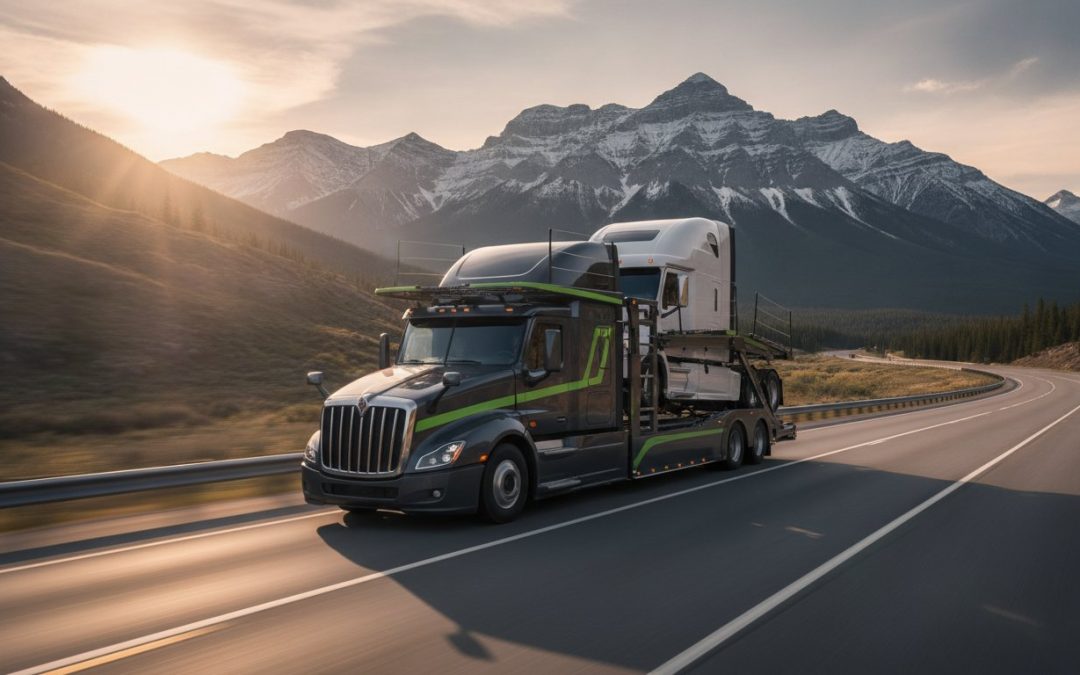
Driving a heavy-duty vehicle from Halifax to Vancouver isn’t just a long trip; it’s a calculated risk to your bottom line. When you choose to transport a truck across Canada’s vast terrain, you’re battling more than just distance. With diesel prices in the Greater Toronto Area climbing above $2.39 per litre in 2026, the fuel bill alone is enough to stall any DIY plan. You realize that every kilometre driven adds mechanical wear and potential repair costs to an expensive asset. Finding a carrier capable of handling oversized dimensions shouldn’t be your second job.
We understand that your priority is a streamlined, stress-free move. This guide teaches you exactly how to manage professional logistics for a safe, cross-country delivery in 2026. You will learn how to prepare your vehicle for the journey, the crucial differences between dispatchers and carriers, and how to navigate a market where spot rates have jumped nearly 49 per cent. From mandatory electronic logging device compliance to damage-free delivery, we provide the clarity you need to move your truck with confidence.
Key Takeaways
- Save on fuel and prevent depreciation by understanding the hidden costs of driving thousands of kilometres versus professional hauling.
- Learn how to accurately assess your vehicle’s weight and height to ensure you choose the right equipment to transport a truck safely across Canada.
- Compare open-carrier and flatbed methods to determine which hauling strategy fits your truck’s specific dimensions and value.
- Use our preparation checklist to organize your vehicle for transit, from securing accessories to managing fluid levels for a damage-free journey.
- Simplify your logistics by using a dispatch service that provides a single point of contact and access to a vetted network of national carriers.
Professional Truck Transport vs. Driving: Evaluating Your Options
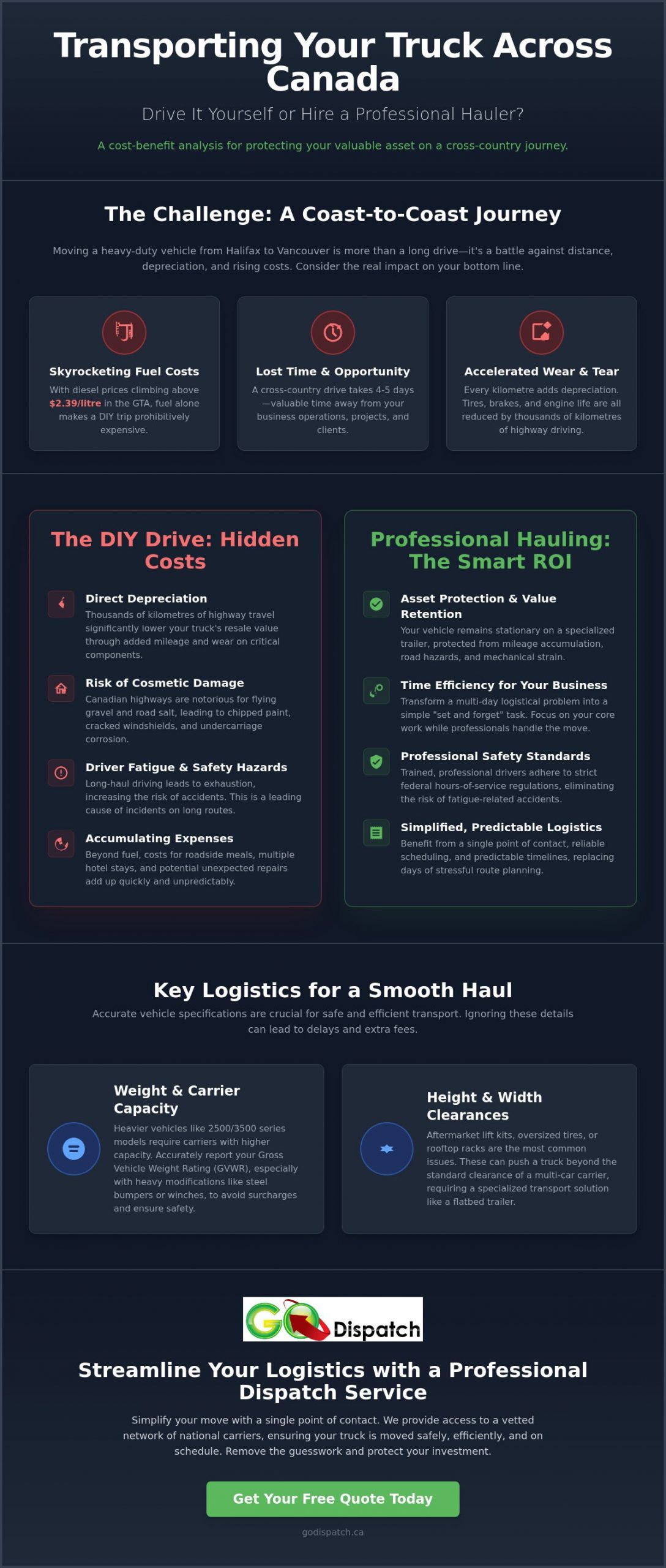
Deciding between driving your vehicle yourself or hiring a professional service is a matter of ROI. On the surface, a road trip might seem like a cost-effective adventure. The reality is often a logistical headache. When you choose to transport a truck across provinces, you are protecting a major financial asset. Driving from Ontario to British Columbia involves thousands of kilometres of high-speed highway travel. You face fluctuating fuel prices, expensive roadside meals, and multiple hotel stays. These costs accumulate rapidly. By the time you reach your destination, you have spent more than just money; you have spent your energy and your focus.
The Real Cost of Kilometres and Wear
Every kilometre on the odometer translates to direct depreciation. Modern pickup trucks maintain high resale values, but only if they are kept in peak condition. A cross-country trip adds significant wear to tires, brakes, and the engine. You also risk cosmetic damage. Canadian highways are notorious for flying gravel and road salt, which lead to chipped paint or cracked windshields. Utilizing commercial vehicle hauling in Canada eliminates these risks. Your vehicle remains stationary on a specialized trailer, protected from the pavement. Proven car hauling methods ensure your truck is secured properly, regardless of its size or aftermarket modifications.
Time Efficiency for Business Operations
Your time is your most valuable resource. Spending four or five days behind the wheel is a massive opportunity cost for any professional. If you are a business owner, those are days you aren’t closing deals or managing projects. Professional dispatching transforms a complex national move into a “set and forget” task. You drop off the vehicle and return to your core work while the logistics happen behind the scenes.
- Reliable Scheduling: Professional carriers operate on strict, predictable timelines.
- Reduced Fatigue: Avoid the physical and mental toll of long-haul driving and highway stress.
- Simplified Logistics: One point of contact replaces days of route planning and fuel stop calculations.
Safety remains a critical factor. Highway fatigue is a leading cause of accidents on long routes. Professional drivers are trained for these distances and follow strict federal hours-of-service regulations. When you transport a truck with experts, you remove the human error associated with exhaustion. It is a safer, faster, and more efficient way to move your equipment across the country without sacrificing your week.
Key Logistics of Shipping Large Vehicles: Weight and Height
Shipping a pickup is a different beast than shipping a sedan. Most carriers treat cars as standard units, but a truck’s footprint dictates the entire logistics strategy. If you need to transport a truck, you must account for its physical volume and mass before it ever touches a trailer. Ignoring these specs leads to delays, extra fees, or even a carrier refusing the load at the curb. We prioritize accuracy to ensure your vehicle fits the first time.
Understanding Weight Classes and Carrier Capacity
Trucks vary wildly in weight, from light-duty pickups to heavy-duty service vehicles equipped with cranes or toolbeds. This weight directly impacts carrier selection and cost. Heavier vehicles require more fuel to move and take up a larger portion of the trailer’s legal weight limit. Because of this, carriers often apply a weight-based surcharge for 2500 or 3500 series models. Gross Vehicle Weight Rating (GVWR) is the maximum allowable weight of your vehicle as specified by the manufacturer, and it serves as the primary metric for transport safety and equipment choice. If your truck is modified with heavy steel bumpers or winches, its actual weight might exceed the standard factory specs. Providing an accurate estimate helps us match you with a carrier that has the necessary suspension and braking capacity to handle your load safely. If you aren’t sure about your vehicle’s specific class, our team at GO DISPATCH can help you identify the right equipment for your needs.
Height and Width Clearances
Height is the most common hurdle in truck logistics. Many Canadian owners add aftermarket lift kits, oversized tires, or rooftop accessories like racks and canopies. These modifications can push a truck past the standard height clearance of a multi-car carrier. If a truck is too tall, it cannot sit on the bottom deck of a standard trailer without risking damage to the upper deck. Wide-body dually trucks present a similar challenge. Their flared rear fenders often exceed the width of a standard car hauling ramp. These vehicles require specialized flatbed trailers or “low-boy” setups to ensure they don’t overhang dangerously.
National routes are strictly governed by Canadian transportation regulation, which varies between provinces. What is legal in Alberta might require a special permit in Ontario or Quebec. Most highways have an “over-dimensional” threshold of approximately 2.6 metres in width. Once your truck crosses this line, the logistics become more complex. You may need specific routing to avoid low bridges or narrow construction zones. Taking precise measurements of your truck’s highest and widest points is essential. This data allows us to secure a carrier that can navigate your specific route without legal or physical obstacles.
Choosing the Right Hauling Method for Your Truck
Selecting a hauling method is a choice between cost, speed, and the physical constraints of your vehicle. While a compact car fits almost anywhere, a heavy-duty pickup requires specific equipment to ensure a safe journey. Most owners find that the “standard” option works well, but certain modifications or vehicle conditions demand a more specialized approach. We help you match your vehicle to the right trailer to ensure a damage-free delivery.
Open Carrier Transport: The Industry Standard
Most people who choose to transport a truck across Canada utilize multi-car open carriers. These are the large, double-decker trailers you frequently see on the Trans-Canada Highway. They are the most cost-effective and readily available option for national moves. Modern open carriers use advanced tie-down systems that secure the truck by its tires or chassis, preventing any movement during transit. This method is highly reliable for standard factory models and light-duty pickups. For a deeper look at how these systems operate across different provinces, you can consult our national vehicle transport guide. It provides a clear overview of general hauling principles that apply to most Canadian routes.
Flatbed and Specialized Equipment
If your truck is non-running, exceptionally heavy, or modified with a wide dually axle, a standard open carrier might not be an option. In these cases, flatbed hauling becomes the necessity. Flatbeds provide a level surface that accommodates wider wheelbases and heavier Gross Vehicle Weight Ratings. Loading and unloading these large vehicles in residential areas requires precision. Large trailers often cannot navigate tight suburban crescents or narrow downtown streets. We often coordinate a central meeting point or use specialized ramps and hydraulic lifts to bridge the gap. This ensures your truck is loaded safely without risking damage to the undercarriage or the surrounding property.
Other niche methods exist, but they come with specific trade-offs. Rail transport is often discussed as a budget option, yet it has strict limitations. Most rail cars have rigid height and width clearances that exclude lifted trucks or those with wide mirrors. Enclosed transport offers the highest level of protection from road debris, but the cost is rarely justified unless you are moving a high-value classic or a custom show truck. For urgent, single-vehicle moves, a “hotshot” trailer is often the most efficient choice. These smaller trailers are pulled by heavy-duty pickups and can reach remote locations that larger rigs simply cannot access. When you transport a truck with a professional dispatch service, we evaluate these variables to find the most logical fit for your timeline and budget.
How to Prepare Your Truck for National Transport
Preparing your vehicle is the final step before the carrier arrives. A well-prepared vehicle ensures a faster hand-off and minimizes the risk of transit delays. When you prepare to transport a truck, the details matter. You must look beyond the engine to the physical exterior and the contents of the cab. Taking an hour to secure your vehicle today prevents a logistical headache tomorrow. We prioritize a smooth transition, and that starts with your preparation.
Securing Exterior Accessories
Trucks are often customized with gear that standard car carriers aren’t built to house. Fold in your side mirrors and retract any power-running boards to reduce the vehicle’s width. If you have a loose drop-in bed liner, secure it firmly or remove it entirely; high wind speeds on an open trailer can easily lift unsecured liners. Canopies and toppers require special attention. Ensure all latches are locked and inspect the seals to prevent water ingress during highway travel. You should also remove any non-standard auxiliary lights or light bars that extend beyond the truck’s factory silhouette. These small steps protect your accessories from the vibrations and elements of a cross-country journey.
The Pre-Transport Inspection
A successful move depends on a clear Bill of Lading. This is your primary legal protection and serves as an official receipt of the vehicle’s condition. Before the driver arrives, wash your truck thoroughly. Dirt and mud hide small scratches or dents, making it impossible for the carrier to perform an accurate condition report. Once the truck is clean, take high-resolution photos of every angle. Capture the roof and the undercarriage to ensure you have a complete visual record.
- Document Everything: Note any existing mechanical quirks or minor cosmetic flaws on the Bill of Lading alongside the driver.
- Fluid Levels: Keep your fuel tank at approximately one-quarter full. This provides enough fuel for loading while keeping the overall weight manageable.
- Battery Maintenance: Ensure the battery is secure and the terminals are clean so the truck starts easily for every transition.
- Personal Items: Clear the cab of all loose items. Carriers are not licensed to haul household goods inside a vehicle, and these items can shift and cause interior damage.
The Bill of Lading is more than a checklist; it is a binding document. When the driver performs their walk-around, stay present and involved. Compare their notes to your own photos before signing. Once both parties sign, the responsibility for the vehicle’s safety officially transfers to the carrier. If you want a partner who prioritizes this level of detail, book your truck transport with our professional team. We guide you through every step of the inspection process to ensure total peace of mind.
Streamlining Truck Hauling with Professional Dispatch Services
Managing a cross-country move involves more than just finding a trailer. It requires constant communication, legal compliance, and rigorous scheduling. When you choose to transport a truck, the logistics can quickly become overwhelming. Many people believe calling a direct carrier is the fastest route. In reality, a single carrier is limited by their own fleet availability and fixed routes. If their trucks are full or their drivers are on a break, your vehicle stays put. A professional dispatch service removes these barriers by connecting you to a massive network of vetted professionals. We act as the bridge between your needs and the best available equipment on the road.
The Advantage of a One-Stop Dispatch Solution
A dispatcher acts as your logistical architect. We don’t just find a trailer; we match your specific truck to the exact equipment it needs. Whether you have a standard pickup or a modified dually, we realize efficiency by sourcing the right fit from a national pool of carriers. This is especially vital for remote or non-standard routes where specialized equipment is scarce. You don’t have to call dozens of companies to find a spot. You have a single point of contact who handles the search, the negotiation, and the scheduling. This centralized approach provides immediate peace of mind. You can focus on your business while we manage the movement behind the scenes. Our goal is to make the process feel simple, even when the underlying logistics are complex. If you manage inventory at scale, our dedicated truck transport for dealerships guide outlines how professional dispatching can streamline multi-unit moves and keep your sales cycle on track.
Ensuring Reliable and Safe Delivery
Safety is not a suggestion; it is a requirement. We take the administrative burden off your plate by conducting a rigorous vetting process for every carrier in our network. This includes verifying active insurance policies, checking safety ratings, and ensuring compliance with federal regulations. Understanding the full scope of vehicle transport insurance requirements helps you confirm that your carrier meets the national liability minimums and carries adequate cargo coverage before you hand over the keys. We only partner with professionals who meet our high standards for reliability. This proactive problem-solving ensures that your vehicle is in safe hands from the moment of pickup to the final delivery. You avoid the risk of unverified operators and gain the security of a professional partnership. Logistics should be a solution, not a source of stress.
- Vetted Networks: Access to carriers that have been screened for safety and insurance.
- Single Point of Contact: No more chasing multiple drivers for updates.
- Route Flexibility: Capacity to transport a truck to virtually any location in Canada.
By choosing a dispatch service, you are choosing a partner that prioritizes your timeline and your vehicle’s safety. We handle the paperwork, the carrier coordination, and the troubleshooting. This allows you to reclaim your time and rest easy knowing your truck is moving toward its destination. Simplify your truck transport today with GO DISPATCH. Our team is ready to organize your move with the speed and authority your business deserves.
Ready for a Stress-Free National Move?
Moving a heavy-duty asset across the country requires more than just a driver. You now understand how weight classes and height clearances dictate your hauling strategy. You’ve learned how to prepare your vehicle to ensure a smooth inspection at the curb. Most importantly, you recognize that a professional dispatch service provides the vetted network and single point of contact needed to realize true efficiency.
When you are ready to transport a truck across Canada, you shouldn’t have to manage the administrative burden alone. We specialize in one-stop transport dispatching that connects you with a vetted network of professional auto carriers. Our team handles all vehicle types; we have the expertise to move your heavy-duty trucks with total precision. We take pride in being the facilitator that lets you focus on your business while we handle the complex logistics behind the scenes.
Get a Professional Truck Transport Quote from GO DISPATCH. Your vehicle’s safe arrival is our priority. We are here to make your next move simple and dependable.
Frequently Asked Questions
Can I transport a truck that has a lift kit or oversized tires?
Yes, you can transport a truck with modifications, but it requires specific trailer equipment. Lifted trucks often exceed the height clearances of standard multi-car carriers. We match these vehicles with specialized flatbeds or low-boy trailers that accommodate the extra height and width. You must provide accurate measurements of the highest and widest points to ensure the carrier can safely navigate the route without hitting overhead obstacles.
How much does it cost to transport a truck across Canada in 2026?
The cost to move a truck depends on its total weight, physical dimensions, and the distance of the journey. Larger trucks take up more space on a trailer and increase the carrier’s fuel consumption, which often results in a higher rate than a standard sedan. Seasonal demand and current fuel surcharges also play a role in the final price. For a detailed breakdown of what drives shipping rates and how to avoid hidden fees, our comprehensive 2026 guide to vehicle transport cost in Canada provides transparent pricing information to help you budget accurately. Providing precise details about your vehicle helps us secure the most efficient and cost-effective hauling option for your budget.
Is my truck insured during the transportation process?
Professional carriers must maintain cargo insurance to protect your vehicle from the moment of pickup until it reaches its destination. We verify the insurance policies and safety records of every carrier in our network to ensure they meet our high standards. To fully understand what coverage protections apply to your shipment, reviewing the vehicle transport insurance requirements for Canadian shippers will clarify the difference between liability and cargo coverage and what the 2026 regulatory changes mean for your claim. You should always document the vehicle’s condition on the Bill of Lading at both ends of the trip. This document serves as your legal record and is essential for any insurance claims.
Can I leave my tools or personal belongings in the truck bed?
You cannot leave tools, equipment, or personal belongings in the truck bed or inside the cab. Transport carriers are not licensed to haul household goods or loose cargo, and these items are not covered by the carrier’s insurance. Loose items can shift during transit, causing damage to your interior or even creating a safety hazard on the trailer. Keeping the vehicle empty also ensures the truck stays within its legal weight class for the journey.
How long does it typically take to ship a truck nationally?
Shipping a truck across Canada generally takes between 10 and 14 days for major cross-country routes. The exact timeline is influenced by the total distance, current weather conditions, and mandatory driver rest periods required by federal law. We provide you with a clear delivery window so you can organize your schedule. Using a professional dispatcher helps minimize delays by matching your vehicle with a carrier already heading in your direction.
What happens if my truck is delivered while I am not available?
If you are unavailable at the time of delivery, you must appoint a designated representative to accept the vehicle. This person must be authorized to perform a final inspection and sign the Bill of Lading on your behalf. It is crucial that someone is present to verify the truck’s condition before the driver leaves the site. A signed inspection is the final step in the logistics process and confirms the successful delivery of your asset.
Do I need to have a full tank of gas when shipping my truck?
You should keep your fuel tank at approximately one-quarter full for the duration of the trip. This provides enough fuel for the driver to load and unload the vehicle without adding unnecessary weight to the trailer. A full tank of gas adds significant mass to an already heavy vehicle, which can affect the carrier’s legal weight capacity and fuel efficiency. Maintaining a lower fuel level is a standard safety practice for all national vehicle hauling.
What is the difference between a transport broker and a direct carrier?
A direct carrier owns the trucks and operates on fixed routes, while a dispatcher or broker connects you to a vast network of vetted professionals. Choosing a dispatcher provides more flexibility because you aren’t limited to one company’s schedule or fleet size. We handle the vetting, insurance verification, and scheduling for you. This one-stop solution allows you to find the right equipment to transport a truck regardless of its size or the complexity of the route.