
What if the insurance certificate you’re holding is just a piece of paper with no actual protection for your vehicle? It’s a valid fear for any Canadian shipper, especially with cargo theft hitting record highs in 2026. You want to move your car, truck, or van across the country without losing sleep over “fly-by-night” carriers or hidden damage claims. It’s stressful to hand over the keys to a high-value asset, and we realize that the industry’s technical jargon often makes things worse.
Understanding vehicle transport insurance requirements shouldn’t feel like a guessing game. This guide will give you the confidence to vet any carrier like a pro. You’ll learn exactly how to verify coverage limits and protect your assets against all risks. We’ll explain the critical difference between liability and cargo coverage, break down the $1,000,000 national liability minimum, and show you how the July 1, 2026 insurance changes in Ontario impact your shipment’s safety. By the end of this article, you’ll have a clear checklist to ensure your cargo is fully protected from pickup to delivery.
Key Takeaways
- Understand the 2026 legal landscape and why carrier-side insurance is a non-negotiable foundation for professional hauling.
- Master the specific vehicle transport insurance requirements for Canadian carriers, including the $1,000,000 third-party liability minimum.
- Realize why personal auto insurance is rarely sufficient and how to identify the cargo coverage needed to protect your vehicle.
- Gain a practical framework for vetting carriers by learning how to read a Certificate of Insurance and verify policy activity.
- Discover how professional dispatch services simplify your workload by pre-vetting every carrier for active and adequate insurance.
Vehicle Transport Insurance Requirements: The Foundation of Safe Hauling
Shipping a vehicle across Canada in 2026 involves more than just finding an available trailer. It requires a solid understanding of the legal safety nets that keep your asset protected. Professional carrier insurance isn’t just a “nice to have” feature. It’s a non-negotiable requirement for any legitimate operation. While some sources claim insurance isn’t a legal requirement for the vehicle owner, the carrier must meet strict provincial and federal standards to operate legally on Canadian roads. The primary goal is simple. You want to ensure your vehicle’s value is protected from the moment it’s loaded until the keys are back in your hand.
Mandatory vs. Optional Protections
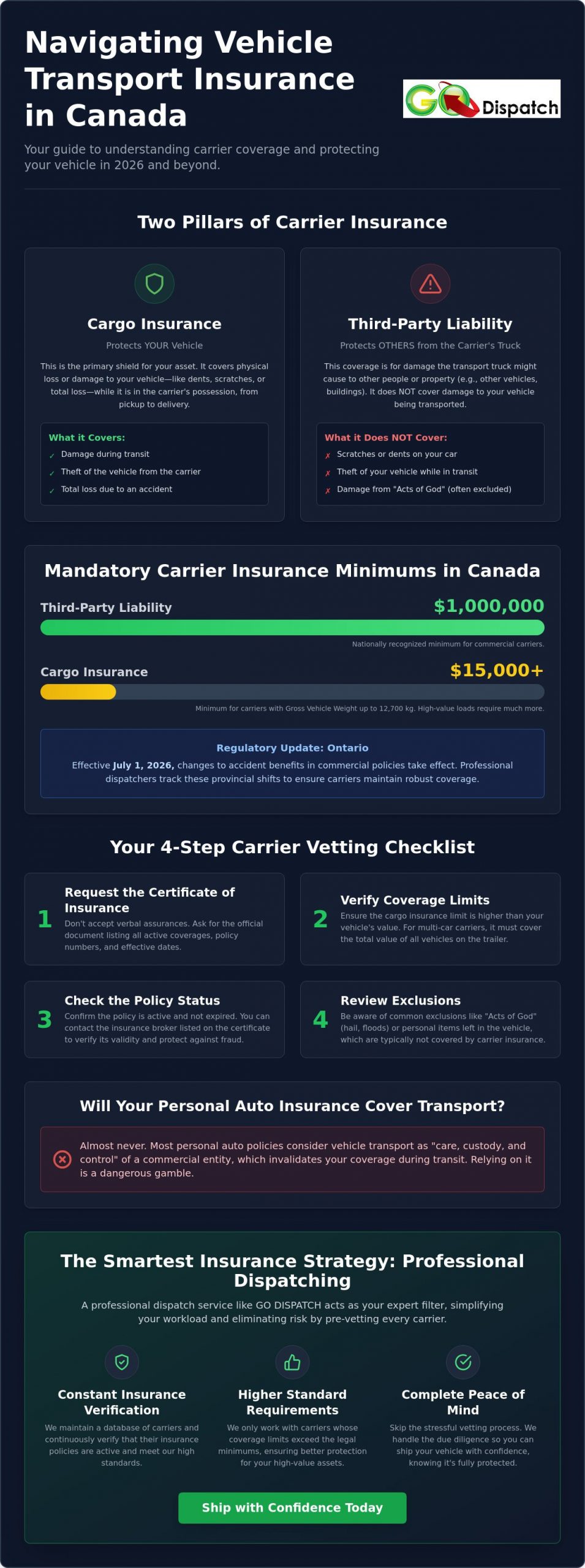
Many shippers hear the phrase “fully insured” and assume every possible risk is covered. This is often a dangerous misconception. In Canada, carriers must hold basic third-party liability insurance. This covers damage the truck might cause to other people or property. However, cargo insurance is what actually protects your car, truck, or van. You need to look past vague marketing terms and confirm the actual policy limits.
A key part of this framework is the Commercial Vehicle Operator’s Registration (CVOR) in Ontario or similar provincial certificates elsewhere. These documents prove the carrier is registered and monitored for safety. If you’re working with an Auto transport broker, they act as an essential filter. They ensure the carriers they dispatch meet specific vehicle transport insurance requirements before your vehicle is ever touched. This professional oversight prevents you from accidentally hiring a “fly-by-night” operator with lapsed coverage.
The Role of Transport Canada and Provincial Regulations
Carrier safety isn’t just a suggestion; it’s monitored by federal and provincial bodies. Transport Canada oversees broad safety standards, while provinces manage specific insurance mandates. As of early 2025, the nationally recognized minimum for third-party liability insurance for commercial carriers is CAD $1,000,000. Cargo insurance minimums are based on the vehicle’s Gross Vehicle Weight (GVW). For example, carriers with a GVW up to 12,700 kg must carry at least CAD $15,000 in cargo insurance.
It’s vital to realize that requirements can shift when crossing provincial borders. Effective July 1, 2026, Ontario implemented changes making several accident benefits optional in commercial policies. This means carriers must actively choose their coverage levels for income replacement and caregiver benefits. A professional dispatch service tracks these regulatory shifts. They maintain a database of carriers who meet the highest safety ratings and insurance limits, providing you with peace of mind across every province.
Decoding Carrier Coverage: Cargo, Liability, and Beyond
Understanding vehicle transport insurance requirements means looking under the hood of a carrier’s policy. Most shippers assume a single policy covers every risk, but professional hauling requires several layers of protection. These layers ensure that every stakeholder is shielded if an incident occurs. High-value inventory, such as luxury SUVs or oversized commercial trucks, demands policy limits that far exceed the bare legal minimums. You need to know exactly what each policy type does before you trust a carrier with your keys.
Cargo Insurance serves as the primary protection for the vehicle itself, covering physical loss or damage from the point of pickup until final delivery.
Cargo Insurance: The Shipper’s Primary Shield
Cargo insurance is the heavy lifter in the logistics world. It specifically covers physical damage like scratches, dents, or a total loss during transit. However, you must be aware of common exclusions. Many standard policies exclude “Acts of God,” such as sudden hail storms or floods. If you’re shipping a high-value collector car, a basic $15,000 limit won’t provide enough security. The Canadian Trucking Alliance emphasizes that credible carriers often carry much higher limits to account for the total value of all vehicles on their trailer. You should always confirm that the policy limit matches or exceeds the combined value of the entire load. This is especially critical in 2026, as rising cargo theft and sophisticated “fictitious pickups” make high-limit, verified coverage more important than ever.
Liability and Pollution Coverage
While cargo insurance protects the vehicle, other policies protect the environment and the public. Commercial General Liability (CGL) is essential for site-specific accidents, such as a mishap at a loading dock or a dealership lot. Another often overlooked policy is Transportation Pollution Liability. This coverage handles the cleanup costs if a vehicle leaks significant fluids during transit or after an accident. This protection is a staple for professional commercial vehicle hauling in Canada, where large fleets of vans and trucks are moved regularly. Without it, you or the carrier could be held responsible for expensive environmental remediation costs.
If you’re feeling overwhelmed by these technical details, our team can help you verify active carrier coverage to ensure your shipment meets all safety standards. We take the guesswork out of the process so you can focus on your business.
Assessing Your Own Policy: Does Your Personal Insurance Step In?
Many shippers assume their personal auto policy provides a safety net during transit. It’s a natural thought. You pay your premiums faithfully, so you expect protection. However, relying on personal coverage while your vehicle is on a trailer is a significant risk. Most standard Canadian policies are designed for vehicles under your direct control. Once a professional hauler takes possession, the legal landscape shifts. You must understand how your own coverage interacts with vehicle transport insurance requirements before you sign a contract.
Handing over your keys shouldn’t mean handing over your peace of mind. While every driver in Canada is legally required to have auto insurance, those policies often contain “Commercial Use” exclusions. These clauses can void your coverage the moment your vehicle enters the care of a professional transport company. If damage occurs during long-distance hauling, your insurer might argue that the vehicle was being used for a commercial purpose, leaving you to foot the bill. You need a solution that protects your asset without risking your personal standing with your insurer.
Personal vs. Commercial Transport Clauses
Personal policies generally cover collision and comprehensive risks while you are behind the wheel. They rarely extend to scenarios where your car is one of nine vehicles on a multi-car carrier. Before booking, call your broker. Ask them directly: “Is my vehicle covered while it is being transported by a third party on a trailer?” Most will say no. If you own a high-value or classic vehicle, ask about “Gap Coverage.” This specialized add-on can provide an extra layer of security that standard vehicle transport insurance requirements might not fully address for rare assets. It’s better to find out now than after an incident.
When Your Personal Policy Acts as Secondary Protection
In very rare cases, your personal insurance might act as secondary protection. It could potentially fill the gap if a carrier’s deductible is unusually high. However, this is a path you should avoid if possible. Filing a claim through your personal insurance for transport damage can cause your future premiums to skyrocket. It is always better to ensure the carrier’s cargo policy is the primary responder. Additionally, personal insurance almost never covers “diminished value.” Even if the car is repaired, its resale value may drop because of the accident history. Professional carrier insurance is your only real protection against these specific financial losses. Relying on the carrier’s coverage keeps your personal record clean and your wallet protected.
The Ultimate Vetting Checklist: How to Verify Carrier Protection
Verifying a carrier’s coverage is the most important step in your shipping journey. You cannot just take a driver’s word for it. In 2026, sophisticated cargo theft and lapsed policies are real threats to your peace of mind. Meeting vehicle transport insurance requirements is the legal baseline, but active verification is your real safety net. Use this framework to ensure your car, truck, or van is truly protected before the trailer ever moves. It’s about moving from anxiety to absolute confidence.
The Insurance Certificate Verification Process
A Certificate of Insurance (COI) is your window into a carrier’s level of protection. Follow these steps to ensure the document is more than just a piece of paper. First, request a copy of the COI directly from the carrier or your dispatch service. A legitimate professional will provide this without hesitation. Second, look at the “Producer” section. This is the insurance broker who issued the policy. Do not just glance at the expiry date. Call the broker to confirm the policy is currently in good standing and covers the specific trailer type hauling your vehicle. Third, ensure the “Insured” name matches the business name on your transport contract exactly. Discrepancies here are a major red flag for “fly-by-night” operations that might be using another company’s credentials.
For an extra layer of security, use the Insurance Bureau of Canada’s free VIN Verify service. This helps you check if a vehicle has been reported as non-repairable or has negative branding. If your shipment is crossing the border, confirm the carrier has a valid CBSA Carrier Code. These small steps separate professional shippers from those who leave their assets to chance. If you want to go beyond insurance verification and master the full coordination process, our complete guide to vehicle hauling services in Canada walks you through every step of managing a national transport from start to finish.
The Bill of Lading: Your Most Important Document
The Bill of Lading (BOL) is more than a receipt; it is the “contract of carriage” and your primary evidence for any claim. Before the vehicle is loaded, perform a meticulous walk-around with the driver. Note every existing scratch, chip, or dent on the BOL. If you do not document it now, you cannot claim it later. This document creates the legal “snapshot” of your vehicle’s condition at the point of pickup.
When the vehicle arrives at the destination centre, repeat the inspection before the driver leaves. If you find new damage, note it clearly on the BOL and have the driver sign it. Digital proof is your best friend here. Take high-resolution photos of all angles at both the origin and the destination. This creates an undeniable timeline that insurance adjusters must respect. If you want to skip the manual vetting process, we can pre-verify every carrier’s insurance and safety rating for you. We handle the paperwork so you can focus on your day.
Why Professional Dispatching is Your Best Insurance Strategy
Vetting every carrier yourself is a monumental task. You have a business to run and a schedule to keep. While you now understand vehicle transport insurance requirements, tracking every expiry date and policy shift is nearly impossible for a single shipper. This is where professional dispatching becomes your most valuable asset. GO DISPATCH acts as your expert filter. We don’t just find a truck. We find a partner who meets the highest standards of safety and coverage. It’s about shifting the burden of proof from your shoulders to ours.
The Vetting Power of a Dispatch Service
We take vehicle transport insurance requirements seriously because we know what is at stake. Our team maintains a rigorous database of carriers across Canada. We verify safety ratings and insurance limits before every single job. Our real-time monitoring systems alert us immediately if a carrier’s policy lapses or if their safety rating drops. This proactive approach prevents risks before they reach your driveway. You also gain a human advocate. If a claim ever needs to be filed, you aren’t fighting a large insurance company alone. We provide the documentation and support to ensure a fair resolution.
Simplifying Logistics for Businesses and Dealerships
For businesses moving multiple units, the administrative work can be overwhelming. Managing individual contracts and insurance certificates for ten different carriers is not an efficient use of your time. Our one-stop approach handles the national delivery logistics for you. We realize that peace of mind is the ultimate goal. Whether you need to transport a truck or a fleet of SUVs, our vetted network is ready to move. Dealership managers looking to streamline their inventory movement can also benefit from our dedicated truck transport for dealerships solutions, which are specifically designed to handle the 2026 regulatory landscape and high-volume hauling needs. By centralizing your transport needs, you ensure consistent protection and professional service every time. This streamlined process allows you to focus on your core operations while we handle the complexities of the road. Streamline your vehicle transport with GO DISPATCH today.
Secure Your Shipment with Confidence
Shipping a vehicle shouldn’t be a source of stress. You now have the tools to verify coverage and understand the legal baseline for hauling in Canada. Remember that a meticulous Bill of Lading and a verified Certificate of Insurance are your best defences against uncertainty. By staying informed about vehicle transport insurance requirements, you protect your high-value investment from pickup to delivery. You don’t have to navigate these technical complexities alone.
GO DISPATCH has provided expert logistics coordination since 2020. We maintain a vetted network of professional Canadian carriers and perform comprehensive carrier insurance verification on every load we dispatch. We realize your workload is heavy. Our team handles the paperwork and the vetting so you can stay focused on your own core business. Let us take the weight off your shoulders with a streamlined, secure transport process that prioritizes your cargo’s safety. It’s time to move your vehicle with absolute peace of mind.
Get a Professional Transport Quote from GO DISPATCH and experience the difference that expert vetting makes for your next shipment. We’re ready to help you get on the road safely.
Frequently Asked Questions
Do I need my own insurance to ship a car across Canada?
You don’t need a specialized transport policy, but your vehicle should remain registered and covered by your standard personal insurance. While the carrier’s cargo policy provides the primary protection during transit, your personal policy acts as a secondary safety net. Keeping your registration active also ensures there are no legal hurdles when the vehicle is unloaded at the destination centre.
What happens if my vehicle is damaged during transport?
You must document any new damage immediately on the Bill of Lading before the driver leaves the delivery site. Take high-resolution photos of the affected areas and compare them to your pickup photos. This clear evidence allows you to file a claim against the carrier’s cargo insurance. A professional dispatch service can act as an advocate during this process to ensure a fair resolution.
Does the carrier’s insurance cover my personal belongings inside the car?
No, a carrier’s cargo insurance policy specifically protects the vehicle and does not extend to personal items left inside. Most transport companies prohibit shipping personal belongings because they can shift and cause interior damage or attract theft. It’s best to remove all valuables and loose items to avoid losses that won’t be reimbursed.
What is the standard cargo insurance limit for a professional car hauler?
Standard cargo limits for reputable professional haulers typically start at $100,000 per vehicle on the trailer. While the legal vehicle transport insurance requirements in Canada set lower minimums based on Gross Vehicle Weight, these are often insufficient for modern SUVs or luxury cars. Always confirm that the carrier’s total policy limit covers the combined value of all vehicles they are hauling.
How do I verify if a carrier’s insurance policy is actually active?
You verify a policy by requesting a Certificate of Insurance and calling the insurance broker listed in the “Producer” section. Don’t just rely on the expiry date printed on the page. A quick phone call confirms that the policy hasn’t been cancelled due to non-payment or safety violations. This simple step protects you from “fly-by-night” operators with lapsed coverage.
Can I ship a vehicle that doesn’t have its own active insurance policy?
Yes, you can ship an uninsured vehicle, but you must realize that you’ll have no secondary coverage if the carrier’s policy fails. The carrier’s cargo insurance covers the physical asset while it’s in their care, regardless of your personal policy status. This is a common practice for project cars or vehicles being moved between dealerships.
Will shipping my car through a dispatch service cost more in insurance fees?
No, using a dispatch service doesn’t add extra insurance fees to your total cost. Insurance is a standard operating expense that carriers already include in their hauling rates. The dispatch service provides value by ensuring the carrier already meets all vehicle transport insurance requirements, saving you the time and effort of manual verification.
What is a Bill of Lading and why is it critical for insurance?
The Bill of Lading is a legal contract and receipt that records the exact condition of your vehicle at pickup and delivery. It is the most critical document for any insurance claim because it establishes a baseline of existing damage. Without a correctly signed and noted Bill of Lading, it’s nearly impossible to prove that damage occurred during transit.