
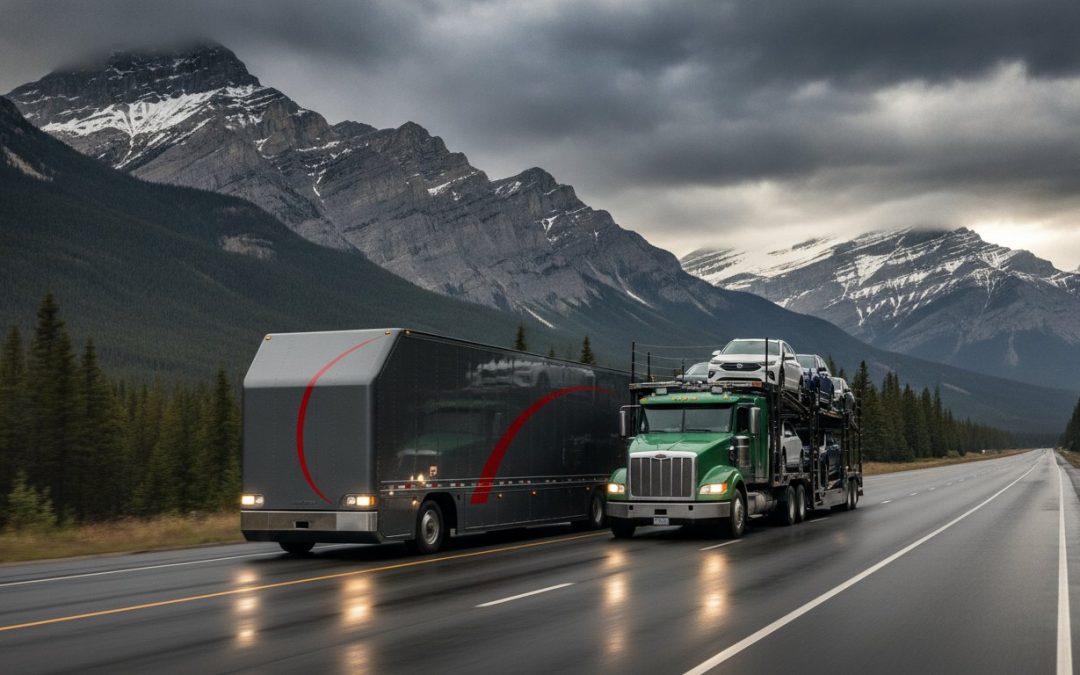
Would you gamble the pristine finish of your vehicle on a 4,000-kilometre journey through winter road salt and flying gravel? While nearly 90 percent of vehicles move on open trailers, the right choice for your specific move depends on more than just the lowest quote. Deciding between open vs enclosed car hauling canada is a strategic balance of protecting your investment and managing your shipping budget. It’s about knowing when the extra cost is a necessity and when it’s an optional luxury.
We understand the stress of watching your car disappear on a trailer. You want to know it’s safe from rock chips on the Coquihalla and that your insurance coverage actually matches the car’s value. This guide simplifies the 2026 transport landscape so you can make an informed decision. We will break down the logistical differences in transit times, compare insurance limits between trailer types, and provide a clear decision framework based on your vehicle’s specific needs. You’ll finish this article with the confidence to choose a vetted carrier that gets the job done right.
Key Takeaways
- Understand the core differences between open and enclosed trailers to select the most efficient transport method for your car, truck, or SUV.
- Evaluate the impact of Canadian winter road salt and gravel to decide if open vs enclosed car hauling canada is right for your specific route.
- Identify the vehicle value thresholds where premium enclosed transport becomes a necessary investment for proper insurance coverage.
- Learn how trailer weight and fuel efficiency dictate your final quote and influence overall transit times across the country.
- See how professional dispatchers vet carrier safety records to remove the stress of coordinating complex national logistics on your own.
Understanding Open and Enclosed Car Hauling Methods
Car hauling is the professional movement of vehicles via specialized road trailers. It’s the engine that keeps the Canadian automotive market moving. When you’re planning a cross-country move, the first technical hurdle is choosing the right equipment. The decision between open vs enclosed car hauling canada sets the tone for your entire shipping experience. It dictates how your vehicle is handled, how it’s loaded, and the level of protection it receives from the elements.
Open car hauling involves multi-vehicle trailers designed for standard transport. These are the workhorses of the industry. Conversely, enclosed car hauling uses fully shielded trailers for maximum protection. The physical loading process also varies. Open trailers rely on adjustable ramps. Drivers manoeuvre vehicles up these inclines to maximize space. Enclosed trailers often utilize hydraulic lift gates. These gates keep the vehicle perfectly level during loading, which is a critical feature for cars with low ground clearance. Choosing open or enclosed car carrier trailers depends largely on your vehicle’s specific physical requirements.
The Mechanics of Open Trailers
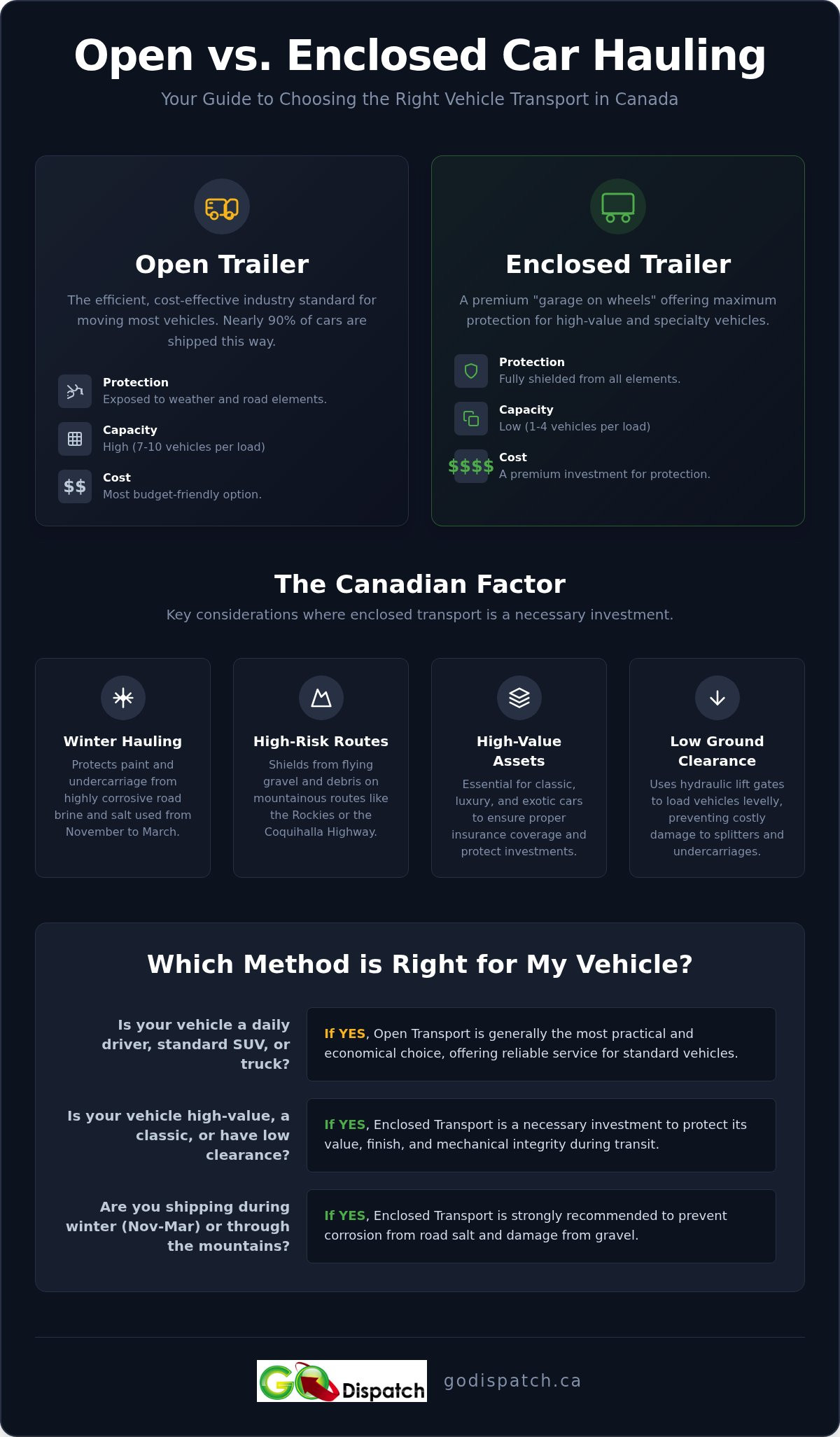
You’ll see these rigs on every major highway from coast to coast. They’re designed for high-capacity efficiency, often carrying seven to ten vehicles at once. This design is the industry standard for manufacturers and dealerships because it optimizes space and fuel. Open trailers are incredibly versatile. Their skeletal frames allow for easy adjustments to accommodate larger SUVs and heavy-duty pickup trucks. If you’re moving a daily driver, this method offers a reliable and straightforward solution that fits most standard vehicle dimensions.
The Anatomy of Enclosed Trailers
Enclosed trailers offer a premium environment. They’re essentially a garage on wheels. You’ll typically choose between soft-sided and hard-sided options. Soft-sided trailers use heavy-duty vinyl curtains to block the majority of road debris. Hard-sided trailers feature solid walls for total isolation from the outside world. These trailers are built to prevent low-clearance damage. Since they use level lift gates, there’s no risk of scraping the front splitter or undercarriage. There’s also an element of exclusivity. These trailers carry fewer vehicles per load. This allows for more personalized attention and rigorous inspections during the journey. Understanding the nuances of open vs enclosed car hauling canada ensures you select the right level of service for your specific vehicle type.
The Canadian Climate Factor: Weather and Road Hazards
The Canadian landscape presents challenges that go far beyond simple mileage. When you move a vehicle across the provinces, you aren’t just fighting the clock. You’re fighting the elements. Choosing open vs enclosed car hauling canada involves a serious look at the calendar. A summer haul across the Prairies is vastly different from a January trek over the Rockies. The environment is often the deciding factor in whether a standard move becomes a restoration nightmare.
Between November and March, road brine is a constant threat. This liquid salt solution is designed to melt ice, but it’s incredibly corrosive to exposed metal. On an open carrier, your vehicle’s undercarriage and side panels are constantly blasted by salt spray for thousands of kilometres. This is why enclosed transport is the definitive “safe vehicle transport service” during the peak winter months. It keeps your investment in a sealed environment away from chemical damage. If you’re moving a high-value asset, the protection from winter corrosion often outweighs the cost savings of an open trailer.
Winter Logistics and Road Brine
Road treatments in Canada have evolved. Modern brine sticks to surfaces longer than traditional rock salt. For an open-air vehicle, this means a week-long journey results in a thick layer of corrosive film that can damage paint and chrome. Enclosed trailers act as a protective shell. They block moisture and prevent salt from reaching sensitive components like brake lines and electrical sensors. Winter also brings operational delays. Heavy snowfall can shut down major arteries like the Trans-Canada Highway. While both methods face these delays, enclosed carriers provide peace of mind that your car isn’t sitting in a snowbank during the wait.
National Geography: From the Prairies to the Coquihalla
Geography plays a massive role in risk assessment. Routes through the Rockies or the Coquihalla Highway are notorious for flying gravel and debris. Even in summer, construction zones and heavy transport traffic kick up stones that can easily chip a windshield or ruin a custom paint job. Open trailers often use “nose-cones” to deflect wind and some debris, but they offer no protection from the sides or rear. Carriers must adhere to the National Safety Code (NSC) to ensure safe operation, but these regulations don’t prevent natural road hazards.
Door-to-door vehicle delivery becomes more complex in remote regions or narrow mountain passes. Large enclosed rigs may require a wider turning radius than open trailers. This is where expert dispatch services become invaluable. They help you navigate these geographical hurdles by matching your vehicle with the right equipment for the specific terrain. Whether it’s UV exposure during a humid Ontario summer or the gravel-heavy roads of the North, the environment should dictate your transport choice.
Analyzing Costs, Insurance, and Logistical Value
Budgeting for a move involves more than just comparing bottom-line numbers. It requires an understanding of how equipment choice drives the final price. Enclosed transport typically commands a 50 percent to 100 percent premium over open hauling. This isn’t just a “luxury tax.” It reflects the higher operating costs of specialized trailers. Enclosed units are heavier and create more wind resistance. This reduces fuel efficiency and limits the number of vehicles per load. Ultimately, your vehicle transport cost in Canada depends heavily on the level of protection selected.
The relationship between vehicle value and hauling method is logical. If you’re moving a standard daily driver, the cost savings of an open trailer make sense. However, for high-value assets, the premium for enclosed transport serves as a form of financial security. This becomes even more critical during cross-border moves. If you’re importing a car, you must coordinate with the Registrar of Imported Vehicles (RIV) to ensure compliance. A professional dispatcher manages these logistical layers, ensuring the cost of transport aligns with the total value of your investment.
Cargo Insurance Tiers for Canadian Hauling
Insurance coverage is the most overlooked factor in the open vs enclosed car hauling canada debate. Standard open carriers often have cargo insurance limits that hover around $65,000 CAD per vehicle. This is usually sufficient for most sedans and SUVs. Enclosed carriers operate on a different scale. They frequently offer expanded coverage reaching $300,000 CAD or more. When you use a dispatch service, we vet these insurance certificates for you. We ensure the carrier’s policy is active and the limits actually cover your vehicle’s current market value.
Availability and Lead Times
Open carriers are the workhorses of the national highway system. Because they represent the majority of the fleet, they’re more readily available on high-volume routes between major cities. You can often secure a spot on short notice. Enclosed equipment is more specialized and harder to find. This scarcity can impact your scheduling, especially during peak seasons. A dispatcher streamlines vehicle delivery scheduling in Canada by accessing a vast network of both trailer types. We find the right equipment that matches your timeline, removing the stress of calling dozens of individual carriers to check their current capacity.
Selection Criteria: Which Method Suits Your Vehicle?
Establishing a clear decision framework for open vs enclosed car hauling canada starts with your vehicle’s market value and physical condition. Most industry experts recommend a value threshold of approximately $80,000 CAD. If your car exceeds this amount, the per-vehicle insurance limits on a standard open trailer may not provide full coverage for a total loss. Beyond value, the “unrestored” factor is a major consideration for collectors. If your vehicle features original, single-stage paint or delicate vintage decals, the shielding provided by an enclosed trailer becomes mandatory to prevent irreversible pitting from road debris. Conversely, transporting cars between dealerships usually favours open hauling because it maximizes volume and keeps logistical costs low for standard inventory.
When Open Hauling is the Right Choice
Standard SUVs, pickup trucks, and daily-use sedans are built to withstand the elements. Their modern clear-coat finishes are resilient and designed for highway exposure. If your primary drivers are budget and the speed of pickup, open transport is the superior choice. It remains the most common method in Canada, accounting for roughly 90 percent of all vehicle moves. This high volume means more trucks are on the road, leading to faster dispatch times. Physical dimensions also play a critical role. Because of their height and width, the decision to transport a truck across the country is almost always an open-carrier operation. Most enclosed trailers simply cannot accommodate the vertical clearance required for lifted or heavy-duty pickups.
When Enclosed Hauling is Essential
Low ground clearance is a technical deal-breaker for standard open ramps. If your vehicle sits less than six inches off the ground, such as a specialized sports car or exotic, you need the hydraulic lift gates found on enclosed trailers. These gates keep the car perfectly level, preventing expensive damage to front splitters or undercarriage components during the loading process. Deciding between open vs enclosed car hauling canada often comes down to this requirement for level loading. High-MSRP luxury vehicles and exotics also require a “zero exposure” environment. This eliminates the risk of environmental debris or unwanted attention at rest stops. Classic cars with older, brittle window seals also benefit from the wind-protection of a hard-sided trailer. If you are unsure which category your vehicle fits into, you can request a custom logistics plan from our team to ensure your car gets the specific equipment it requires.
The Dispatch Advantage: Sourcing the Right Carrier
Choosing between open vs enclosed car hauling canada is only the first step in a complex logistical journey. Once you’ve decided on the level of protection your vehicle needs, the challenge shifts to finding a carrier you can trust. This is where a one-stop dispatch service becomes your most valuable asset. We don’t just find a truck. We find the right truck. By outsourcing the search, you eliminate the stress of vetting individual operators and managing conflicting schedules. Our role is to act as your professional facilitator. We ensure that professional car hauling dispatch matches your car, truck, or SUV to the exact trailer type required for a safe arrival.
A dispatcher’s primary value lies in their national network. We have access to a vast pool of both open and enclosed equipment across every province. This high-capacity reach means we can source specialized trailers that an individual might struggle to find on their own. Whether you need a multi-car open carrier for a dealership move or a hard-sided enclosed trailer for a vintage exotic, we handle the technical matching. You get the benefit of our expertise without the burden of the background work.
Vetting Carriers for Quality and Reliability
We maintain a rigorous vetting process for every carrier in our network. We verify that their cargo insurance is active and that their operating authority is in good standing. This protects your investment before the wheels even turn. One of the hidden benefits of using a dispatcher is our ability to find “backhaul” rates on enclosed lanes. Because we manage a high volume of shipments, we can often identify carriers looking to fill an empty spot on a return trip. This provides you with premium service at a more competitive value. We also manage the communication between you and the carrier during transit. You get regular updates without having to track down a driver on the road. This streamlined process ensures the debate of open vs enclosed car hauling canada ends with a successful delivery.
Simplifying National Logistics
Managing multi-vehicle moves across several provinces is a massive undertaking. Whether you’re moving a single van or a fleet of SUVs, having a single point of contact simplifies the entire process. For modern Canadian dealerships, outsourced auto dispatching is the key to maintaining inventory flow. We handle the paperwork, the routing, and the carrier selection so you can focus on your core business. It’s about efficiency and peace of mind. We take pride in being a proactive problem-solver that handles the complex tasks behind the scenes.
Ready to move? Contact GO Dispatch for a professional hauling quote today.
Secure Your Vehicle’s Journey Across Canada
Deciding on a transport method is a strategic choice between environmental protection and logistical value. You now understand how Canadian winters and gravel-heavy routes dictate the need for a sealed environment for high-value assets. You also recognize that insurance coverage limits vary significantly between trailer types. Navigating open vs enclosed car hauling canada is simple when you have a clear decision framework based on your vehicle’s value and physical needs.
Let a professional manage the complex details of your move. GO Dispatch has provided expert logistics management since 2020. We offer a one-stop dispatching solution for all vehicle types, including cars, trucks, SUVs, and vans. Our team accesses a vetted national carrier network to match your vehicle with the perfect equipment. We remove the burden of carrier selection and provide peace of mind through every province. Get a Quote from GO Dispatch for National Car Hauling today. Move your vehicle with the confidence it deserves.
Frequently Asked Questions
Is enclosed car hauling much more expensive than open hauling in Canada?
Enclosed transport typically costs between 30 and 60 percent more than open hauling. This price difference reflects the higher fuel consumption and the limited number of vehicles these trailers can carry. While it’s a significant investment, it’s the preferred choice for protecting high-value assets from the elements. You’re paying for specialized equipment and the increased insurance limits that come with a fully shielded environment.
Can I ship a large pickup truck in an enclosed trailer?
Most large pickup trucks cannot fit inside standard enclosed trailers due to height and width restrictions. Heavy-duty or lifted trucks usually exceed the vertical clearance of enclosed units. Because of these physical dimensions, open-carrier transport is the standard for trucks and large vans across the country. If you have a specialized or lowered truck, a dispatcher can help you determine if a specific enclosed rig has the necessary clearance.
Does open car hauling cause damage to the vehicle’s paint?
Open hauling exposes your vehicle to road debris, but it doesn’t guarantee damage. Modern automotive paint is resilient and designed for highway speeds. However, the risk of small rock chips or environmental staining is higher than with enclosed methods. While 90 percent of vehicles travel safely this way, owners of cars with custom or delicate finishes often choose enclosed trailers to eliminate the risk of surface pitting from gravel.
What is the maximum insurance coverage for open car transport?
Standard cargo insurance for open carriers often provides around $65,000 CAD of coverage per vehicle. Total cargo limits for the entire trailer typically range from $100,000 to $250,000. If your vehicle’s market value exceeds these amounts, you should consider enclosed transport. Enclosed carriers carry higher-value loads and maintain much larger insurance policies, often exceeding $1,000,000 per shipment to ensure every vehicle on board is fully protected against total loss.
How much lead time is needed to book an enclosed car carrier?
You should ideally book enclosed transport at least one to two weeks in advance. Because enclosed trailers represent a smaller portion of the national fleet, their schedules fill up quickly. Open carriers are more abundant and can often be booked with just a few days’ notice. Planning ahead ensures a dispatcher can source a vetted carrier that matches your specific timeline and route requirements without compromising on safety or equipment quality.
Is door-to-door delivery available for both open and enclosed transport?
Door-to-door delivery is available for both methods, provided the delivery location is accessible to large transport rigs. Many residential streets have low-hanging branches or tight corners that prevent a multi-car carrier from reaching your driveway. In these cases, the driver will coordinate a meeting at a nearby parking lot or terminal. Using a one-stop dispatch service helps you identify these logistical hurdles early so your delivery remains efficient and stress-free.
What happens if my vehicle is damaged during open transport?
If you notice damage upon delivery, you must document it immediately on the Bill of Lading before the driver leaves. Take clear photos of the affected areas and compare them to the pre-shipment inspection report. Once the damage is noted on the document, you can initiate a claim through the carrier’s insurance. A professional dispatcher facilitates this process by ensuring you have all the necessary documentation and carrier information to resolve the issue quickly.
Which method is better for shipping a car during a Canadian winter?
Enclosed transport is the superior choice for winter moves to avoid the corrosive effects of road brine. When comparing open vs enclosed car hauling canada during the snowy months, the zero-exposure environment of an enclosed trailer is a major advantage. It prevents salt spray from reaching your undercarriage and electrical systems. While open hauling is more budget-friendly, the long-term cost of potential rust or chemical damage makes enclosed transport a safer investment.