
Imagine watching your delivery window slip away while your carrier stops answering the phone. It is a frustrating reality for many, but managing vehicle transport timelines canada shouldn’t feel like a gamble. You deserve certainty when moving your assets across the country. We understand that Canada’s vast geography and unpredictable seasons create genuine logistical hurdles. You need a partner who values your time as much as you do.
In this 2026 logistics guide, you’ll learn how to master the complexities of auto hauling schedules. We will show you how professional dispatching ensures your vehicles arrive on time without the usual stress. This article explores current transit averages, the impact of the latest safety regulations, and how a human-centric approach to logistics reduces your administrative burden. By the end, you will have the tools to ensure every car, truck, or SUV arrives safely and exactly when expected. It’s time to replace uncertainty with reliable communication and predictable results.
Key Takeaways
- Distinguish between transit times and total delivery windows to create a predictable schedule for your vehicle arrival.
- Evaluate the speed and flexibility of open carrier trucking versus the cost-savings and longer lead times of rail transport.
- Simplify managing vehicle transport timelines canada by leveraging professional dispatchers who vet carriers and handle the heavy lifting.
- Secure your preferred dates by booking two to three weeks in advance and preparing your vehicle to prevent pickup delays.
- Consolidate your logistics through a one-stop dispatching desk that manages everything from cars and trucks to SUVs and vans.
The Reality of Vehicle Transport Timelines Across Canada
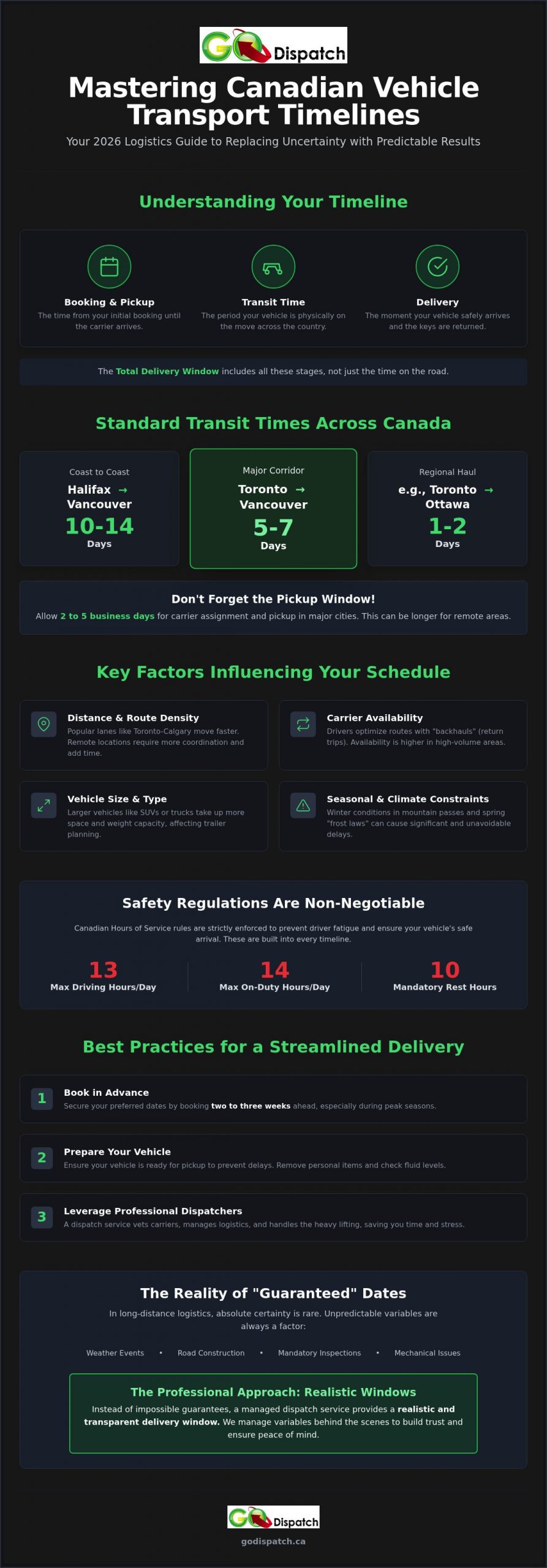
Shipping a vehicle across Canada is a massive undertaking. The sheer distance between major hubs like Toronto and Vancouver requires precision. Success depends on knowing the difference between transit time and the total delivery window. Transit time is the period your vehicle is physically on the move. The total delivery window includes the time from your initial booking to the moment the keys are back in your hand. Managing vehicle transport timelines canada requires looking at both metrics to avoid frustration.
Canada’s infrastructure is unique. The Transportation in Canada network relies heavily on a few primary corridors. Unlike the dense highway grids found in Europe or parts of the United States, Canadian logistics often funnel through specific east-west routes. This makes the industry highly efficient but also sensitive to local disruptions. Door-to-door service is the standard for convenience, but it requires more coordination than terminal-to-terminal shipping. We handle that coordination for you. We focus on creating a seamless experience so you don’t have to worry about the details.
Defining Standard Transit Windows
Standard windows vary based on distance and route density. For 2026, a move from Toronto to Vancouver typically takes 5 to 7 days once the vehicle is loaded. Longer coast-to-coast trips, such as Halifax to Vancouver, usually require 10 to 14 days. Shorter regional hauls might only take 1 to 2 days. These are transit times, but you must also factor in the pickup window.
The pickup window is the time between your booking and the carrier arriving at your curb. In major cities, this is often 2 to 5 business days. In remote areas, it can take longer. Express services prioritize your vehicle for the next available slot. Standard national hauling remains the most common choice for cost-effective moves. It balances speed with value.
Why ‘Guaranteed’ Dates are Rare in Auto Transport
Absolute certainty is rare in long-distance logistics. Carriers face strict safety regulations that prioritize the well-being of the driver and your cargo. In 2026, Canadian drivers are limited to 13 hours of driving time and 14 hours of on-duty time per day. These rules prevent driver fatigue and ensure your vehicle arrives safely. Weather, road construction, and mandatory inspections also play a role in the schedule.
Professional dispatchers manage these variables behind the scenes. We vet carriers to ensure they have the capacity to meet their commitments. By coordinating multiple moves, we reduce the risk of delays caused by empty trucks or inefficient routing. While direct carriers might promise a specific hour, a managed dispatch service provides a realistic window. This approach builds trust through transparency. It ensures you have peace of mind from pickup to delivery.
Key Factors Influencing Your Auto Hauling Schedule
Predicting a delivery date involves more than looking at a map. Several moving parts dictate the speed of your shipment. Route density is a primary driver. Popular lanes like Toronto to Calgary move quickly because carriers frequent these routes daily. Remote locations require more coordination. If a carrier has to travel off the main highway, it adds time. Managing vehicle transport timelines canada means understanding these regional nuances. We prioritize efficiency by matching your vehicle with the most active lanes whenever possible.
Carrier availability also shifts based on backhauling opportunities. Drivers want to keep their trailers full in both directions to remain profitable. If you are shipping from a low-volume area, you might wait longer for a truck to arrive. Vehicle size matters too. An SUV or a large truck takes up more physical space and weight capacity than a compact sedan. This affects trailer planning. Our team handles these variables by connecting you with the right carrier for your specific vehicle type. It is a streamlined process that saves you from endless phone calls.
Regulations keep everyone safe on the road. In 2026, Canadian truck drivers must follow strict hours-of-service rules. They are limited to 13 hours of driving and 14 hours of on-duty time per day. Mandatory 10-hour rest periods are non-negotiable. These safety standards prevent fatigue but require realistic scheduling. We build these requirements into your timeline so there are no surprises. Safety is our priority, and it ensures your vehicle arrives in the same condition it left.
Seasonal and Climate Constraints in Canada
Canadian weather is a constant factor in logistics. Winter conditions in mountain passes can slow highway speeds to a crawl or cause temporary closures. During the spring thaw, provinces often implement weight restrictions on secondary roads. These “frost laws” prevent heavy trucks from damaging the pavement. Peak demand also plays a role. The annual “snowbird” migration sees thousands of vehicles moving, which tightens carrier capacity across the country. Planning around these cycles ensures a smoother experience.
Infrastructure and Remote Area Logistics
Off-corridor deliveries present unique challenges. If your vehicle is headed to a northern community or a coastal town, ferry schedules and road closures become critical. Bottlenecks can occur at major crossings or during construction seasons. For a deeper look at how these factors interact, read our Vehicle Delivery Logistics in Canada: A 2026 Strategic Guide. We specialize in solving these complex puzzles. If you need a hand with your next move, contact our dispatch desk for professional support. We take the weight off your shoulders.
Comparing Transport Methods: Truck vs. Rail Timelines
Choosing the right mode of transport is the biggest decision you will make. It directly dictates your arrival date. Open carrier trucking is the industry standard for speed. It offers door-to-door flexibility that rail simply cannot match. If you are managing vehicle transport timelines canada, you need to know how these methods stack up. A truck can pick up your vehicle at your driveway and deliver it directly to your destination. This eliminates the extra days spent waiting at busy transport hubs.
Rail transport is often seen as a cost-effective alternative for long-distance moves. However, it comes with a significant time penalty. While a truck might complete a cross-country trip in 5 to 7 days, rail can easily take 14 to 21 days. You also have to consider enclosed transport. This method provides maximum protection for luxury or classic vehicles. Because enclosed trailers are specialized equipment, sourcing them can add a few extra days to your pickup window. Hybrid solutions, which combine truck and rail, are sometimes used for remote areas. These often create complex schedules that require expert oversight to stay on track.
The Speed of Professional Car Hauling
Trucks are generally faster because they operate on your schedule, not a train’s departure list. A car hauler can bypass terminal congestion and take the most direct route available. This agility is why most of our clients choose road transport for national moves. You get a tighter delivery window and fewer hand-offs. For more details on how we organize these moves, see our guide to Professional Car Transport: Your Guide to National Hauling. We focus on getting your vehicle moved without the wait.
Rail Logistics and Terminal Delays
Rail transport relies on a process called batching. Trains don’t leave the station until every car rack is full. This can add several days to your timeline before the journey even begins. Once the train arrives, your vehicle must be unloaded at a terminal. It then waits for a local truck to complete the final delivery. These terminal drop-offs and pickups are common bottlenecks in the 2026 market. Rail is a strategic choice when budget is your only priority and time is not a factor. If you need your vehicle for work or daily life, the direct nature of trucking is almost always the better path. We help you weigh these options to find the perfect fit for your specific needs.
Best Practices for Streamlining Your Vehicle Delivery Schedule
Success in managing vehicle transport timelines canada isn’t just about the carrier. It’s about your own preparation. Booking in advance is the single most effective way to hit your target dates. Aim for a two-to-three-week lead time whenever possible. This “sweet spot” allows our dispatchers to secure the best carrier for your specific route. Most professional carriers plan their schedules weeks in advance. Last-minute bookings often lead to higher costs or longer waits. Be flexible with your dates. A wider window attracts more reliable carriers who can easily fit your move into their existing schedules. It creates a win-win for everyone involved.
Preparation also reduces the risk of administrative delays. When you are organized, the carrier can focus on the road. We see it every day: a little bit of foresight prevents a lot of stress later. If you need a reliable partner to handle these details, partner with GO DISPATCH for your next move. We take the complexity out of the process so you can focus on your business or your move.
Documentation and Vehicle Preparation
A smooth hand-off starts at the curb. You must have your registration and insurance papers ready for the driver. These documents are essential for inspections and provincial crossings. A clean vehicle is not just about aesthetics. It allows for a fast and accurate initial inspection. Dirt and mud can hide existing scratches or dents. This slows down the loading process as the driver must be thorough to protect both parties. Perform a final mechanical check. Ensure your fluids are topped up and the battery is fully charged. If a vehicle won’t start, it becomes a “non-runner.” This requires specialized winching equipment. It can cause significant delays and added costs. We want to avoid these hurdles before the truck even arrives.
Proactive Communication Strategies
Information silos are the enemy of logistical efficiency. We recommend using a single point of contact for your entire move. This ensures that updates from the dispatch desk reach the right person immediately. Consistent tracking is essential for high-priority moves. You should expect updates at key milestones: pickup, major provincial crossings, and the final approach. Clear communication prevents the “where is my car?” anxiety. For those moving larger commercial assets, preparation requirements are even more specific. Read our guide on how to transport a truck across Canada for truck-specific preparation tips. We keep the lines of communication open from start to finish to ensure your peace of mind.
How Professional Dispatching Eliminates Timeline Uncertainty
Predictability in logistics comes from oversight, not just luck. When you are managing vehicle transport timelines canada, the “One-Stop” advantage of professional dispatching becomes your greatest asset. Instead of juggling multiple carriers and tracking numbers, you work through a single, dedicated desk. We manage the entire network for you. This centralized approach eliminates the communication gaps that lead to missed deadlines. You get a clear, bird’s-eye view of your assets without the administrative headache of calling different drivers across multiple time zones.
Our vetting process is the first line of defence against delays. We don’t just find a truck; we find the right truck. We source carriers based on their proven history of reliability and safety. By choosing partners with a track record of hitting their windows, we prevent mid-route delays before they happen. If a situation does arise, such as a mechanical issue or a road closure, we intervene immediately. Troubleshooting is where a professional dispatcher earns their keep. We reroute, reschedule, or find alternative capacity to keep your delivery on track. You stay informed, but we handle the heavy lifting. GO DISPATCH acts as the proactive partner that realizes your delivery goals through logistical expertise.
The GO DISPATCH Approach to National Logistics
We focus on what we do best: cars, trucks, SUVs, and vans. Whether you are a business owner moving a single service vehicle or a corporation relocating a fleet, our approach remains human-centric. We realize that behind every shipment is a person who needs results. Our dispatchers source carriers based on real-world performance data, not just the lowest bid. This focus on quality ensures that your vehicles are handled by professionals who respect your schedule. We coordinate complex national moves with a level of precision that automated systems simply cannot match. It is about personal accountability and professional results.
Moving Inventory and Dealership Trades
Dealerships and fleet managers face unique pressures when moving inventory. A delayed trade can cost a sale. Coordinated multi-vehicle moves require a specific type of expertise to stay efficient. We synchronize pickups and deliveries to ensure that your lot stays full and your customers stay happy. Our team understands the urgency of inventory relocation and dealership trades. For a deeper look at how we support the automotive industry, explore our guide on Dealership Auto Transport Logistics. We provide the B2B solutions you need to keep your business moving forward. Let us manage the clock so you can focus on the sale.
Take Control of Your Delivery Schedule
You now have the tools to navigate the 2026 transport market with confidence. Successful managing vehicle transport timelines canada depends on proactive planning and choosing direct trucking over slower rail options. By booking your move two to three weeks in advance and preparing your vehicle properly, you eliminate the most common causes of delay. You deserve a logistics process that is predictable and stress-free.
You don’t have to handle these complexities alone. We provide professional auto carrier dispatching and one-stop logistics management across every province. Our national coverage for cars, trucks, SUVs, and vans ensures your assets arrive safely and on time. We take the administrative burden off your desk so you can focus on your core business. We realize that your time is valuable, and we are here to protect it. Streamline your vehicle logistics with GO DISPATCH today. Your next successful delivery is just one click away.
Frequently Asked Questions
How long does it take to ship a vehicle across Canada in 2026?
Shipping a vehicle across the country usually takes between 5 and 14 days depending on the specific route. For example, moving a car from Toronto to Vancouver generally takes 5 to 7 days once it is loaded. Coast-to-coast shipments, such as Halifax to Vancouver, typically require 10 to 14 days. These timelines reflect actual transit time and do not include the initial pickup window.
Can I track my vehicle’s progress during transport?
You can track your vehicle by staying in direct contact with your dedicated dispatch team. We provide updates at key milestones, including pickup, major provincial crossings, and the final approach to the delivery destination. This human-centric approach ensures you receive accurate information without the frustration of automated systems. We prioritize clear communication to give you peace of mind throughout the entire journey.
What is the fastest way to transport a car between provinces?
Open carrier trucking is the fastest method for moving vehicles between provinces. Trucks offer door-to-door flexibility and bypass the terminal “batching” delays that are common with rail transport. This direct service is the most efficient way of managing vehicle transport timelines canada for urgent moves. It allows for a tighter schedule and fewer hand-offs between carriers during the trip.
Do weather conditions often cause significant delivery delays?
Canadian weather can impact schedules, particularly during winter storms or the spring thaw. Heavy snow in mountain passes may cause temporary highway closures, while “frost laws” can restrict heavy truck weights on secondary roads in the spring. We monitor these conditions closely and adjust routing to ensure safety. We always prioritize the safe arrival of your vehicle even when the elements create challenges.
How much notice do I need to give for a vehicle pickup?
We recommend providing two to three weeks of notice for a vehicle pickup. This lead time is the “sweet spot” that allows our dispatchers to secure the most reliable carrier for your route. Booking in advance ensures you get a spot on a high-density lane and helps maintain a predictable delivery window. Last-minute bookings can sometimes be accommodated but often result in less flexibility.
What happens if my vehicle delivery is delayed?
Our dispatch team intervenes immediately if a delay occurs due to mechanical issues or road closures. We troubleshoot the situation by rerouting the carrier or finding alternative capacity to keep your delivery moving forward. You will receive direct updates so you aren’t left wondering about the status of your asset. We take the lead on problem-solving so you can focus on your own daily priorities.
Is there a difference in timeline between open and enclosed hauling?
Enclosed hauling often requires a longer pickup window than open transport. Because enclosed trailers are specialized equipment, it can take a few extra days to source an available unit for your specific route. Once the vehicle is loaded, the transit speed is generally the same as an open carrier. If your timeline is strict, open transport usually offers the most immediate availability.
Does the type of vehicle (SUV vs. Truck) affect the transport schedule?
The size and weight of your vehicle influence how we plan the trailer space. Larger assets like trucks and SUVs take up more room and weight capacity than compact cars. This requires more precise coordination to ensure the carrier remains within legal weight limits and safety standards. While it may occasionally add a day to the pickup window, it ensures your vehicle is transported safely.