

Relocating key talent shouldn’t force your HR team to act like a full-time freight brokerage. If you’re wondering how to choose the right employee vehicle shipping program for corporate relocations, you already know the operational stakes. Juggling fragmented carrier contacts, verifying fluctuating cargo insurance policies, and fielding frantic calls about missed delivery windows drains valuable administrative hours. Unreliable transit windows create immediate friction for newly relocated staff, while varying carrier coverage levels introduce unnecessary financial liability to your organization.
Centralized dispatch management transforms corporate auto relocation from administrative chaos into a distinct operational advantage. You don’t need more logistics headaches; you need dependable, door-to-door execution and verified carriers. In this guide, you’ll discover how to evaluate, structure, and implement an efficient national employee vehicle shipping program. We’ll explore rigorous carrier vetting standards, liability safeguards, and the exact framework to maintain complete schedule visibility across nationwide freight corridors without burdening your internal team.
Key Takeaways
- Establish a formal employee vehicle shipping program to replace unpredictable employee expense claims with centralized corporate oversight and reliable timelines.
- Protect your organization against financial liability by verifying active commercial cargo insurance and provincial regulatory compliance across every transport corridor.
- Leverage one-stop transport dispatching rather than direct carrier booking to secure verified equipment capacity for cars, pickup trucks, SUVs, and passenger vans.
- Streamline internal operations by building clear policy parameters around relocation eligibility, vehicle preparation, and inspection protocols.
- Eliminate administrative friction by delegating operational logistics and schedule tracking to specialized national dispatch coordinators.
What Is an Employee Vehicle Shipping Program and Why It Matters
Corporate mobility is more than shifting furniture; it is about getting your people settled and operational quickly. Modern relocation services treat vehicle transport as a specialized pillar of employee care rather than an afterthought. An employee vehicle shipping program is a structured corporate benefit that coordinates the movement of personal vehicles during staff transfers. This differs fundamentally from casual consumer towing. A corporate program utilizes professional auto transport dispatching to ensure verified insurance, pre-screened equipment, and dependable scheduling, replacing chaotic expense reports with direct corporate control.
A structured transport policy signals genuine investment in transferring personnel. When organizations eliminate personal driving logistics, onboarding accelerates. New hires arrive focused on their roles instead of recovering from days spent behind the wheel, driving retention and protecting initial productivity.
Defining Corporate Auto Transport Programs
Turnkey corporate programs manage the entire vehicle journey through dedicated door-to-door coordination. A comprehensive program accommodates a wide range of personal transportation profiles:
- Standard sedans and hatchbacks requiring secure multi-car carrier slots.
- Pickup trucks and commercial work vehicles requiring specialized deck space.
- SUVs and family passenger vans needing balanced axle distribution.
Centralized dispatch creates single-point accountability. Instead of HR coordinators chasing fragmented drivers, a dedicated dispatch team handles every milestone, updates schedules, and relieves your internal staff of operational stress.
The True Cost of Employee Road Trips
Asking employees to drive their personal vehicles across long distances creates hidden operational drains. Long-haul road trips pull talent away from productive work for days at a time. The direct loss of employee hours quickly outstrips any perceived savings from mileage reimbursements.
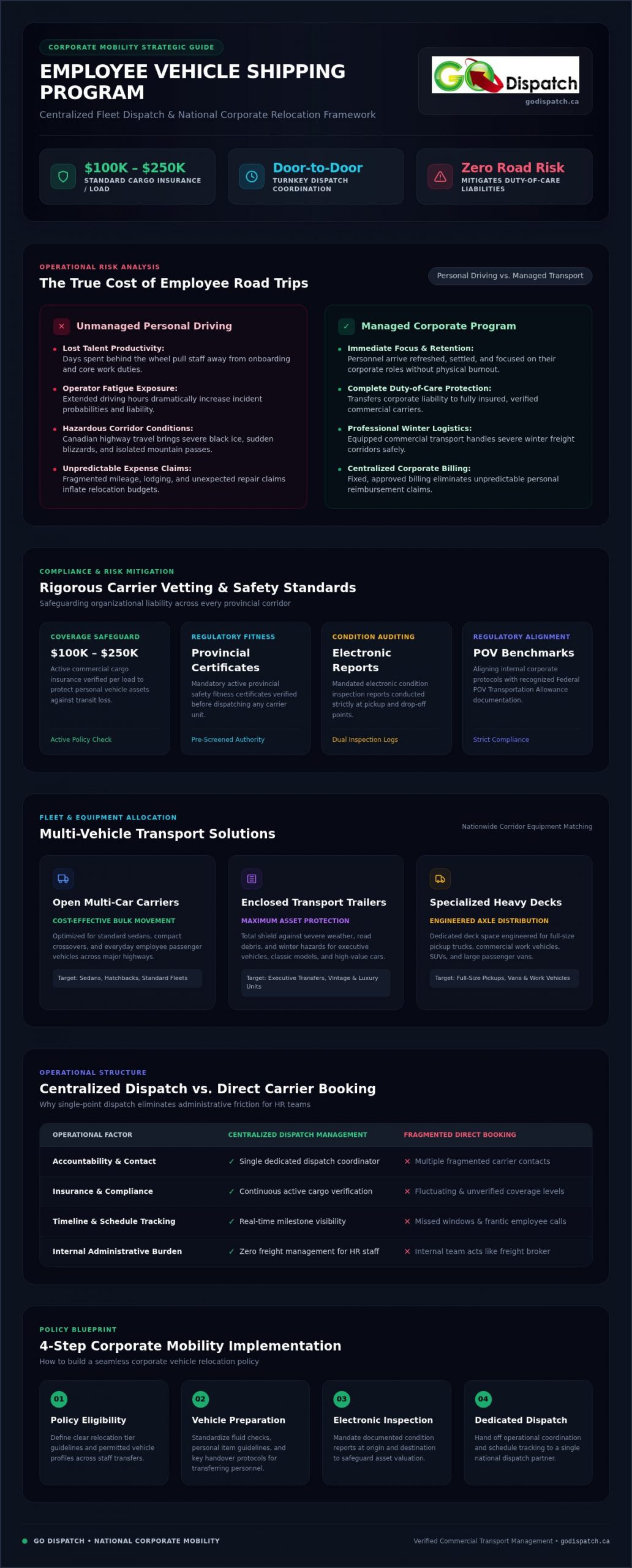
Beyond lost time, personal cross-province road trips introduce severe duty-of-care liabilities. Extended driving hours cause severe operator fatigue. Compounding this challenge, Canadian highway corridors present demanding winter conditions, including black ice, sudden blizzards, and isolated mountain passes. Pushing relocating staff into hazardous winter routes creates unnecessary legal and physical exposure. A managed employee vehicle shipping program completely eliminates road risks by putting personal vehicles onto verified professional carriers.
Key Criteria for Selecting an Employee Vehicle Shipping Partner
Selecting the right dispatch partner determines whether your corporate transfers run smoothly or stall out. A dependable employee vehicle shipping program requires rigorous carrier vetting, diverse equipment access, and clear accountability. Leaving employees to coordinate their own transport or booking unverified direct haulers creates serious exposure. You need a partner that treats corporate vehicle relocation with systematic precision.
Safety Standards and Insurance Verification
Never rely on standard commercial auto liability alone. A qualified transport partner must verify active commercial cargo insurance for every assigned hauler. Standard carrier cargo coverage typically ranges from $100,000 to $250,000 per load, protecting valuable personal assets against transit damage. Benchmarks like Federal POV Transportation Allowances emphasize strict transit documentation, and your corporate policy should mirror this rigour. Mandate electronic vehicle condition inspection reports at pickup and drop-off, and verify active provincial safety fitness certificates before dispatching any vehicle.
Capacity, Fleet Diversity, and Route Coverage
Relocating personnel drive varied vehicles with distinct transport requirements. Your shipping partner must supply flexible equipment types across nationwide corridors:
- Open multi-car carriers: Cost-effective transit for standard passenger sedans and compact crossovers.
- Enclosed transport trailers: Maximum weather and road-debris protection for executive, vintage, or high-value vehicles.
- Specialized heavy decks: Dedicated configurations engineered to safely transport a truck, full-sized SUV, or passenger van across long-haul freight lanes.
Your dispatch partner should maintain carrier networks capable of handling both primary trans-provincial highways and remote operational hubs without service gaps.
Communication, Tracking, and Dispute Resolution
Logistical transparency eliminates anxiety for transferring personnel. Top-tier providers deliver proactive milestone alerts directly to the employee while maintaining consolidated reporting for HR. When severe winter storms or highway closures force schedule adjustments, a dedicated dispatch contact resolves bottlenecks immediately. Rather than managing fragmented driver conversations, partnering with a dedicated coordination service like GO Dispatch provides centralized dispatch oversight, unified corporate billing, and straightforward resolution protocols from pickup through final delivery.
Centralized Dispatch vs. Direct Carrier Booking
Managing an internal employee vehicle shipping program often forces HR leaders into a critical operational fork: coordinate directly with independent truck operators, or centralize transport through a specialized auto dispatch partner. While dealing directly with a single carrier might seem straightforward on paper, it introduces severe operational bottlenecks in practice. Independent truckers typically operate along rigid, fixed routes. When your corporate moves span varying provincial origins and destinations, relying on individual carriers quickly fractures into administrative chaos.
The Pitfalls of Managing Individual Carriers
Direct carrier booking shifts heavy freight coordination straight back onto your corporate staff. Sourcing individual owner-operators means your administrative team must manage several recurring risks:
- Unforgiving route limitations: Single-truck operators lack expansive national reach, leaving remote locations or complex lanes uncovered.
- Spot-market instability: Direct bookings leave you vulnerable to sudden equipment shortages, sudden rate spikes, or last-minute load cancellations.
- Continuous credential verification: Your staff must manually inspect provincial safety fitness certificates, operating authorities, and active cargo policies for every separate shipment.
When an independent carrier suffers a mechanical breakdown or encounters severe winter highway closures, they rarely possess backup equipment. Your relocating employee sits stranded, and your corporate onboarding schedule unravels.
The Advantage of One-Stop Dispatching
Centralized dispatching removes individual carrier dependencies entirely. Instead of tying your transfers to single trucks, you gain instant access to an expansive, nationwide network of pre-vetted carriers. Professional dispatch managers analyze each transport request, matching specific vehicle profiles (from sedans and pickup trucks to SUVs and family vans) with the exact trailer equipment required.
This operational model adapts proven dealership auto transport logistics strategies to meet private corporate relocations. Large vehicle networks operate with structured precision, moving assets continuously across high-density corridors. One-stop dispatching applies these exact enterprise efficiencies to corporate talent mobility. If a mechanical delay or adverse weather event impacts an assigned hauler, dedicated dispatchers immediately reroute the vehicle to alternative verified capacity. Your internal team maintains a single dispatch point of contact, consolidated billing, and seamless visibility, securing a predictable employee vehicle shipping program across every province.
How to Build a Seamless Corporate Vehicle Relocation Policy
A well-crafted internal policy eliminates guesswork and prevents administrative friction. When mobility teams establish clear operational guidelines up front, both the business and the relocating staff benefit from predictable timelines and defined expectations. Standardizing your employee vehicle shipping program ensures equitable support across departments while safeguarding corporate budgets against unplanned expenses.
Establishing Eligibility and Relocation Tiers
Start by outlining objective qualification benchmarks. Establish a minimum distance threshold, such as transfers exceeding 500 kilometres, to determine when professional auto transport activates versus personal driving. Tiered support structures keep policies fair and scalable:
- Standard Corporate Moves: Open multi-vehicle transport for primary passenger sedans, pickup trucks, SUVs, and passenger vans.
- Executive Allocations: Enclosed carrier options for high-value or specialty vehicles requiring extra protection from transit elements.
To accurately project operational budgets across varying transit lanes, consult a comprehensive vehicle transport cost guide to benchmark distance and seasonal variables effectively.
Preparing the Employee and the Vehicle
Give transferring staff a structured preparation checklist well before carrier dispatch. Standard vehicle preparation requires three essential actions:
- Mechanical inspection: Confirm adequate fluid levels, healthy battery charge, and approximately one-quarter tank of fuel to minimize transport weight.
- Personal property removal: Commercial cargo policies strictly prohibit packing personal goods, luggage, or tools inside vehicles during transit.
- Detailed condition documentation: Wash the exterior and take clear, date-stamped photographs of all body panels before carrier handoff.
These preparation protocols streamline carrier collection and protect both the employee and company during the mandatory initial inspection report.
Coordinating Timelines and Expectations
Successful relocations align freight scheduling with the employee’s onboarding calendar. Schedule vehicle pickup several days before the employee’s scheduled flight or departure. Always factor seasonal transit buffers into delivery projections, particularly when navigating challenging winter weather corridors across the country.
Provide employees with clear milestone tracking protocols so they know when to expect dispatch updates and driver handoffs. Ready to modernize your corporate relocation policy? Coordinate your corporate transport program with GO Dispatch to access vetted national carrier networks and end-to-end dispatch management.
Partnering with GO Dispatch for National Corporate Mobility
Establishing an effective corporate relocation strategy requires more than standard vendor contracts; it requires an experienced, dedicated dispatch partner. GO Dispatch operates as a specialized one-stop transport dispatching service across Canada, coordinating dependable carriers for corporate clients nationwide. Whether your organization is relocating individual executives or coordinating seasonal staff rotations, our dispatching model takes operational logistics off your desk. We bridge the gap between corporate HR demands and professional highway transport, giving your mobility managers total operational confidence.
National Reach with Rigorous Carrier Vetting
Our dispatch coordination spans nationwide freight corridors across all Canadian provinces. Every carrier in our network undergoes comprehensive pre-screening before receiving a dispatch assignment. We verify active provincial operating authorities, inspect safety fitness certificates, and confirm active commercial cargo insurance policies. By applying proven vehicle delivery logistics strategies, our dispatchers match the right equipment to your specific vehicle profile, securing reliable transit for passenger cars, pickup trucks, SUVs, and commercial fleet vans alike.
Dedicated Account Support for Corporate Mobility
Corporate mobility leads shouldn’t have to navigate automated phone trees or chase individual truckers across time zones. GO Dispatch pairs your company with a dedicated logistics specialist who serves as your single point of human contact. Whether you are dispatching a single family vehicle or organizing multi-vehicle transfers for full team realignments, your coordinator manages the schedule from start to finish. We deliver proactive milestone tracking, keeping both your HR coordinators and relocating staff informed at every stage without adding administrative overhead.
Streamlined Booking and Onboarding
Administrative simplicity sits at the core of effective corporate dispatching. Responsive lane coordination and centralized dispatch oversight replace unpredictable spot-market rates and carrier cancellations with structured reliability. We handle carrier vetting, route planning, and transit communication, allowing your internal teams to focus on talent integration rather than freight tracking. Connect with our logistics team today to launch a dependable national employee vehicle shipping program that protects your personnel and your bottom line.
Transform Your Relocation Logistics into a Corporate Advantage
Managing corporate transfers doesn’t need to drain internal resources or leave your employees guessing. Moving away from manual mileage claims and fragmented trucking operators protects your operational budget while prioritizing staff safety. Implementing a structured employee vehicle shipping program ensures your transferring personnel receive dependable door-to-door transit, backed by rigorous carrier vetting protocols and verified commercial cargo insurance.
With specialized national auto transport dispatch across Canada, GO Dispatch manages complex highway logistics from origin to delivery. Whether coordinating transit for individual cars, pickup trucks, SUVs, or corporate vans, our team aligns every move with pre-screened equipment across nationwide freight corridors. Free your HR department from transit tracking and provide your people with the support they deserve. Streamline your corporate mobility with GO Dispatch and set your relocated talent up for immediate success.
Frequently Asked Questions
What is an employee vehicle shipping program?
An employee vehicle shipping program is a structured corporate mobility policy that coordinates the transport of transferring staff members’ personal automobiles. Instead of leaving workers to arrange casual towing or drive thousands of kilometres themselves, the business partners with a professional dispatch service. This setup ensures verified carrier insurance, standardized invoicing, and dependable door-to-door vehicle delivery while keeping internal human resources teams completely free from daily logistics coordination.
How much notice is required to arrange vehicle transport for a relocating employee?
Providing two to three weeks of advance notice delivers the best results for scheduling and equipment matching across nationwide freight corridors. This window allows dispatchers to select vetted carriers, coordinate exact pickup dates, and accommodate your employee’s travel schedule. While expedited dispatch can often accommodate shorter timelines during unexpected corporate transfers, giving reasonable lead time guarantees smoother coordination and greater carrier availability.
Can employees leave personal belongings inside the vehicle during transport?
Relocating employees shouldn’t pack personal items, household goods, or luggage inside their vehicles. Commercial auto transport carriers operate under strict weight regulations and provincial transport authorities that forbid household goods transit on open car haulers. Additionally, commercial auto cargo insurance policies only cover the vehicle itself, meaning any personal belongings left in the trunk or cabin remain entirely uninsured against theft, loss, or transit shifting damage.
What is the difference between open and enclosed auto transport for corporate moves?
Open auto transport places vehicles on standard multi-car haulers, offering a dependable, cost-effective solution for everyday sedans, crossovers, and fleet vehicles. Enclosed transport houses the automobile within fully walled trailers, protecting high-value luxury, antique, or executive vehicles from highway gravel, salt, and inclement weather. Corporate mobility policies often assign open transport for standard employee moves while reserving enclosed trailer dispatch for senior executive transfers.
How do professional dispatchers verify auto carrier safety and insurance?
Dedicated dispatchers independently audit every carrier before issuing load confirmation. This screening process includes checking active provincial operating authority, reviewing regional safety fitness certificates, and verifying valid commercial cargo insurance certificates directly with insurance providers. Dispatchers continuously monitor these compliance metrics, preventing carriers with revoked credentials, lapsed policies, or poor safety ratings from ever handling vehicles enrolled in your employee vehicle shipping program.
Can corporate programs transport larger personal pickup trucks, SUVs, and vans?
Yes, a comprehensive dispatch program accommodates a broad range of vehicle types beyond standard passenger sedans. Experienced dispatch managers coordinate specialized multi-car and flatdeck equipment specifically engineered for pickup trucks, full-size SUVs, and passenger or cargo vans. Because larger vehicles take up different deck space and carry higher gross weights, dispatch specialists calculate axle weights and trailer dimensions carefully to secure safe, damage-free transit across Canada.
What happens if an employee vehicle is delayed due to severe winter weather?
Highway closures, severe snowstorms, and mountain pass delays occasionally impact winter transit across Canadian highway corridors. When adverse weather causes transit delays, a dedicated dispatch team proactively communicates schedule revisions to both your HR team and the relocated employee. Dispatchers monitor regional road advisories continuously, coordinating alternative routes or safe terminal staging points to protect cargo without leaving your relocating staff wondering about their delivery status.