
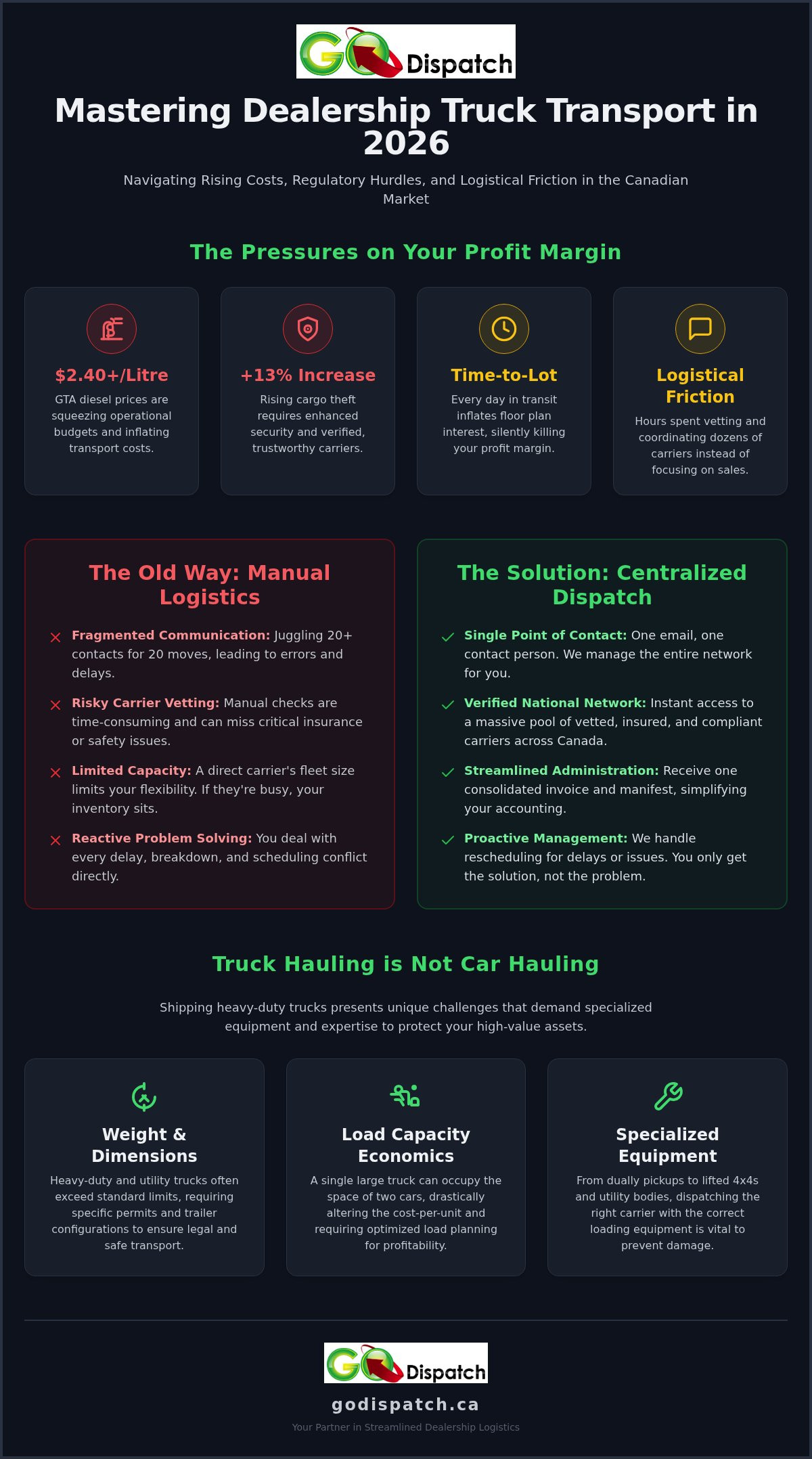
With diesel prices in the Greater Toronto Area climbing past $2.40 per litre and cargo theft rising by 13 percent, your profit margins are under constant pressure in 2026. You likely feel the daily strain of managing dozens of carriers while floor plan interest eats away at your bottom line. It’s exhausting to track down late arrivals or decipher shifting interprovincial regulations when you should be focused on selling units. Managing dealership truck transport logistics shouldn’t feel like a second full-time job that leaves you burnt out and behind schedule.
We understand that reliability is everything when moving high-value inventory across Canada. This guide will show you how to master these complexities by using a centralized dispatch network to eliminate administrative friction and secure predictable delivery timelines. We’ll look at the current regulatory environment, ways to mitigate rising operational costs, and how a one-stop dispatching model ensures your trucks arrive safely.
In this guide, you will learn:
• How to optimize the time-to-lot metric to ensure your dealership truck transport logistics stay profitable in the 2026 market.
• Why replacing multiple carrier contacts with a single dispatching partner reclaims hours of your work week.
• Ways to navigate the June 12th MOU and new driver standards to move inventory across provincial lines without friction.
• How to protect your margins by coordinating rapid auction pickups and seamless dealer trades that prevent inventory from sitting.
• Strategies to scale your operations with a national network that provides verified insurance and predictable delivery timelines.
Understanding Dealership Truck Transport Logistics in Canada
Effective inventory management starts long before a vehicle reaches your lot. In the competitive Canadian market, Understanding Dealership Truck Transport Logistics is about more than just moving metal from point A to point B. It’s the strategic coordination of high-value assets across vast distances. When you realize that every day a truck spends in transit is a day it isn’t generating profit, the importance of a streamlined system becomes clear. You aren’t just shipping a product; you’re managing cash flow.
The most critical metric for your success in 2026 is “time-to-lot.” This KPI measures the speed at which a vehicle moves from an auction or trade partner to being front-line ready. Slow logistics directly inflate your floor plan interest costs. Every hour of delay adds to your overhead and reduces your eventual margin. In a country as large as Canada, moving inventory across provincial borders requires precision to avoid bottlenecks at scales and inspection stations. You need a process that works as hard as your sales team does.
The High Cost of Logistical Friction
Administrative friction is a silent profit killer. When your staff spends hours calling multiple carriers to find a single trailer spot, they aren’t selling trucks. These delays create a ripple effect that stalls your entire operation. A late arrival doesn’t just hurt your bottom line; it dampens sales team morale and frustrates customers who are waiting for their new rigs. Relying on manual carrier vetting is an outdated practice that introduces unnecessary risk. Modern dealership truck transport logistics requires a more proactive, automated approach to ensure every move is handled by a verified professional.
Key Differences Between Car and Truck Hauling
Shipping a heavy-duty pickup is not the same as moving a compact sedan. Trucks bring unique challenges that require specialized knowledge and equipment. You must consider several factors to ensure a safe move:
- Weight and Dimensions: Heavy-duty trucks and utility vehicles often exceed standard weight limits, requiring specific trailer configurations.
- Load Capacity: A single large truck can take up the space of two smaller cars, which drastically changes the economics of a multi-car carrier load.
- Specialized Equipment: From dually pickups to lifted 4x4s, ensuring the right equipment is dispatched is vital to prevent damage during loading and unloading.
Navigating these variables is where expert dealership truck transport logistics proves its value. By matching the right carrier to the specific requirements of your inventory, you protect your investment and ensure a predictable delivery timeline.
The Dispatch Model: Why Dealerships Are Outsourcing Logistics
Choosing between a direct carrier and a dispatch service is a choice between limitation and flexibility. A direct carrier is bound by the size of their specific fleet. If their trucks are full or sidelined for repairs, your inventory stops moving. A professional dispatch service removes these barriers. It provides a massive, national network of vetted professionals. You no longer need to manage 20 different relationships to move 20 different trucks. One email starts the process. One contact manages the journey. This model turns a chaotic administrative burden into a streamlined, predictable system.
Safety isn’t just a buzzword; it’s a legal requirement. Professional dispatchers handle the heavy lifting of carrier verification so you don’t have to. They verify that every partner adheres to the 2026 Regulations and Equipment Standards. This includes checking for valid insurance, up-to-date safety ratings, and proper securement protocols. When you outsource your dealership truck transport logistics, you gain an expert advocate who prioritizes your cargo’s safety as much as you do. It’s about protecting your high-value assets through professional accountability.
Streamlining the Administrative Burden
The logistics trail is often where profit disappears. Managing multiple invoices, tracking numbers, and delivery confirmations takes time your staff doesn’t have. Dispatchers consolidate this data. You get one invoice and one clear manifest for all your moves. This centralized approach reduces errors and simplifies your accounting. More importantly, dispatchers act as a proactive buffer. If a driver faces a weather delay or a mechanical issue, your dispatcher handles the rescheduling. You only get the solution, not the problem.
Accessing a National Network of Carriers
Canada’s geography is a logistical challenge. Finding a reliable carrier for a specific route from Quebec to Alberta can take days. A dispatch model provides instant access to specialists who know those routes intimately. This ensures your inventory keeps moving during peak seasons or the inevitable driver shortages. By leveraging professional dealership auto transport logistics, you maintain the lot consistency needed to hit your sales targets. It allows you to scale your inventory without scaling your workload. If you want to see how this efficiency works in practice, a one-stop dispatching partner is the logical next step.
Navigating 2026 Regulations and Equipment Standards
The regulatory landscape for moving heavy inventory has shifted dramatically this year. In 2026, the full implementation of Mandatory Entry Level Training (MELT) standards has reshaped driver availability across the country. While these rules ensure higher safety levels, they’ve initially tightened the labour pool. You might notice longer lead times if you’re still vetting individual carriers manually. Simultaneously, the June 12th Memorandum of Understanding (MOU) has begun standardizing interprovincial trucking requirements. This is a significant win for your dealership. It reduces the regional red tape that previously slowed down moves between provinces like Ontario and Manitoba.
Insurance expectations have also climbed in response to rising asset values. For high-value truck inventory, $2 million in liability coverage is now the industry minimum. Anything less leaves your dealership’s bottom line exposed to unnecessary risk. When you manage dealership truck transport logistics, you have to decide between open-air and enclosed hauling. Open-air remains the standard for most pickups, but enclosed transport is the right call for custom builds or luxury units that need protection from road debris and harsh Canadian weather. It’s about matching the level of protection to the value of the unit.
Compliance as a Competitive Advantage
Verifying carrier insurance is the single most important step in your logistics chain. You can’t afford to take a carrier’s word for it in a high-stakes market. The new 2026 safety regulations are effectively pushing “cowboy” operators out of the industry. This is good news for your peace of mind. A professional dispatcher ensures every carrier complies with federal motor carrier safety regulations before a single vehicle is loaded. This layer of protection turns compliance into a business advantage. It keeps your inventory moving while others are stuck in inspections.
Equipment Selection for Heavy Inventory
Moving a heavy-duty dually or a service body truck requires different gear than a standard sedan. You can’t always rely on traditional multi-car racks for these units. Sometimes, a flatbed is the only safe way to transport oversized units without risking structural damage. If you’re dealing with custom finishes or high-end models, enclosed transport provides the premium protection those assets deserve. Navigating vehicle delivery logistics in Canada for oversized units requires a partner who understands these equipment nuances. It’s about matching the right trailer to the specific weight and dimensions of your inventory. This specialized focus is a core part of modern dealership truck transport logistics.
Strategic Inventory Movement: Auctions and Dealer Trades
Speed is the lifeblood of inventory turnover. When a customer walks onto your lot asking for a specific heavy-duty rig that’s currently sitting at a sister location 500 kilometres away, the clock starts ticking. You can’t afford to let that sale slip away because of a transport delay. Strategic dealership truck transport logistics ensures that these units move as fast as your sales team talks. Whether it’s a single dealer trade or a massive fleet acquisition, your dispatching strategy should be invisible and infallible.
Managing the Dealer Trade Process
A successful dealer trade requires a disciplined approach to avoid bottlenecks. You turn a complex move into a routine task by following a clear structure. This allows your sales team to focus on the customer while the logistics happen behind the scenes. You can book your next dealer trade today to see how a professional dispatch service simplifies this cycle. Follow these steps to keep your inventory flowing:
- Step 1: Finalize the trade agreement and vehicle manifest immediately to lock in the unit.
- Step 2: Submit the transport request to your dispatch partner to secure a spot on the next available trailer.
- Step 3: Coordinate gate releases and keys at both the origin and destination centres to prevent the driver from waiting.
- Step 4: Track the unit in real-time so your staff can provide accurate updates to the waiting customer.
Optimizing Auction Pickups
Auctions are high-pressure environments where every hour counts. Most major Canadian sites enforce a strict “48-hour rule” for vehicle removal. If your unit isn’t off the lot within that window, you start paying storage fees that eat directly into your margins. Coordinating rapid pickup requires having your paperwork ready. You need gate passes, VIN verification, and condition reports at your fingertips. Learning how to transport a truck efficiently after a successful bid is the difference between a profitable acquisition and a logistical headache.
Fleet acquisitions require even more coordination. Moving ten units at once is a different beast than moving one. You need to ensure your service and detail teams are ready for the influx. If ten trucks arrive on a Tuesday and your prep team is booked until Friday, those units sit idle while floor plan interest accrues. A professional dispatcher coordinates these arrivals to match your shop’s capacity. This level of precision is what defines modern dealership truck transport logistics. It’s about synchronizing every move to protect your bottom line.
Optimizing Your Dealership Bottom Line with GO DISPATCH
Imagine your dealership running without the constant headache of tracking late trailers or vetting new drivers. GO DISPATCH acts as the logistics department you don’t have to manage yourself. We take the weight of dealership truck transport logistics off your shoulders. This allows your team to focus on closing deals while we handle the movement of your assets. It doesn’t matter if you’re a small independent lot or a large franchise group. We provide the national reach and professional carrier sourcing you need to stay competitive in 2026. You get the benefits of a full-scale logistics team without the overhead of hiring one.
Our approach combines human expertise with a high-capacity network. We don’t just rely on automated boards. We use real human dispatchers who understand the nuances of the Canadian trucking industry. This ensures that your high-value trucks are matched with carriers who have the right equipment and a proven safety record. We manage the behind-the-scenes complexity so you only see the final result: a truck ready for your front line. By outsourcing your dealership truck transport logistics, you eliminate the administrative burnout that often leads to errors and delays. We provide a buffer between you and the road, ensuring every move is handled with professional confidence.
A Partnership for National Growth
Regional limitations shouldn’t dictate your inventory strategy. With our network, you can source trucks from any corner of Canada and know they’ll arrive as promised. This flexibility is essential for dealerships looking to scale their operations without increasing their administrative staff. You can buy with confidence at distant auctions or trade with partners three provinces away. You gain the peace of mind that comes from professional, verified, and insured hauling on every move. This reliability is why we’re recognized as a leading choice for car hauling services in Alberta and across the country. We realize that your reputation depends on our performance, so we never compromise on carrier quality.
Getting Started: Your Logistics Consultation
Integrating our services into your daily sales workflow is simple and direct. When you submit your first transport enquiry, include the VIN, the specific pickup and delivery locations, and your required timeframe. This data allows us to provide an accurate quote and find the best carrier for the job. We manage the entire lifecycle of the move. From the initial booking to the final signature at delivery, we’re your single point of contact. You don’t need to chase drivers or decode manifests. We handle the paperwork, the scheduling, and the follow-up. Ready to streamline? Book your truck transport today and reclaim your workday.
Take Command of Your Inventory Movement
Success in 2026 requires a proactive approach to dealership truck transport logistics. You don’t have to navigate the complexities of national coverage or insurance verification alone. By choosing a one-stop dispatching service, you eliminate the administrative friction that slows down your sales cycle. Our professional carrier vetting ensures every move is safe, compliant, and fully insured. This allows you to source inventory from any province across Canada with complete confidence. Managing time-to-lot metrics and interprovincial standards doesn’t have to be your burden when you have a reliable partner in your corner.
It’s time to stop chasing drivers and start focusing on your customers. Streamline your dealership logistics with GO DISPATCH today. We handle the behind-the-scenes coordination so your team can focus on what they do best: selling trucks. Your inventory is your greatest asset. Let’s keep it moving forward together.
Frequently Asked Questions
What is the difference between a direct carrier and a dispatch service for dealerships?
A direct carrier owns a specific fleet of trucks while a dispatch service manages a massive network of vetted carriers. This model gives you more flexibility because you aren’t limited by one company’s schedule or fleet size. It’s a one-stop solution that simplifies your workflow by giving you access to the entire Canadian market through a single contact.
How long does it typically take to transport a truck between provinces in Canada?
Delivery timelines depend on the distance and specific route. Short moves between neighbouring provinces often take 2 to 4 days. Cross-country hauls, such as moving a unit from British Columbia to Ontario, usually require 7 to 10 days. Your dispatcher provides a specific timeline for every move to help you manage your lot inventory.
Do dealership truck transport logistics include insurance coverage for high-value inventory?
Yes, verified insurance is a core part of professional dealership truck transport logistics. Every carrier in our network must carry a minimum of $2 million in liability coverage to protect your high-value assets. We handle the verification process and maintain up-to-date records so you don’t have to worry about the details.
Can GO DISPATCH handle multi-vehicle moves from auctions?
Absolutely, we specialize in coordinating multi-vehicle pickups from major auction sites across Canada. We understand the urgency of the 48-hour removal rule and work quickly to avoid storage fees. Our team organizes the right equipment to move all your units in a single, coordinated effort to protect your margins.
What are the 2026 regulations for interprovincial truck hauling?
The 2026 landscape is defined by Mandatory Entry Level Training (MELT) and the June 12th MOU. These rules standardize safety and licensing across provincial borders. Modern dealership truck transport logistics rely on these standards to ensure faster, safer moves between provinces like Alberta and Ontario while maintaining high safety ratings.
How do I track my truck inventory while it is in transit?
You can track your inventory by contacting your dedicated dispatcher for real-time updates. We maintain constant communication with our drivers throughout the journey. This allows us to provide accurate arrival times so your prep and detail teams are ready to receive the unit as soon as it hits the lot.
What paperwork is required for a dealer trade transport move?
You’ll need a finalized vehicle manifest, gate releases, and the keys ready for the driver. Our team handles the carrier-specific documents and transport manifests behind the scenes. This reduces the administrative burden on your sales staff and ensures the trade happens without unnecessary delays or confusion.
Is enclosed transport necessary for standard inventory trucks?
Enclosed transport is usually not necessary for standard pickup trucks or utility vehicles. Open-air carriers are the industry standard and provide a cost-effective solution for most inventory. We only recommend enclosed hauling for custom builds, luxury models, or units with sensitive finishes that require extra protection from the elements.