
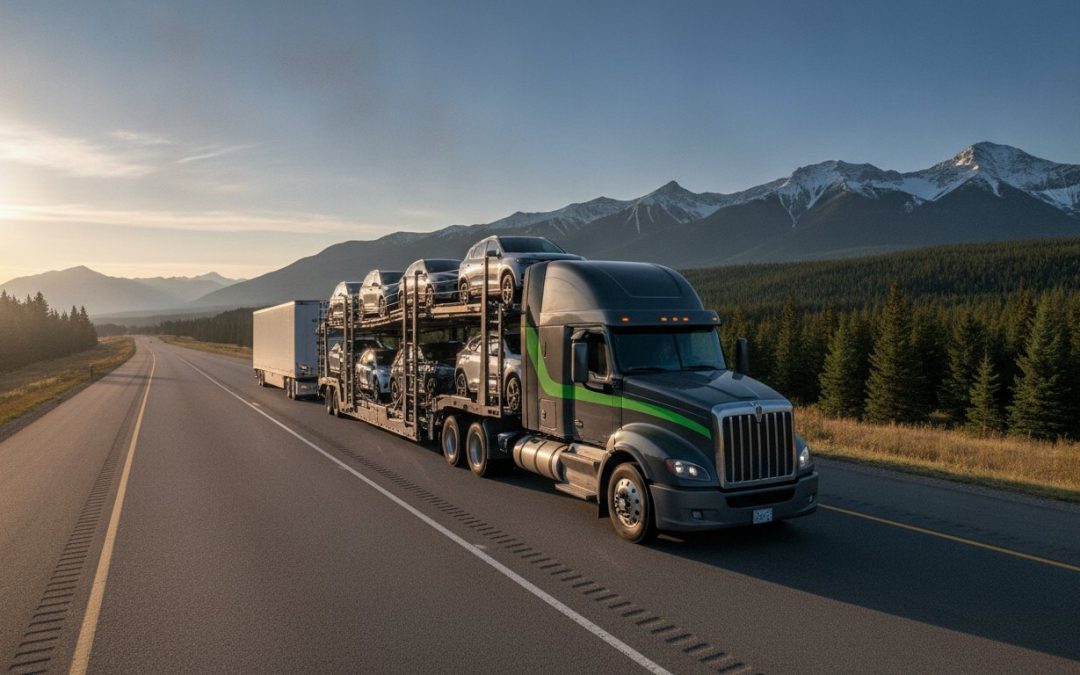
Is your vehicle’s safety worth the gamble of a budget carrier? Moving a vehicle across the country often feels like a high-stakes game of chance, especially when you consider the logistical complexity of professional car hauling. You worry about potential damage during transit. You dread the discovery of hidden brokerage fees at the last minute. With over 11,000 vacant truck driver positions across Canada as of late 2025, you likely feel the weight of coordinating schedules in a tight market. It’s a heavy administrative workload that takes you away from your core business.
We understand that your vehicle is a significant investment, not just a piece of cargo. You deserve a logistics process that offers peace of mind and predictable results. In this article, you’ll discover the most efficient ways to organize transport while protecting your asset and streamlining your logistics. We provide a clear comparison of transport methods and explain how the June 2026 regulatory updates impact your delivery timelines. You’ll realize how simple a professional dispatching strategy can be for achieving a damage-free delivery on a predictable schedule. Let us simplify your transport needs so you can focus on your own core business.
Key Takeaways
- Identify the most cost-effective transport methods by comparing open-deck trailers with enclosed transport for high-value vehicles.
- Streamline your logistics by using a professional dispatch service to manage the entire transport lifecycle instead of juggling individual carriers.
- Protect your investment during car hauling with a comprehensive pre-transport inspection and a step-by-step preparation checklist.
- Eliminate the risk of hidden fees and administrative burdens by centralizing your national vehicle transport through a one-stop dispatching solution.
What is Car Hauling? Understanding National Vehicle Logistics
Professional car hauling is much more than just moving a vehicle from point A to point B. It is a highly specialized sector of the Canadian freight industry that manages the movement of passenger cars, trucks, and SUVs across vast distances. Unlike a local towing service that handles short-distance recovery or emergency roadside assistance, car hauling involves sophisticated logistics, multi-car trailers, and interprovincial coordination. It’s a structured system designed to move high-value assets with precision.
The equipment used in this industry is built for safety and volume. Most professional transporters utilize a Car carrier trailer equipped with hydraulic ramps and specialized tie-down systems. These trailers can carry up to ten vehicles at once, which maximizes efficiency and reduces the cost per unit for the customer. Businesses and individuals choose professional hauling because it protects the vehicle’s resale value. Driving a car across Canada adds thousands of kilometres of wear and tear, not to mention the high cost of fuel, hotels, and meals along the way. Professional transport eliminates these burdens and provides a safer, more predictable result.
The Core Components of Vehicle Transport
Effective vehicle transport relies on a robust network of professional carriers. These networks form the backbone of national supply chains, ensuring that vehicles reach dealerships or private residences on schedule. A critical part of this process is the Bill of Lading (BOL). The BOL serves as your official contract and a detailed condition report. It records every existing scratch or dent before the journey begins, providing you with essential legal protection and peace of mind. National logistics providers use this documentation to organize complex routes. They analyze traffic patterns and weather conditions to ensure your vehicle moves through the most efficient corridors possible, regardless of the season.
Key Terminology Every Shipper Should Realize
Understanding the industry language helps you make better decisions for your logistics needs. You’ll often choose between two primary delivery models:
- Door-to-Door: The carrier picks up and drops off the vehicle as close to your specific addresses as possible. It’s the most convenient option for busy professionals who value their time.
- Terminal-to-Terminal: You drop off and pick up your vehicle at a central storage hub. This can be more cost-effective but requires more effort on your part to coordinate the drop-off.
It’s also vital to distinguish between “Transit Time” and the “Delivery Window.” Transit time is the actual duration the vehicle is on the road. The delivery window is the range of dates when the carrier expects to arrive. Finally, realize the difference between a direct carrier and a professional dispatch service. A direct carrier owns a single truck, while a dispatch service like GO DISPATCH provides access to an entire fleet. This ensures you aren’t left waiting if one truck breaks down or a driver changes their route. You get a single point of contact and a much more reliable service experience.
Open vs. Enclosed Car Hauling: Comparing Your Options
Choosing the right method for car hauling depends on your vehicle’s value, your budget, and the current Canadian season. While most people opt for the standard open-air method, others require the vault-like security of an enclosed trailer. Understanding car shipping industry statistics shows that the majority of vehicles move via open carriers because of their high capacity and cost-efficiency. It’s the engine that keeps the national automotive market moving. Before committing to any service, it pays to review the most common car shipping questions and dangerous myths that could lead you to make a costly mistake.
In Canada, environmental factors play a massive role in this decision. Our roads face extreme conditions, from winter salt and slush to spring gravel and summer hailstorms. If you’re moving a vehicle through the Rockies or across the Prairies in the middle of January, you must weigh the risk of road salt corrosion against the cost of a premium service. For a standard daily driver, a thorough wash after an open-air trip usually suffices. However, for a classic or luxury investment, the extra protection is often a necessity.
Open Transport: The Industry Standard
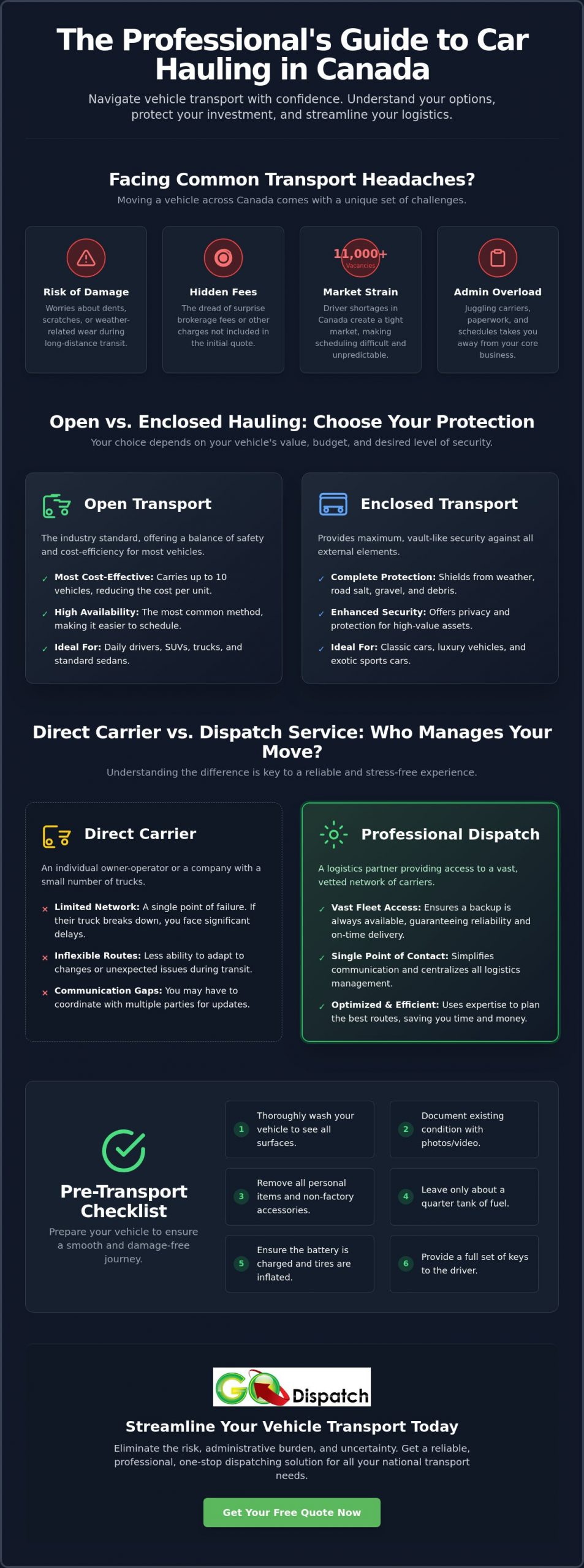
Open-deck trailers are the workhorses of the logistics world. They are the most cost-effective solution for SUVs, vans, and trucks because they allow for maximum visibility and easier loading. A common myth is that vehicles on open carriers are constantly pelted by debris. In reality, professional carriers organize their loads strategically. They often place vehicles on the upper deck to minimize exposure to road gravel. It’s a reliable, transparent process that delivers results without the premium price tag of a specialized container.
Enclosed Hauling: Maximum Protection
For high-value assets, enclosed transport offers total peace of mind. This method utilizes hard-sided or soft-sided trailers to create a physical barrier against the elements. Hard-sided trailers are the gold standard, providing a rigid shell that protects against theft, weather, and prying eyes. Dealerships often choose this for showroom inventory to ensure the paint remains in factory condition. While you’ll realize a higher cost for this service, the investment is justified when moving a vehicle that can’t be easily replaced. If you aren’t sure which level of protection your vehicle requires, you can speak with a logistics expert to find the best fit for your specific route and vehicle type.
Ultimately, the choice comes down to your personal risk tolerance and the vehicle’s purpose. Open transport is fast, available, and affordable. Enclosed transport is private, secure, and pristine. Both methods provide a professional solution to a complex logistical challenge, allowing you to move your property across the country without the stress of a long-distance drive.
Direct Carriers vs. Dispatch Services: Finding the Best Value
Many people believe that calling a truck owner directly is the fastest way to save money on car hauling. This is a common misunderstanding known as the “Carrier Myth.” While it seems simpler, it often limits your options to a single route and a single schedule. If that driver’s truck breaks down or they face a delay at a provincial weigh station, your vehicle stays stationary. You’re left managing the fallout yourself. A professional dispatch service eliminates this risk by acting as your single point of contact, managing the entire logistics lifecycle behind the scenes.
Working with a dispatcher shifts the administrative burden away from your desk. You don’t have to spend hours vetting carrier insurance or checking safety ratings. We do that work for you. We ensure every carrier in our network meets strict Canadian standards, protecting your investment from the moment of pickup. This proactive approach saves you time and reduces the stress of coordinating with individual drivers who may not be reachable during transit. You get the benefit of a professional safety net without the heavy lifting.
Why Managed Dispatching Wins on Reliability
A managed dispatch service provides access to a national network rather than a single fleet. With over 11,000 vacant transport truck driver positions in Canada as of Q3 2025, capacity is often tight. If a carrier experiences a mechanical failure, a dispatcher can quickly “recover” the load by finding an alternative driver in the area. You gain the peace of mind that comes from professional coordination, ensuring your vehicle keeps moving even when obstacles arise. It’s about maintaining momentum in a challenging market.
Understanding Professional Brokerage and Dispatch Fees
Some shippers worry about the cost of a third-party service. However, dispatchers use their high volume to secure better rates than an individual could get on their own. These fees cover the cost of logistics expertise, insurance verification, and active problem-solving. Specifically, car transport brokerage fees protect the shipper from hidden costs and administrative errors that often occur in DIY transport. It’s a small investment that guarantees a more predictable and professional outcome for your vehicle.
Preparing for National Transport: A Safety and Logistics Checklist
Handing over your keys shouldn’t feel like a leap of faith. Proper preparation for car hauling ensures your vehicle arrives in the same condition it left. Start with a thorough wash. In Canada, road salt and mud can easily hide small dents or paint chips. A clean exterior allows you to identify every existing mark before the driver arrives. Remove all personal belongings from the cabin and trunk. Carriers are not licensed to transport household goods. These items add unnecessary weight and are never covered by the carrier’s insurance policy. Secure or remove loose parts like aftermarket spoilers or bike racks to prevent wind damage during the cross-country trek.
The Pre-Shipment Inspection Protocol
Your most powerful tool is the Bill of Lading (BOL). This document is your legal contract and a detailed condition report. When the carrier arrives, perform a walk-around together. Take high-resolution photos of all four sides, the roof, and the interior. If your vehicle has low ground clearance or custom modifications, inform your dispatcher early. Special ramps or specific trailer positions may be required to avoid scraping the undercarriage. Documenting these details ensures there’s no ambiguity if a claim needs to be filed later. It’s a simple step that provides massive legal protection.
Mechanical and Fuel Guidelines
Safety and weight management are critical for national transport. Keep your fuel level at approximately one-quarter of a tank. This provides enough fuel for the driver to load and unload while minimizing the total weight of the trailer. Ensure the vehicle is in “run and roll” condition. This means the battery is charged, tyres are properly inflated, and the brakes are fully functional. If your vehicle is non-operational, inform your dispatcher immediately. Transporting a non-running vehicle typically requires a winch and adds a fee of $150 to $250 CAD as of 2026.
If you need to transport a truck or an oversized van, realize that height and width clearances are much tighter. Professional drivers need to know these dimensions in advance to plan the route safely under low bridges or through narrow provincial corridors. Verify the carrier’s insurance before the trailer pulls away. A professional dispatch service handles this vetting for you, ensuring every driver carries the necessary cargo insurance for your vehicle’s value. Don’t leave your logistics to chance. For a streamlined, worry-free experience, start your transport plan with GO DISPATCH today.
Professional Car Hauling Dispatch: Streamlining Your Logistics with GO DISPATCH
GO DISPATCH serves as your primary partner in the complex world of national vehicle logistics. We are a one-stop dispatching solution designed to remove the friction from your daily operations. Our professional team manages the entire logistics lifecycle for you, from the moment you request a quote to the final delivery signature. We go beyond basic car hauling by providing a structured, reliable system that protects your assets. We take pride in sourcing only high-capacity carriers. Every driver in our network is fully insured and vetted for reliability. This ensures your vehicles are always in safe hands.
Our strategic location in Leduc and Edmonton, Alberta, provides a significant advantage for national coordination. As a central hub, we are perfectly positioned to manage the flow of traffic between Western Canada and the Eastern provinces. This geographic edge allows us to monitor route efficiency and respond quickly to changing road conditions across the country. We act as your proactive problem-solver, handling the complex tasks behind the scenes so you don’t have to. You get the benefit of a national reach with the personal touch of a dedicated logistics partner.
Solutions for Dealerships and Commercial Fleets
Commercial clients require speed and precision to keep their business moving. We specialize in transporting cars between dealerships to ensure your showroom inventory is always where it needs to be. High-frequency shippers realize immediate value through our dedicated dispatch support. We handle the heavy lifting of managing multi-vehicle moves across provincial lines, ensuring all documentation is accurate and complete. Our team understands the urgency of fleet management. We offer the volume-based coordination necessary to secure trailer space even when the market is tight. Businesses managing multiple units across provinces can benefit from a dedicated fleet vehicle transport Canada strategy to streamline carrier vetting, provincial compliance, and multi-vehicle scheduling under one roof. We keep your inventory moving so you can focus on your customers.
Why Canadian Businesses Trust Our Expert Dispatch
Our focus is simple: we aim to reduce your administrative workload. We know that managing individual carriers is a full-time job that takes you away from your core business. Our “human-centric” approach means you get actual support from a real person when you need it. We don’t hide behind automated emails or confusing portals. We provide direct, authoritative communication that builds trust and provides peace of mind. Experience the reliability of a dispatch partner that values your investment as much as you do. Simplify your vehicle moves with GO DISPATCH today.
Take Control of Your National Logistics
Professional car hauling shouldn’t be a source of stress. You now realize the importance of choosing the right equipment for the Canadian climate and the value of a single point of contact for your logistics. By prioritizing thorough preparation and vetting your carriers, you protect your investment and ensure a predictable delivery schedule. You don’t have to manage the administrative burden of cross-country transport alone.
Our team provides a one-stop transport dispatching solution that connects you with a national network of insured carriers. We offer specialized SUV and truck transport expertise to handle your most valuable assets with care. Let us handle the coordination while you focus on your core business goals. We take pride in being the proactive problem-solvers who keep your inventory moving safely across provincial lines.
Get a Professional Car Hauling Quote from GO DISPATCH and experience a more efficient way to move vehicles across Canada. We are ready to streamline your logistics and provide the peace of mind you deserve. Your next successful delivery starts with a single, reliable partner.
Frequently Asked Questions
How much does car hauling cost in Canada?
The total cost depends on the distance, the size of your vehicle, and the current season. You’ll realize the best value by choosing open transport for standard vehicles, while enclosed methods carry a premium. Prices fluctuate based on fuel costs and carrier availability, so requesting a custom quote is the only way to get an accurate figure for your specific route.
Is my vehicle insured while it is on the trailer?
Yes, your vehicle is covered by the carrier’s cargo insurance from the moment it is loaded until it reaches its destination. We vet every driver in our network to ensure they maintain the high coverage limits required for professional transport. Always review the Bill of Lading during pickup to ensure the pre-transport condition is documented accurately for your protection.
How long does it take to transport a car across Canada?
Transporting a vehicle across the country typically takes between seven and fourteen days. This timeline depends on the specific route, traffic patterns, and seasonal weather conditions across the provinces. A professional dispatcher provides a delivery window rather than a single fixed time to account for potential road delays and ensure a safe arrival.
Can I put personal items inside my car during transport?
No, you must remove all personal belongings before the carrier arrives for pickup. Professional car hauling insurance only covers the vehicle itself, not any items left inside the cabin or trunk. Additionally, extra weight from personal goods can cause the trailer to exceed provincial weight limits, leading to delays at weigh stations.
What is the difference between a car hauler and a tow truck?
A car hauler is a specialized multi-car trailer designed for long-distance national logistics. A tow truck is typically used for short-distance recovery, emergency roadside assistance, or moving non-running vehicles to a local repair shop. Haulers provide a more efficient and cost-effective solution for moving vehicles across provincial lines without adding unnecessary wear and tear.
Do I need to be present for the pickup and delivery of my vehicle?
Yes, you or an authorized representative must be present to sign the inspection reports at both ends of the journey. This person needs to verify the vehicle’s condition and sign the Bill of Lading to finalize the process. If you cannot be there personally, you must designate someone you trust to act on your behalf and handle the paperwork.
Can you transport non-running vehicles or project cars?
We can transport non-running vehicles as long as they are still able to roll, steer, and brake. Moving a project car requires a trailer equipped with a winch to safely pull the vehicle onto the deck. You must inform your dispatcher about the vehicle’s condition early so we can source a carrier with the specific equipment needed for a successful load. If you have additional car shipping questions or concerns about common transport myths, our team is ready to provide clear, straightforward answers before you book.