
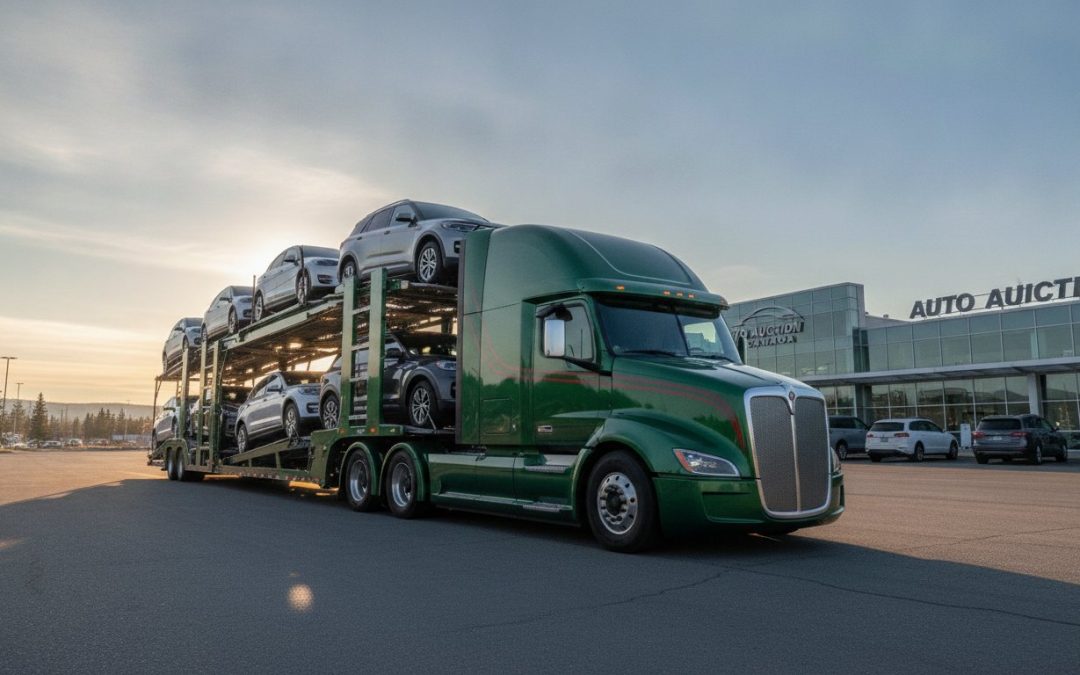
Winning the bid at a high-stakes auction is only half the battle. Real profit is made in the minutes after the hammer falls, yet many dealers find their margins eaten away by rising storage fees and unreliable carriers. If you’re tired of chasing gate passes or wondering when your inventory will actually arrive, you aren’t alone. Coordinating auto auction transport for dealers across Canada has become increasingly complex in 2026, especially with diesel costs pushing transport rates over $0.90 per mile this past May.
We realize that your focus should be on moving units, not managing logistics. This guide explores how professional dispatching eliminates the administrative labour and stress of national inventory movement. You’ll discover how to clear auction lots faster, secure predictable transport costs, and ensure your high-value inventory arrives safely. We will break down the latest 2026 trends and show you how to keep your lot full without the logistical headache.
Key Takeaways
- Understand why the first 48 hours after an auction win are critical for protecting your margins from storage fees and late penalties.
- Master the documentation required for national vehicle hauling, from gate passes to VIN-specific tracking records.
- Discover how professional auto auction transport for dealers eliminates administrative labour by providing a single point of contact for all moves.
- Learn to choose between open and enclosed transport modes to balance inventory safety with predictable delivery costs.
- Realize how streamlined dispatching ensures your lot remains full while significantly reducing your operational overhead.
Navigating the Logistics of Auction Inventory Acquisition
Professional auto auction transport for dealers is more than just a truck picking up a vehicle. It’s a specialized logistics chain designed to move inventory from the auto auction lot to your dealership with surgical precision. For many Canadian dealers, the logistics of clearing a lot can be more stressful than the bidding process itself. You need a partner who understands the urgency of auction rules and the strict timelines imposed by major houses across the country.
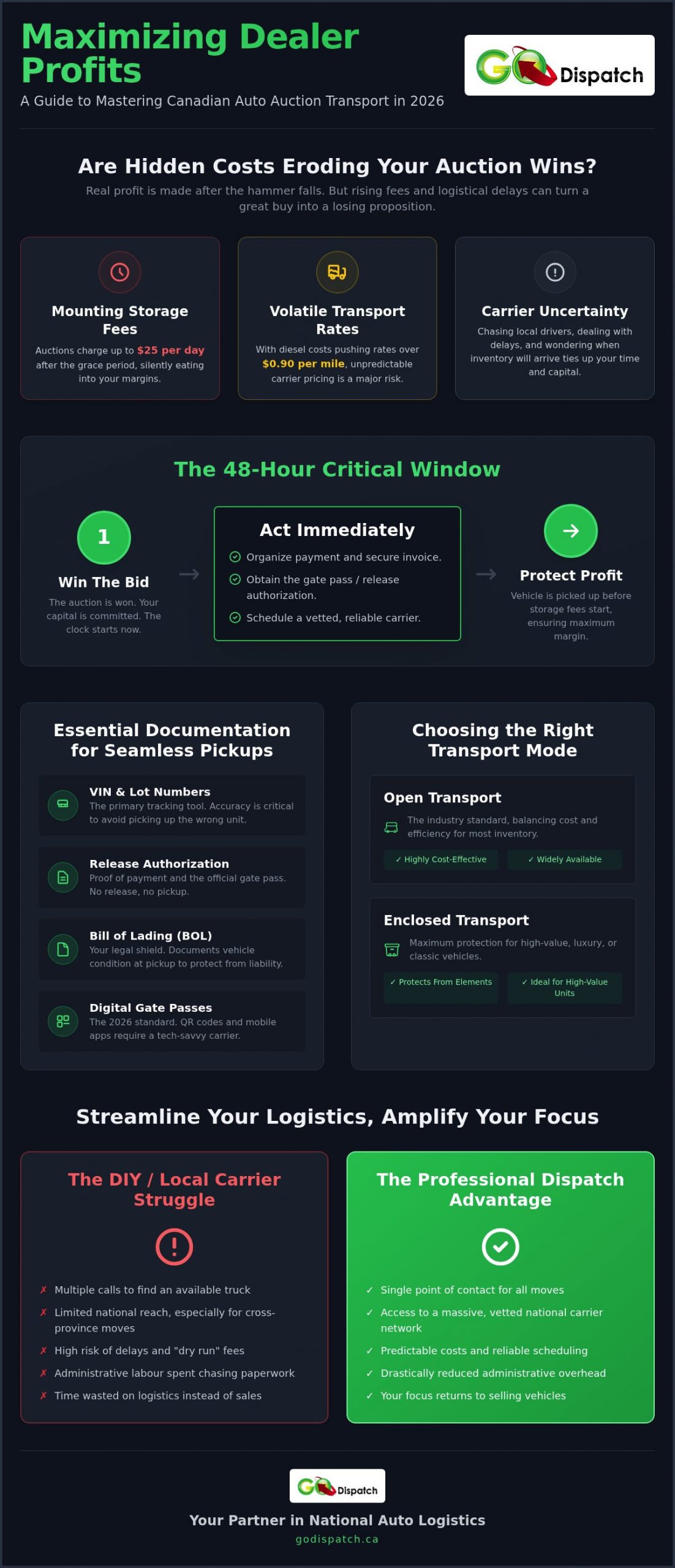
The first 48 hours after you win a bid are the most critical for your bottom line. This is the window where you must organize payment, secure the gate pass, and schedule your carrier. If you delay, the costs start to pile up. Many auctions now charge storage fees of $25 per day after the initial seven-day grace period. These hidden costs eat into your margins before the vehicle even reaches your lot. Beyond the daily fees, every day a car sits at an auction is a day it isn’t being detailed, photographed, or listed for sale.
The Reality of Post-Auction Timelines
Most auction houses operate on tight schedules. They need their lot space cleared to make room for the next sale. While a seven-day window might seem generous, it disappears quickly when you’re coordinating paperwork and waiting for a driver. Relying on a local, independent carrier often leads to delays. If their truck breaks down or they find a higher-paying load elsewhere, your inventory sits. This dwell time ties up your cash flow. You’ve paid for the asset, but you can’t sell it. Professional dispatching ensures a vetted carrier is assigned immediately, clearing your lot before those storage fees kick in.
National Reach vs. Local Limitations
Sourcing a carrier for a cross-province move presents unique challenges. A local operator might have a regular route between Toronto and Montreal, but what happens when you buy a unit in Calgary or Vancouver? National dispatching services bridge this gap. They provide access to a massive network of vetted carriers across Canada. This reach allows for consistent inventory flow, even during peak auction seasons when local trucks are fully booked. Instead of calling multiple carriers to find a spot, you have a single point of contact handling the entire national move. This centralized approach keeps your overhead low and your administrative labour minimal. It’s about maintaining a steady stream of inventory regardless of where the winning bid happened.
Essential Documentation for Seamless Auction Clearing
Successful auto auction transport for dealers depends on more than just a powerful truck. It requires a flawless paper trail. If your documentation isn’t perfect, your driver gets turned away at the gate. This leads to expensive dry run fees and delayed inventory. Managing these moving parts across different auction platforms demands a systematic approach. You need to ensure every VIN, lot number, and release form is aligned before the carrier even arrives.
The Vehicle Identification Number (VIN) is your primary tracking tool. It’s the only way to ensure the right car gets on the right trailer. When you provide your dispatch partner with accurate VIN and lot numbers, you eliminate the risk of picking up the wrong unit. This level of detail is essential for accountability. The Bill of Lading (BOL) serves as your most important shield against liability. It isn’t just a receipt. It’s a legal contract that documents the vehicle’s condition at the point of pickup and delivery. While many Canadian carriers follow domestic standards, understanding FMCSA regulations provides a helpful benchmark for safety and documentation across North America. A clear BOL ensures you aren’t held responsible for damage that occurred before the vehicle left the auction lot.
The Auction Release Workflow
Getting a vehicle released requires a specific sequence of actions. First, you must secure the paid invoice and release authorization immediately. Most auctions won’t even talk to a driver until the funds have cleared and the paperwork is in their system. Second, share the VIN and lot numbers with your dispatch team. Finally, coordinate the carrier’s arrival with the auction’s gate hours. Many sites have strict windows for pickups. Arriving five minutes late can mean waiting until the next business day, which triggers more storage fees.
Digital Logs and Accountability
In 2026, the industry has shifted toward digital gate passes. Most major Canadian auctions now use QR codes or mobile apps to authorize releases. This speed is helpful, but it requires your driver to be tech-savvy and prepared. Your carrier must perform a thorough pre-load inspection and document it digitally. Clear, time-stamped photos are no longer optional. This documentation is vital for meeting vehicle transport insurance requirements. If a claim arises, your digital log is your best evidence. You can simplify your entire workflow by partnering with the professional team at GO DISPATCH. We handle the logistical heavy lifting so you can focus on selling.
Strategic Transport Modes for Dealership Inventory
Choosing the right method for auto auction transport for dealers is a balance of speed, safety, and budget. You shouldn’t pay for white-glove service on a base-model sedan; however, you cannot risk road debris on a high-line exotic. Smart logistics managers look at their inventory in batches rather than individual units. By grouping purchases, you can leverage the economics of multi-vehicle transport. Research shows that full truckloads of eight or more units can bring per-vehicle costs down to a range of $800 to $1,500. This is a significant saving compared to single-unit moves that often cost between $1 and $3 per mile.
Specific attention is required for truck transport for dealerships. Larger pickups and SUVs take up more deck space. They often require specialized trailers or specific positioning to meet weight distribution requirements. A professional dispatcher understands these nuances. They organize loads to maximize every inch of trailer space, ensuring you don’t pay for “dead air” while your inventory moves across Canada. This strategic approach keeps your per-unit overhead low and your profit margins high.
Open Hauling: The Industry Standard
Open carriers are the workhorses of the Canadian automotive industry. They are the most cost-effective choice for standard inventory and daily drivers. As of May 2026, open carrier rates typically range from $0.60 to $1.20 per mile. While the vehicles are exposed to the elements, professional carriers follow strict safety protocols to secure every unit. Lead times for open carriers are usually shorter because there are more of these rigs on the road. It’s the ideal choice when speed and cost are your primary drivers.
Enclosed Transport for High-Line Units
For luxury auction wins or vintage finds, enclosed transport is a necessary investment. It protects high-value assets from Canadian winter road salt, gravel, and unpredictable weather. Rates for enclosed hauling generally sit between $0.90 and $1.80 per mile. This mode is essential for low-clearance vehicles or units with sensitive electronics that shouldn’t be exposed to moisture. When you book enclosed, you’re paying for peace of mind. You ensure the vehicle arrives in the exact same condition it left the auction house, ready for the showroom floor without a detailed cleaning or paint correction.
Reducing Overhead with Professional Dispatch Coordination
Many dealers treat logistics as an afterthought. They assign a sales manager or administrative assistant to “call around” for quotes after every auction win. This manual process is an expensive drain on your dealership’s resources. Professional auto auction transport for dealers replaces hours of phone tag and email chains with a single, streamlined workflow. You aren’t just paying for a truck; you’re buying back your team’s time. When your staff spends their afternoon chasing gate passes instead of closing deals, your overhead is higher than you realize.
A clear understanding of car transport brokerage fees is key to managing your true operational costs. Some managers see a dispatch fee as an added line item. In reality, it’s a hedge against market volatility and administrative waste. With diesel prices pushing transport rates over $0.90 per mile in May 2026, you need a partner who understands current carrier capacity and volume pricing. Professional dispatchers leverage their network to find the best rates, often offsetting their own fees by securing more efficient loads than a single dealer could find on their own.
Carrier Vetting and Compliance
Vetting a carrier is a meticulous task that requires constant vigilance. You must verify their cargo insurance limits, check their safety ratings, and ensure their operating authorities are current. A professional dispatcher performs this heavy lifting before a driver ever touches your inventory. We monitor insurance renewals and safety records in real time. If a dispute or damage claim arises, you don’t have to navigate the complex legalities alone. Your dispatcher acts as your advocate, managing the communication and documentation required to reach a swift resolution. This layer of protection is essential for maintaining your peace of mind.
The One-Stop Shop Advantage
Buying from multiple auction sites across Canada usually results in a chaotic mix of invoices and contacts. Consolidating these moves through a one-stop shop simplifies your accounting and daily operations. You benefit from a single point of contact for every move, whether it’s a local trade or a cross-country haul. This proactive approach allows your team to focus on high-value tasks like sales and customer service. You gain a reliable partner who anticipates problems and solves them behind the scenes. Ready to cut your administrative workload? Partner with GO DISPATCH for national inventory logistics and experience a more efficient way to move your lot.
Optimize Your Dealer Trade and Auction Logistics with GO DISPATCH
Canadian dealers need a partner who understands the high-stakes environment of the auction lot. We provide a comprehensive solution for dealership auto transport logistics that covers every province from coast to coast. Whether you’re moving a single sedan or a full load of heavy-duty pickups, our team handles the heavy lifting. We specialize in auto auction transport for dealers, ensuring that your winning bids turn into lot inventory as quickly as possible. You don’t have to worry about the rising diesel costs or carrier availability; we manage those variables for you.
Our commitment to rapid response means your inventory doesn’t sit idle. We realize that every hour a vehicle spends on an auction lot is an hour of lost revenue. We source professional, vetted carriers who meet our strict safety and insurance standards. This allows you to scale your inventory acquisition without scaling your administrative staff. We handle cars, SUVs, vans, and specialized truck transport with the same level of precision and care. It’s about keeping your lot full and your overhead low through expert coordination.
A Human-Centric Approach to Logistics
Automated bidding boards often leave you talking to a chatbot when a pickup is delayed. We believe in the power of human connection. Every shipment is managed by a dedicated coordinator who understands your specific dealership’s needs. This empathetic approach provides genuine peace of mind. We act as your proactive problem-solver, managing the communication between carriers and auction houses behind the scenes. You get reliable, authoritative service without the cold, corporate feel of a faceless platform. We take pride in being the bridge that simplifies your daily workload.
Getting Started with GO DISPATCH
Our onboarding process is built for speed. We know you have lots to clear and strict auction deadlines to meet. To get started, simply have your VIN, lot numbers, and paid auction invoices ready. We will handle the carrier vetting, scheduling, and gate pass coordination immediately. Our goal is to make your logistics invisible so your team can stay focused on sales and customer service. We provide a streamlined path from the auction hammer to your showroom floor. Ready to clear your lot? Request a dispatch quote for your auction inventory today and experience a more efficient way to move your vehicles.
Take Control of Your Auction Inventory Logistics
Success in 2026 requires more than winning the bid; it requires moving that asset to your lot before storage fees and administrative delays erode your profit. By mastering the 48-hour post-auction window and ensuring your documentation is digital and flawless, you protect your margins and your reputation. Streamlining your auto auction transport for dealers isn’t just a logistical choice. It’s a strategic move to keep your dealership agile and your overhead low in a competitive market.
We provide the national Canadian coverage and professional carrier vetting you need to clear auction lots with confidence. From standard sedans to specialized truck transport, we offer one-stop dispatching for all vehicle types. You don’t have to manage carrier schedules, insurance renewals, or gate pass delays alone. We handle the logistical heavy lifting so you can focus on what you do best: selling cars and growing your business. Streamline your auction logistics with GO DISPATCH today and start clearing your inventory faster than ever. Your next successful sale is just a haul away.
Frequently Asked Questions
How quickly must I move a vehicle from the auction lot before fees start?
Most major Canadian auction houses provide a seven-day grace period before daily storage fees begin. Starting on the eighth day, you can expect to pay approximately $25 per day for every unit left on the lot. To protect your margins, it’s best to schedule your carrier within the first 48 hours. This proactive approach ensures your inventory is cleared before these avoidable penalties eat into your profit.
What information does GO DISPATCH need to provide an accurate transport quote?
We require the vehicle’s year, make, and model, along with the specific auction site and your dealership’s delivery address. Providing the VIN and lot number is also essential for auto auction transport for dealers to ensure we track the correct unit. Knowing if the vehicle is operable or requires a winch allows us to assign the right equipment for a smooth pickup.
Is my auction inventory insured during the transport process?
Yes, every carrier in our professional network must maintain valid cargo insurance that meets strict industry standards. We verify these insurance certificates and monitor their renewal dates so you don’t have to manage that administrative burden. This vetting process ensures that your high-value inventory is protected against transit-related risks from the moment it leaves the auction gate until it reaches your lot.
Can you coordinate transport for non-running or damaged auction vehicles?
We can coordinate transport for non-running or damaged units, provided you disclose the vehicle’s condition during the booking process. These vehicles require specialized equipment, such as a winch or a roll-back trailer, to safely load and unload. While these moves involve different logistics than standard hauls, our team has the resources to clear damaged inventory quickly before expensive storage fees accumulate.
How do brokerage fees for auction transport actually work?
Brokerage or dispatch fees cover the professional management of your entire logistics chain, including carrier vetting, scheduling, and gate pass coordination. Instead of paying for a single truck’s overhead, you pay for access to a national network and a dedicated human coordinator. This fee is often offset by the savings we secure through volume pricing and the elimination of auction storage penalties and administrative labour.
Do you handle cross-province transport for national dealer groups?
We specialize in national coverage across Canada, making us an ideal partner for dealer groups with multiple locations. Whether you’re moving inventory from an auction in Alberta to a lot in Ontario or vice versa, we provide a single point of contact for all moves. This centralized approach simplifies your billing and ensures consistent service standards for every dealership in your group regardless of the distance.
What happens if a vehicle is damaged during transport from the auction?
If damage occurs, the Bill of Lading (BOL) serves as your primary evidence for an insurance claim. Your driver should perform a thorough digital pre-load inspection at the auction to document the vehicle’s initial state. If you notice new damage upon delivery, you must note it clearly on the BOL before signing. Our team will then act as your advocate to help resolve the claim with the carrier.
Can you transport oversized trucks or vans purchased at auction?
We handle a wide variety of vehicle types, including oversized trucks, commercial vans, and large SUVs. These larger units require specific trailer configurations to comply with provincial weight and height regulations. Our dispatchers are experts at organizing auto auction transport for dealers that involves heavy-duty inventory, ensuring your larger purchases are moved safely and efficiently without the risk of being turned away at the gate.