

Did you know that once the transport driver pulls away from your driveway, your window for a successful insurance claim might already be closing? It’s a stressful moment when your vehicle arrives with a fresh scratch or a new dent. You’ve trusted a carrier with your car, truck, or SUV, and now you’re worried they’ll deny responsibility or bury you in paperwork and hidden deductibles. We understand that feeling of uncertainty and the need for a quick resolution.
This guide will show you exactly how to file an insurance claim for shipping damage canada so you can secure the compensation you deserve without the headache. We’ll walk through the critical Bill of Lading (BOL) process, the specific documentation you need to gather, and how to navigate carrier insurance limits to ensure a successful payout. You’ll learn how to act within the standard 24 to 48 hour window for reporting external damage and how to hold carriers accountable. Our goal is to help you organize your claim and turn a frustrating situation into a manageable process with a clear path to resolution.
Key Takeaways
- Inspect your vehicle thoroughly before the driver leaves the premises to ensure any damage is documented immediately on the Bill of Lading.
- Capture high-resolution photos from multiple angles while the vehicle is still on the trailer to provide undeniable proof of delivery condition.
- Master how to file an insurance claim for shipping damage canada by acting within the critical 24 to 48 hour window for reporting external issues.
- Differentiate between a carrier’s high-limit cargo insurance and your personal policy to ensure you have comprehensive coverage during transport.
- Rely on a professional dispatch partner to handle carrier vetting and facilitate the communication needed for a successful insurance payout.
Immediate Actions: What to Do at the Moment of Delivery
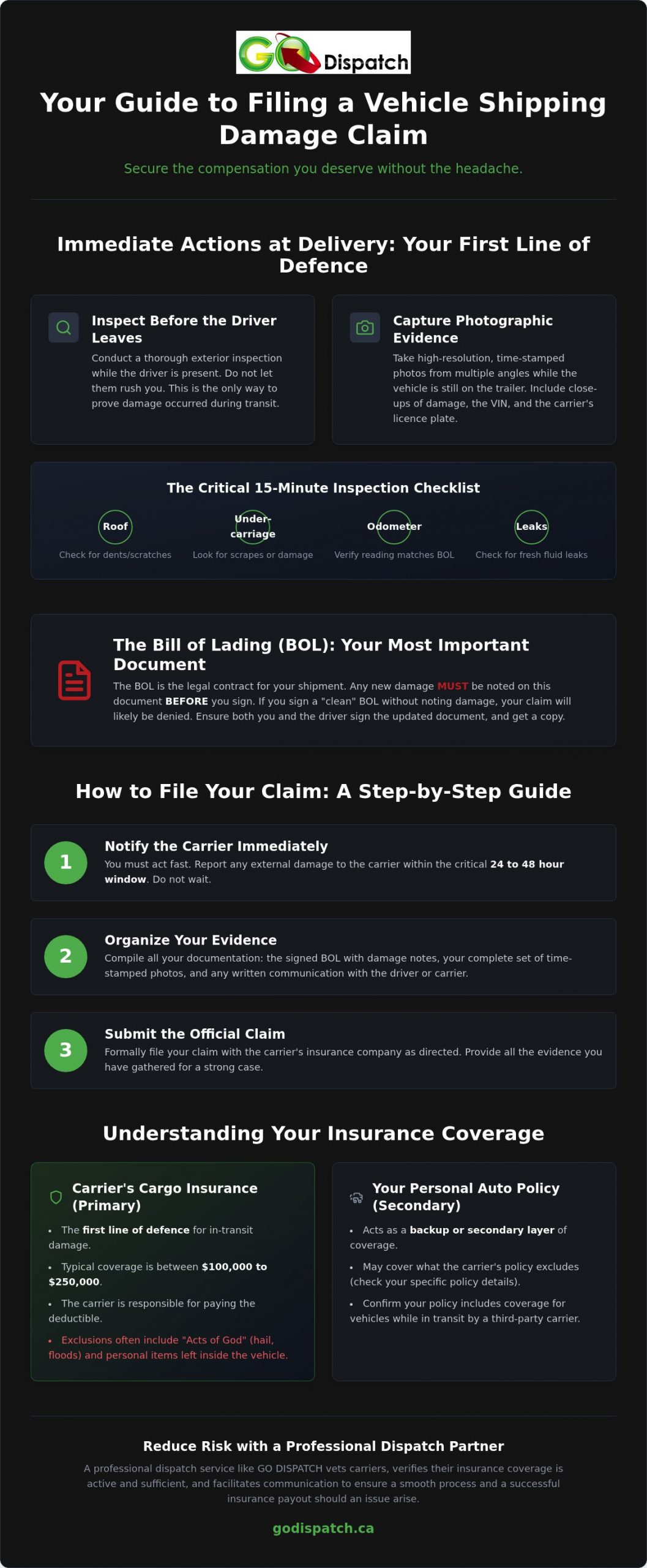
The arrival of your vehicle should be a moment of relief, but you need to stay alert until the driver departs. Your first line of defence starts the second the carrier pulls up. You must conduct a thorough exterior inspection before the driver leaves your premises. This is the only way to prove damage occurred during transit rather than after delivery. If you wait until the truck is gone, you’ll find it much harder to learn how to file an insurance claim for shipping damage canada successfully.
Keep the driver present throughout the process. Don’t let them rush you; it’s their job to wait while you verify the condition of your asset. Compare the current state of your car, SUV, or van to the original pick-up inspection report. If you spot a new scratch, dent, or mechanical issue, point it out immediately. If you’re coordinating a move to transport a truck or another large vehicle, the inspection requires even more focus due to the increased surface area and height of the unit.
The Critical 15-Minute Inspection
Take your time and spend at least 15 minutes looking over every inch of the vehicle. Check the roof and the undercarriage, as these areas are frequently missed during a hurried delivery. Verify that the odometer reading matches what was recorded at the point of origin. A significant discrepancy could indicate unauthorized use during the journey. Look for fresh fluid leaks on the trailer deck directly beneath your vehicle. These signs provide vital physical evidence for your claim.
Photo Documentation Best Practices
Photos are your best witnesses. Take high-resolution shots from multiple angles while the vehicle is still on the trailer. Capture wide shots to show the context and close-ups of any specific damage you find. Use a time-stamped camera app to prove exactly when the delivery occurred. This creates an undeniable digital trail that carriers and insurance adjusters cannot easily dispute.
Make sure to include the vehicle’s VIN and the carrier’s licence plate in the same frame as the damage. This links the incident directly to the specific transport. Finally, take a clear photo of the completed Bill of Lading (BOL) once both you and the driver have signed it. This document is the legal contract for your shipment. If you don’t note the damage here, your chances of a payout drop significantly. Understanding these immediate steps is the foundation of how to file an insurance claim for shipping damage canada and getting the resolution you deserve.
Understanding Auto Transport Insurance in Canada
Insurance isn’t just a safety net; it’s a legal requirement for every professional carrier on the road. When you’re looking into how to file an insurance claim for shipping damage canada, you first need to understand whose policy is on the hook. Most reputable Canadian car haulers carry between $100,000 and $250,000 in cargo insurance. This specific type of coverage protects the vehicles being transported rather than the truck itself. It’s the primary source of compensation for any damage that occurs during the journey.
Carrier Cargo Insurance vs. Personal Policy
It’s a common misconception that your personal auto insurance is the primary responder for transit damage. In reality, your personal policy usually acts as a secondary layer. The carrier’s cargo insurance is the first line of defence. This is why safe vehicle transport services must maintain verified, active policies before they ever load your vehicle. If you’ve ever looked at how to file a claim with Canada Post, you know that documentation is king; the same logic applies to auto transport. You need to verify the carrier’s specific limits to ensure your vehicle’s total value is covered.
Be aware of common exclusions that can complicate a claim. Most commercial policies won’t cover “acts of God,” such as hail or floods, unless specifically noted. They also exclude damage to loose items left inside the car. If you leave electronics or expensive tools in the cabin, the carrier’s insurance won’t pay for them if they’re damaged or stolen. Commercial claims also involve deductibles, which the carrier is responsible for paying. This can sometimes lead to friction if the carrier tries to avoid the out-of-pocket cost, making professional oversight essential to a fair resolution.
The Broker’s Role in Insurance Vetting
This is where a professional dispatch service becomes your biggest asset. GO DISPATCH manages the heavy lifting by ensuring every carrier we use is fully insured and vetted. We don’t just take their word for it. We require a current Certificate of Insurance (COI) that lists the coverage limits and expiry dates. This process drastically reduces the risk of you encountering “under-insured” drivers who lack valid coverage. It’s a proactive step that simplifies how to file an insurance claim for shipping damage canada by ensuring the right documents are already on file.
Working with a brokerage provides a centralized point of contact and an advocate for your interests. We help facilitate the communication needed to move a claim forward if an incident occurs. If you want to ensure your vehicle is handled by a vetted professional, you can request a quote from our team today. Our vetting process is designed to provide peace of mind, ensuring that if something does go wrong, the right insurance is already in place to protect your investment.
The Bill of Lading (BOL): Your Most Important Document
The Bill of Lading (BOL) is the most critical piece of evidence in the Canadian transport industry. It acts as both a receipt and a legal contract between you and the carrier. This document records the condition of your vehicle at every stage of the journey. If you want to understand how to file an insurance claim for shipping damage canada, you must treat the BOL as your primary shield. It provides the “before and after” snapshot that adjusters use to determine liability.
A “clean” BOL is a document signed at delivery without any damage noted. Once you sign a clean BOL, you’ve legally accepted the vehicle in its current condition. This effectively ends your chances of a successful claim for visible damage. The carrier can argue that any issues found later happened after they left your property. Never let the driver pressure you into signing before you’ve finished your walk-around. Your signature is an admission of satisfaction; make sure it’s accurate.
How to Mark the BOL for a Claim
Precision is vital when documenting issues on the BOL. Use clear, specific language such as “Damage noted at delivery” followed by a detailed description of the problem. Instead of writing “scratched door,” write “three-inch scratch on the lower panel of the driver-side door.” This level of detail leaves no room for interpretation by the insurance company. Ensure the driver signs their name directly next to your notes to acknowledge the discrepancy. If the carrier uses a digital system, type your notes into the comments section before providing your digital signature. Always take a clear photo of the final signed document before the driver pulls away.
Common BOL Mistakes to Avoid
Many vehicle owners write “Subject to Inspection” on the BOL, thinking it protects them if they find damage later. In the Canadian legal landscape, this phrase is often insufficient. It doesn’t provide proof that the damage existed while the carrier was still present. It’s far better to take the extra ten minutes to find the issues immediately. Another common error is failing to secure a legible copy of the delivery BOL. Whether it’s a physical carbon copy or a digital PDF, you need that record in your hands immediately. Finally, never lose your original pick-up BOL. Without the initial report showing the vehicle was “clean” at the start, you can’t prove that the damage occurred during transit. If you follow these documentation rules, you’ll be in a much stronger position when learning how to file an insurance claim for shipping damage canada.
Step-by-Step: How to File the Claim
Once you’ve documented the damage on the Bill of Lading, the clock starts ticking. You must act quickly to ensure your claim stays valid. The most important first step is to notify both the carrier and your dispatch service immediately; ideally within 24 hours of delivery. While some general freight carriers allow longer windows, vehicle transport claims in Canada often require notice within this tight timeframe to prevent disputes over when the damage occurred. This immediate action is the core of how to file an insurance claim for shipping damage canada and protects your right to compensation.
After the initial notification, you need to gather your evidence package. This includes your pick-up BOL showing the original condition, the delivery BOL with your damage notes, and the high-resolution photos you took at the scene. You should also submit a formal written “Letter of Intent to File a Claim” to the carrier. This letter officially puts them on notice and prevents them from claiming they weren’t aware of the issue. To support your financial demand, obtain two independent repair quotes from reputable Canadian body shops. These estimates provide a fair market value for the repairs and give the insurance adjuster a concrete number to work with during the evaluation.
Contacting the Right Parties
Start by identifying the specific carrier listed on your vehicle delivery logistics Canada paperwork. You should also inform GO DISPATCH right away. We maintain a complete dispatch file for every shipment and can provide supporting documentation to strengthen your case. Always use email for these communications. A concise email summarizing the incident, including the date, VIN, and nature of the damage, creates a permanent paper trail that is essential for legal and insurance purposes.
The Timeline of a Canadian Shipping Claim
Managing your expectations regarding the timeline will reduce your stress during the resolution process. The process follows a specific sequence. First, note all damage on the BOL before the driver leaves. Second, send a formal notice to all parties within 24 hours. Finally, submit your full documentation package, including repair quotes, within 7 days. It’s important to understand that the vehicle transport cost Canada you paid at the start does not include any hidden insurance fees; the carrier’s policy is responsible for the claim payout.
Typical resolution times for Canadian cargo claims range from 30 to 90 days. During this period, you should follow up consistently with the assigned insurance adjuster to ensure your file doesn’t stall. If you need assistance navigating this process, contact our support team for expert guidance. Staying persistent and organized ensures your file remains a priority until you receive your settlement.
Reducing Risk with Professional Dispatching Services
Professional dispatching isn’t just about moving a vehicle from point A to point B. It’s about comprehensive risk management. When you choose a high-capacity logistics partner, you’re investing in a vetting process that filters out unreliable carriers before your vehicle is ever loaded. This proactive approach significantly reduces the likelihood that you’ll ever need to know how to file an insurance claim for shipping damage canada. We focus on prevention so you can focus on your business.
Centralized communication is a game-changer for complex moves. If you need to transport a truck or a fleet of large vans, the logistics become more demanding. A professional dispatcher acts as your single point of contact. We manage the paperwork trail from the initial quote to the final delivery signature. This organized record is vital for dealerships and corporate clients who need to maintain clear accountability across multiple shipments. We handle the behind-the-scenes coordination, providing you with a streamlined experience and total peace of mind.
Vetted Carriers and Safety Standards
GO DISPATCH only works with carriers who meet our strict Canadian safety and insurance criteria. We don’t just check for a valid licence; we verify active, high-limit cargo insurance policies. We use historical performance data to avoid haulers with a track record of delays or damage incidents. This rigorous selection process is a core component of dealership auto transport logistics. By partnering with proven professionals, we ensure that safe delivery remains the standard for every car, SUV, and van we manage.
Final Checklist for a Stress-Free Move
A successful transport starts long before the driver arrives at your door. Preparation is the best way to avoid the stress of a potential claim. Follow this final checklist to protect your investment:
- Confirm Insurance Limits: Always verify the carrier’s cargo insurance limits before the vehicle is picked up.
- Organize Your Records: Keep a digital folder containing all transport communications, the original BOL, and your pre-shipping photos.
- Partner with Experts: Rely on a professional dispatch service to handle the heavy lifting of carrier vetting and logistics coordination.
Our team acts as your advocate throughout the entire shipping process. If an incident does occur, having a professional partner makes it much easier to manage how to file an insurance claim for shipping damage canada. We provide the supporting documentation and industry expertise needed to facilitate a fair and fast resolution. Trusting your vehicle to a vetted network is the most effective way to ensure a smooth, damage-free delivery across the country.
Securing Your Vehicle’s Safe Arrival
Understanding how to file an insurance claim for shipping damage canada gives you the power to protect your investment. Success depends on your attention to detail during those first few minutes of delivery. By noting every discrepancy on the Bill of Lading and acting within the critical 24-hour window, you turn a stressful incident into a manageable process. You don’t have to navigate these complex logistics alone when you have the right support in your corner.
Reliability starts with choosing a partner who prioritizes safety from the beginning. Our one-stop dispatching service simplifies the entire logistics chain for cars, trucks, and SUVs. We maintain a vetted network of professional Canadian carriers to ensure your vehicle is always in safe hands. We manage the vetting, the insurance verification, and the paperwork trail so you can focus on your daily business without the extra burden. Expert logistics management is just a click away.
Streamline your vehicle transport with GO DISPATCH today and experience the peace of mind that comes with professional oversight. Your vehicle deserves a smooth journey, and we’re here to ensure you get a stress-free resolution every time.
Frequently Asked Questions
Who is responsible if my car is damaged during transport in Canada?
The carrier is legally responsible for your vehicle while it is under their care. Their commercial cargo insurance policy acts as the primary responder for any damage that occurs between the pick-up and delivery points. GO Dispatch ensures every carrier in our network maintains active, high-limit coverage to protect your asset. If an incident happens, you’ll work directly with the carrier’s insurance provider to secure your compensation.
Can I refuse delivery of my vehicle if it arrives damaged?
You should not refuse delivery of a damaged vehicle. Refusing the car often leads to expensive storage fees and makes it difficult to conduct a proper inspection. Instead, accept the vehicle and document every issue on the Bill of Lading while the driver is present. This documentation is the foundation for learning how to file an insurance claim for shipping damage canada and ensures you have the evidence needed for a payout.
How long do I have to file an insurance claim for shipping damage?
You must report visible external damage within 24 to 48 hours of delivery. While Canadian domestic carriers often allow up to 60 days to submit a formal written claim, the initial notification should happen immediately. Delaying this report gives the carrier a chance to argue that the damage occurred after they left. Prompt action is the most effective way to protect your right to a fair settlement.
What if I notice the damage after the driver has already left?
Damage discovered after the driver leaves is called concealed damage. It’s more difficult to prove, so you must act the moment you find it. Take photos immediately and notify both the carrier and GO Dispatch. You’ll need to provide strong evidence that the damage couldn’t have happened on your property. Keep all documents and photos from the pick-up location to show the vehicle’s original “clean” state.
Does my personal car insurance cover damage during professional transport?
Your personal policy might offer secondary protection, but it isn’t the primary responder. The carrier’s commercial cargo insurance is legally required to cover damage during professional transit. Using your own insurance often requires you to pay a personal deductible and may lead to higher premiums. It’s always best to hold the carrier’s professional policy accountable for the full cost of repairs and any related expenses.
Will filing a claim affect my personal insurance premiums?
Filing a claim against the carrier’s commercial policy won’t impact your personal insurance rates. This is a business-to-business insurance matter between the transport company and their provider. By ensuring the carrier is held responsible, you avoid using your own policy entirely. This is one of the main benefits of working with a dispatch service that only uses carriers with verified, high-limit cargo insurance policies.
What documents are required to successfully file a shipping claim?
You need four primary pieces of evidence for a successful claim. These include the pick-up Bill of Lading, the delivery Bill of Lading with damage notes, high-resolution photos from the delivery site, and two independent repair estimates. Having these records organized is essential when you’re learning how to file an insurance claim for shipping damage canada. This documentation package leaves no room for the carrier to dispute the facts.
What happens if the carrier denies my claim?
If a carrier denies your claim, you can appeal the decision or pursue legal action. In most Canadian provinces, you have up to nine months from the delivery date to start a legal proceeding. A professional dispatch service can assist by providing records from the dispatch file and facilitating communication between the parties. Having a clear paper trail and expert support significantly increases your chances of reversing a denial.