
What if the lowest quote you received for shipping your vehicle is actually the most expensive mistake you’ll make this year? It’s a valid concern for anyone moving a car across the second-largest country on earth. You’re likely tired of staring at vague delivery windows and worrying about hidden surcharges that appear only after your car is loaded. We know you want a simple, dependable process that protects your investment and your schedule.
Understanding dealership vehicle transport costs canada is the first step toward a stress-free move. We’ll show you exactly how distance, vehicle size, and 2026 market shifts influence your final price. This guide provides a transparent breakdown of current rates and the logistical secrets to securing a reliable delivery timeline. You’re about to discover how professional coordination turns a complex haul into a streamlined, predictable success.
Key Takeaways
- Learn how distance, vehicle weight, and seasonal demand create a dynamic pricing equation for your next vehicle move.
- Understand how dealership vehicle transport costs canada are optimized by leveraging high-volume shipping corridors between major urban hubs.
- Compare the cost-efficiency of open-air hauling with the specialized protection of enclosed transport to find the right balance for your budget.
- Discover strategic booking windows and delivery options that help you avoid seasonal price spikes and unexpected winter surcharges.
- See how professional dispatch coordination removes the burden of managing multiple carriers while ensuring a reliable, stress-free delivery timeline.
What Determines the Cost to Ship a Car in Canada?
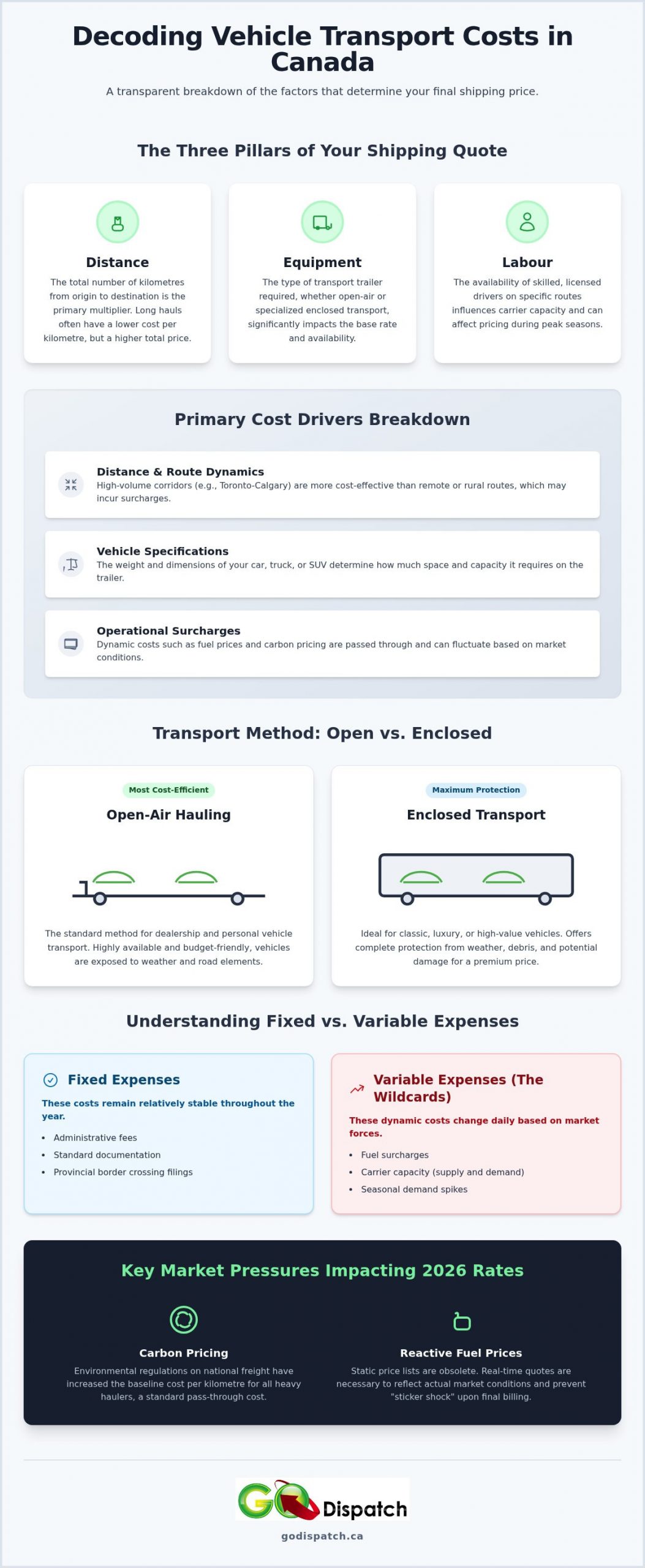
Shipping a vehicle across the second-largest country on earth is a complex logistical feat. It is not a flat-rate service. Your total invoice is a combination of three main pillars: distance, equipment, and labour. Distance is the most obvious factor, but the type of equipment required and the availability of skilled drivers play equally large roles. In 2026, these factors are more interconnected than ever before. Understanding dealership vehicle transport costs canada requires looking beyond the sticker price to see the moving parts of the national supply chain.
Beyond the basics, hidden factors often catch people off guard. Insurance coverage, provincial brokerage fees, and administrative filings are essential for a legal and safe move. These details are often managed by an Auto transport broker or a dedicated dispatch partner. They handle the fine print so you don’t have to. When these elements are coordinated correctly, you avoid the surcharges that typically plague poorly planned shipments.
Primary cost drivers in the current market include:
- Total distance: The number of kilometres between the origin and destination.
- Vehicle specifications: The weight and dimensions of your car, truck, or SUV.
- Transport method: The choice between open-air trailers and specialized enclosed transport.
- Operational surcharges: Dynamic costs like fuel and carbon pricing.
Fixed vs. Variable Transport Expenses
Fixed expenses include administrative fees and standard documentation for provincial border crossings. These stay relatively stable throughout the year. Variable expenses are the real wildcards. Fuel surcharges and carrier capacity change daily. If a specific route has low carrier volume, the base rate naturally rises to attract a driver. It is a supply and demand game. Professional dispatchers monitor these shifts to find the best possible rate for your specific timeline, ensuring that dealership vehicle transport costs canada remain competitive even when capacity is tight.
The Impact of Carbon Pricing and Fuel in 2026
The 2026 economic landscape has introduced specific pressures on the logistics industry. Higher carbon pricing on national freight has increased the cost per kilometre for heavy haulers. These environmental regulations are now standard pass-through costs. Because fuel prices are so reactive, static price lists are a thing of the past. You need a real-time quote to ensure your budget reflects the actual market conditions on your shipping date. This precision prevents “sticker shock” when the final bill arrives, giving you peace of mind throughout the journey.
Distance and Route Dynamics: Calculating the Price per Kilometre
Distance is the bedrock of any shipping quote. In Canada, the sheer scale of the Trans-Canada Highway dictates the math. While a cross-country haul from Halifax to Victoria covers thousands of kilometres, the price per kilometre actually drops as the distance increases. Carriers prefer long hauls. It allows them to settle into a rhythm and maximize fuel efficiency over several days. However, the total cost will always be higher for these marathon trips than for a regional move between Calgary and Edmonton. Total distance remains the primary multiplier in the pricing equation.
Major corridors act as the arteries of the industry. Routes connecting hubs like Toronto, Montreal, Calgary, and Vancouver benefit from high traffic volume. This consistent flow keeps dealership vehicle transport costs canada more predictable for businesses and individuals alike. When a carrier can fill a multi-car trailer for a single destination, they pass those savings on to you. If your vehicle is coming from across the border, you must also account for Canadian vehicle import regulations, which can impact the initial logistics before domestic transport begins.
Remote location surcharges are the reality for deliveries outside these primary lanes. If a driver has to divert 200 kilometres off the main highway to reach a small town, they will charge a premium. This covers the extra fuel and the time lost while they are away from profitable main routes. Navigating multi-province transit requires a deep understanding of provincial weight scales and road restrictions, which vary significantly from the Rockies to the Atlantic coast.
Major Transport Corridors vs. Rural Routes
High-traffic lanes are efficient, but rural destinations present a different challenge. You can often mitigate high rural costs by looking for backhauling opportunities. This happens when a carrier has an empty slot on a return trip and offers a discount to fill it. Understanding these vehicle delivery logistics in Canada helps you time your shipment for maximum savings. It turns a potential surcharge into a strategic advantage for your budget.
Terminal-to-Terminal vs. Door-to-Door Service
Choosing between terminal and door-to-door service is a direct trade-off between price and convenience. Terminal shipping requires you to drop off and pick up your vehicle at a central hub. It is often the most budget-friendly choice because it allows the carrier to avoid navigating narrow residential streets with a heavy trailer. Door-to-door service is the premium alternative. It removes the travel burden from your shoulders entirely. If you need help deciding which route fits your budget, you can request a custom shipping quote to see the price difference in real time.
Vehicle Specifications and Transport Methods: Impact on Final Rates
Your vehicle’s physical footprint is just as important as the distance it travels. The weight, height, and length of a car determine exactly how much space it occupies on a trailer and how much fuel the carrier consumes. When professionals calculate dealership vehicle transport costs canada, they look at the specific dimensions of every unit. A compact sedan takes up less “real estate” than a full-size SUV, and that difference is reflected in your final quote. Heavier vehicles also increase the carrier’s fuel burn, which is a critical factor in a market shaped by 2026 carbon pricing and fuel surcharges.
Condition also plays a role in the labour required. If a vehicle is inoperable and cannot be driven onto the trailer, it requires specialized equipment like a winch or a forklift. This typically adds an additional surcharge of C$150 to C$250 to the total cost. Similarly, transporting a truck across the country requires specific trailer configurations to accommodate the extra weight and height. These logistics are managed behind the scenes by your dispatch partner to ensure the right equipment arrives for the job.
Open Hauling vs. Enclosed Transport Costs
Open hauling is the industry standard for a reason. It is the most cost-effective way to move vehicles across Canada. Your car sits on a multi-car trailer, exposed to the elements but secured by professional grade rigging. For most daily drivers, this is the ideal balance of safety and price. Enclosed transport is the premium alternative. It provides a hard-sided shield against road debris and harsh Canadian weather. You should expect to pay a 30% to 60% premium for enclosed service. This is usually reserved for luxury, classic, or high-value dealership inventory that requires absolute protection from the environment.
Weight, Height, and Modification Factors
Standard rates apply to factory-spec vehicles. If you have added a lift kit, oversized tyres, or a permanent roof rack, your transport profile changes. An oversized van or a modified truck might take up the space of two smaller cars. This “lost space” on the trailer must be compensated, leading to higher fees. Accurate measurements are the only way to secure a firm, no-surprise quote. Providing the exact make, model, and any modifications ensures the dispatcher can assign the correct carrier and equipment. This precision prevents delays at the loading site and keeps dealership vehicle transport costs canada predictable for your budget.
Strategic Timing and Delivery Options to Reduce Shipping Expenses
Timing is often the most overlooked variable in the pricing equation. While distance and vehicle size are fixed, the calendar is dynamic. Rates fluctuate based on who else is trying to move a car at the same time you are. If you can align your schedule with carrier availability, you’ll see a significant drop in your total invoice. Understanding these patterns is essential for managing dealership vehicle transport costs canada without sacrificing service quality. It’s about working with the market rhythm rather than against it.
For businesses moving multiple units, dealer trade vehicle transport offers a distinct advantage. Consolidating shipments allows a dispatcher to secure a dedicated trailer slot, which is always more cost-effective than booking single cars sporadically. This professional coordination ensures that your inventory moves at a predictable rate, protecting your margins and your delivery promises to customers.
Seasonal Demand and Peak Times
Canadian winters are the most challenging season for logistics. Snow, ice, and reduced daylight hours slow down transit times and increase operational risks for carriers. You should expect higher rates between November and March. This is also driven by the “snowbird” effect, where thousands of vehicles move across the country or toward southern hubs. Spring and autumn are the peak volume months for dealership inventory shifts. To secure the best pricing during these busy periods, we recommend booking at least 2 to 4 weeks in advance. This lead time gives your dispatcher the leverage needed to lock in a professional carrier before the schedule fills up.
Flexibility as a Cost-Saving Tool
Urgency is expensive. If you require a “must-go” pickup within 24 hours, you will pay a premium for expedited service. This forces a carrier to deviate from their planned route or skip other profitable loads to accommodate you. Conversely, providing a 7 to 10 day pickup window is the most effective way to lower your costs. This flexibility allows a dispatcher to negotiate with multiple carriers and find a slot on a trailer that is already passing through your area. It turns your shipment into a “filler” load for the driver, which naturally reduces the fee. Organizing your schedule to allow for this window provides immediate relief to your transport budget. If you have a specific deadline approaching, contact our dispatch team to discuss the most efficient delivery options for your timeline.
Streamlining Your Logistics with GO DISPATCH Professional Coordination
Managing vehicle transport isn’t just about finding a truck. It’s about finding the right truck at the right time. Many people confuse direct carriers with dispatch services. A carrier owns a specific set of trailers and operates on fixed routes. If their truck is full or in the wrong province, your shipment stalls. GO DISPATCH acts as the expert bridge. We connect you with a national network of professional carriers. This one-stop dispatching service ensures your vehicle moves regardless of individual carrier schedules. It’s the most reliable way to stabilize dealership vehicle transport costs canada in a shifting market.
Professional coordination eliminates the stress of the unknown. When you handle logistics yourself, a single delay can derail your entire week. We take that burden off your desk. Our team manages the complex coordination between origin and destination. We handle the paperwork and the provincial compliance. This allows you to focus on your core business while we handle the heavy lifting behind the scenes. You get a streamlined process that requires minimal effort on your part.
The GO DISPATCH Advantage: Vetted Carriers and Safe Delivery
Hidden costs often come from damaged freight or unreliable drivers. We mitigate this risk through a rigorous professional carrier selection process. Every carrier in our network is vetted for safety, equipment quality, and reliability. We don’t just find a driver. We find a partner who meets our high standards. This proactive approach reduces the likelihood of delays and ensures your car, truck, or SUV arrives in the same condition it left. Peace of mind is the ultimate result of professional dispatching.
Getting Your Custom Transport Quote
The total vehicle transport cost in Canada is best managed by experts who understand the 2026 economic landscape. We don’t rely on automated bots or cold algorithms. Our approach is human-centric. When you request an enquiry, you’re speaking with a logistics professional who understands your specific needs. Whether you’re moving a single van or managing high-volume dealership vehicle transport costs canada, we provide a tailored solution that fits your budget.
Requesting a quote is simple. Provide your vehicle details and your route, and we’ll handle the rest. We’ll find the most efficient carrier and secure a competitive rate that reflects current fuel and carbon pricing. Don’t leave your logistics to chance. Contact the GO DISPATCH team today for a 2026-ready transport solution that delivers results without the stress.
Secure Your 2026 Vehicle Transport Strategy
Success in national logistics depends on preparation and professional insight. You’ve seen how distance, seasonal shifts, and vehicle dimensions create a complex pricing landscape. Managing dealership vehicle transport costs canada doesn’t have to be a source of stress. By choosing a partner that understands the 2026 economic environment, you eliminate the fear of hidden surcharges and damage risks. Professional coordination turns a logistical hurdle into a streamlined part of your business operations.
GO DISPATCH provides national coverage across all Canadian provinces with specialized dispatching for cars, trucks, and SUVs. Our rigorous professional carrier vetting ensures your freight is in safe hands. We manage the logistics so you don’t have to. You deserve a partner that prioritizes reliability and human connection. Take the first step toward a predictable, efficient delivery timeline today.
Get a Professional Vehicle Transport Quote from GO DISPATCH
Your vehicle is an investment. Let’s make sure it reaches its destination safely and on schedule.
Frequently Asked Questions
How much does it cost to ship a car 1000 km in Canada?
Shipping a vehicle roughly 1000 km, such as a move between Vancouver and Calgary, typically costs between C$700 and C$950 for open transport. Regional hauls often fall under the C$1,000 mark depending on current fuel surcharges and the specific vehicle size. Prices fluctuate based on whether you choose the convenience of door-to-door service or the savings of a terminal-to-terminal option.
Is it cheaper to ship a car by rail or truck in 2026?
Truck transport is generally the most cost-effective and flexible option for individual moves and small dealership batches in 2026. While rail can be cheaper for massive bulk shipments of fifty units or more, it often involves significant delays and limited terminal access. Trucking provides the speed and door-to-door reliability that most clients require to maintain their daily schedules.
What is the average car transport brokerage fee in Canada?
Most professional dispatch services include their coordination fees within the total quote rather than as a separate line item. This fee covers the essential work of vetting carriers, verifying insurance, and managing provincial paperwork. It ensures that dealership vehicle transport costs canada remain transparent and free from hidden administrative surprises that can appear when booking with unvetted providers.
Does the type of vehicle significantly change the shipping price?
Yes, the dimensions and weight of your vehicle are primary drivers of the final shipping rate. Larger units like oversized SUVs and vans occupy more space on a trailer, which reduces the carrier’s total capacity for other vehicles. Heavier cars also increase fuel consumption, which is a critical factor in the 2026 market shaped by national carbon pricing and fuel trends.
Are there extra costs for shipping a non-running vehicle?
Expect an additional surcharge ranging from C$150 to C$250 for vehicles that cannot be driven onto the trailer. This fee covers the specialized equipment, such as winches or forklifts, required to safely load and unload an inoperable car. It also compensates the driver for the extra labour and time needed to manage a vehicle that does not start and drive.
How does winter weather affect vehicle shipping rates in Canada?
Winter shipping often costs more due to increased operational risks and slower transit times across the country. Snow and ice make mountain passes and rural routes more dangerous, which reduces the number of carriers willing to run certain lanes. These conditions also increase fuel burn, leading to higher surcharges during the coldest months between November and March.
Is insurance included in the car shipping quote?
Professional quotes provided by a reputable dispatch service include basic cargo insurance from the assigned carrier. This coverage protects your vehicle against damage during transit and is a mandatory part of our vetting process. It’s a good idea to confirm the specific coverage limits and your own personal insurance requirements before the vehicle is loaded for transport.
How can I get the most accurate quote for my vehicle transport?
Providing exact details about your vehicle and your desired pickup window is the only way to secure a firm quote. Mention any modifications like lift kits, roof racks, or oversized tyres that change the vehicle’s physical profile. Getting a live quote from a professional dispatcher ensures your price reflects real-time dealership vehicle transport costs canada and current carrier availability.