
What if a single regulatory oversight could sideline your entire fleet and stall your business growth for weeks? With the Canadian commercial vehicle market projected to hit $176 billion by 2033, the stakes for efficient light commercial vehicle transport canada have never been higher. Between diesel prices in the GTA exceeding $2.39 per litre and the strict 2026 ELD mandate, fleet managers face a constant battle against rising costs and red tape. It’s a heavy burden to carry alone while trying to maintain a productive schedule.
We know you’re focused on keeping your business moving, not getting lost in the fine print of provincial transport laws. You need a logistics process that works as hard as you do without the constant worry of damage or delivery delays. This guide promises to simplify the complexities of moving commercial vans and trucks across the country. You’ll learn how to master current Transport Canada safety standards, find vetted carriers for specialized sizes, and implement dispatching strategies that protect your fleet productivity. Let’s organize your transport plan so you can get back to what matters most.
Key Takeaways
- Realize how the National Safety Code and Safety Fitness Certificates impact your fleet compliance across provincial borders.
- Master the complexities of light commercial vehicle transport canada to move vans and utility trucks efficiently within the 2026 market.
- Compare open and enclosed hauling methods to find the perfect balance between cost-efficiency and specialized protection for your commercial units.
- Simplify your relocation process by using a structured inventory and route planning system designed for Canadian winter conditions and long-haul geography.
- Leverage a one-stop dispatching partner to access a vetted network of professional carriers, reducing your workload and ensuring reliable delivery timelines.
Understanding Light Commercial Vehicle (LCV) Transport in Canada
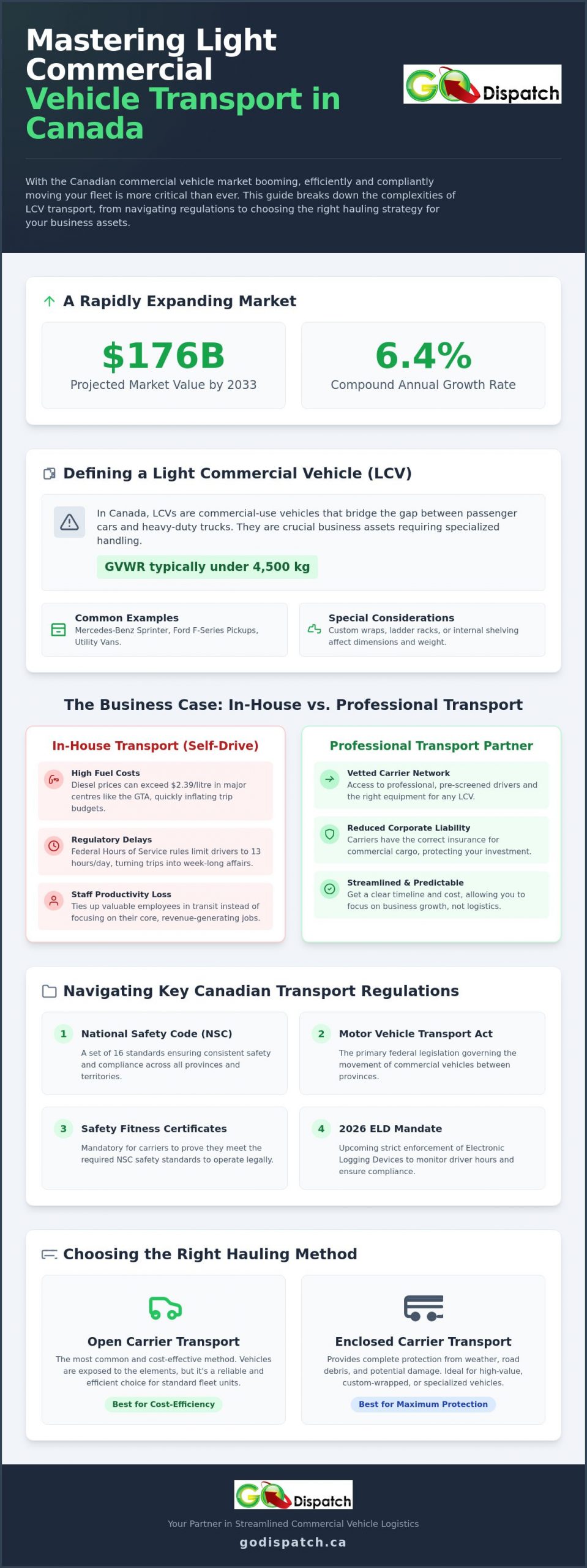
The Canadian commercial vehicle market is moving at a record pace. Projections suggest the industry will reach a staggering $176,614 million by 2033. This growth is fueled by a 6.4% annual growth rate, making light commercial vehicle transport canada a critical component of modern supply chains. Businesses across the country are expanding their fleets to meet rising consumer demand. You need your assets on the ground and ready to work, not stuck in transit or sidelined by logistical errors. Reliable transport ensures your operations remain seamless and your revenue stays on track.
Transporting an LCV is a specialized task that differs significantly from standard passenger vehicle shipping. These units are business tools, not just commuters. They often carry specialized equipment, custom wraps, or unique dimensions that require expert handling. A standard car carrier might not have the clearance for a high-roof van or the weight capacity for a loaded service truck. Professional logistics providers understand these nuances. They match your specific vehicle to the right equipment, preventing damage and ensuring a safe arrival. This proactive approach keeps your fleet productive and your supply chain moving without interruption.
What Qualifies as an LCV in Canada?
Clear definitions help you organize the right transport solution. Understanding Light Commercial Vehicles (LCVs) is essential for compliance and safety. In the Canadian market, this category includes vehicles designed for commercial use that don’t require a heavy-duty Class 8 tractor for transport. You will often see Mercedes-Benz Sprinter vans, Ford F-Series pickups, and specialized utility units in this group. These vehicles frequently feature modifications like ladder racks or internal shelving that increase their height and weight profiles. In Canada, LCV transport involves moving commercial-use vehicles with a Gross Vehicle Weight Rating (GVWR) typically under 4,500 kilograms, bridging the gap between passenger cars and heavy-duty trucks.
The Business Case for Professional Transport
Choosing professional transport is a strategic move for your bottom line. Driving a vehicle across the country might seem cheaper at first glance, but the hidden costs are substantial. Diesel prices in the Greater Toronto Area reached over $2.39 per litre in March 2026. When you add up fuel, meals, and hotels, the price tag climbs quickly. You must also consider the Federal Hours of Service regulations. Drivers are limited to 13 hours of driving per day, which can turn a cross-country trip into a week-long ordeal. Professional hauling eliminates these delays and keeps your staff focused on their core jobs.
Using professional auto carriers also significantly reduces your corporate liability. Expert dispatchers connect you with vetted drivers who carry the correct insurance for commercial cargo. This protects your investment against road hazards and unforeseen accidents. Efficient vehicle delivery logistics in Canada allow you to scale your fleet without the stress of managing individual drivers or complex routes. You get a streamlined process, predictable costs, and total peace of mind. It’s an all-encompassing solution that lets you focus on growing your business while the experts handle the heavy lifting behind the scenes.
Navigating Canadian Commercial Transport Regulations and Safety Standards
Compliance isn’t just about paperwork; it’s about keeping your business legal on the road. For light commercial vehicle transport canada, the National Safety Code (NSC) serves as the foundation. It’s a set of 16 standards designed to ensure safety and consistency across every province. You must realize that failing to meet these standards can lead to heavy fines or impounded vehicles. A professional partner ensures every carrier in the chain understands the Motor Vehicle Transport Act. This legislation governs the inter-provincial movement of commercial assets, making it the primary rulebook for your relocation.
When planning a move, you should also consider Canadian Commercial Transport Regulations regarding vehicle standards. These rules ensure that all commercial units on the road meet environmental and safety benchmarks. Staying compliant with these federal mandates protects your company from liability and ensures your vehicles are ready for immediate use upon arrival. It’s a complex landscape, but understanding these requirements is the first step toward a successful fleet move.
Timing is everything in logistics. The 2026 Federal Hours of Service (HOS) regulations are strict. Drivers are limited to 13 hours of driving and 14 hours on-duty per day. They must take 10 hours off-duty, with 8 of those hours being consecutive. Most federally regulated carriers use certified Electronic Logging Devices (ELDs) to track this data. Enforcement is now data-driven, and inspectors cross-check ELD records with other sources to ensure total compliance. These rules directly impact your delivery timelines. If a route covers thousands of kilometres, a driver must stop, rest, and log their time. Realistic scheduling is vital for maintaining your fleet productivity.
Federal vs. Provincial Oversight
Provinces govern transport within their borders, but federal rules take over the moment a vehicle crosses a provincial line. This is where Safety Fitness Certificates become non-negotiable. An extra-provincial carrier must hold a valid certificate to operate legally across Canada. Vetting these documents is a complex task for any fleet manager. Professional dispatchers handle this behind the scenes. They verify that every carrier has a clean record and current certifications before your vehicle ever touches a trailer. This proactive problem-solving removes the regulatory burden from your team.
Insurance and Liability Requirements
You can’t afford to leave your assets unprotected during transit. Minimum insurance standards exist, but you need to look closer at the details. You must check both cargo insurance and liability insurance. Cargo insurance covers the actual vehicle being hauled, while liability covers damage the transport truck might cause to others. A fully insured move provides the peace of mind you need to focus on your core operations. If you want to skip the regulatory headache, you can outsource your dispatching to experts who manage these details for you every day.
Choosing the Right Hauling Method for Your Commercial Fleet
Selecting the right hauling method is a balance between your budget and the specific needs of your fleet assets. Most businesses find that open carrier transport is the most efficient way to manage light commercial vehicle transport canada. It’s the industry standard for a reason. It offers high capacity and lower costs for bulk relocations, making it the primary choice for national fleet updates. However, if you’re moving branded units with sensitive wraps or high-value specialized equipment, enclosed hauling provides that extra layer of security against the elements and road debris. We prioritize your peace of mind by matching your vehicles with the most appropriate equipment for the job.
Dealerships often face the challenge of moving large volumes of inventory at once. Coordinating several individual drivers is a logistical nightmare for your schedule and your overhead. Multi-vehicle transport on a dedicated carrier streamlines this entire process. It ensures every unit arrives at the same time, ready for the showroom floor or the service lot. This level of organization is what separates a chaotic move from a professional logistics operation. You save on administrative time and reduce the risk of staggered delivery delays that can stall your sales cycle.
Open vs. Enclosed LCV Hauling
Efficiency drives fleet decisions. Open carriers are the workhorses of the logistics industry. They’re perfect for standard pickup trucks and cargo vans. If you need to transport a truck across the country, an open trailer is often your best bet for speed and value. Enclosed hauling is a premium service that acts as a shield. Use it when protection from Canadian winter salt or flying gravel is a top priority. It’s a strategic choice for high-end service vehicles or prototypes that require total privacy and safety. We help you weigh these options to find the most cost-effective path forward.
Logistics for Specialized Commercial Units
Standard trailers don’t always fit specialized LCVs. High-roof Sprinter vans or extended wheelbase Ford F-350s require specific clearance and weight considerations that standard cars don’t. You can’t just hope for the best when loading these units. They need heavy-duty ramps and specialized securing equipment to prevent shifting during transit. Professional dispatchers bridge this gap by acting as your expert facilitator. They maintain a network of vetted carriers who own the right gear for these oversized jobs. This ensures your specialized units are handled with precision, avoiding the risk of damage from under-equipped hauling. You get a reliable expert who takes the complex tasks off your plate, allowing you to focus on your core business.
How to Organize a Seamless National LCV Relocation
Success in logistics comes down to a clear, repeatable process. When you’re managing light commercial vehicle transport canada, you can’t leave anything to chance. A single missed detail can lead to delays that ripple through your entire operation. By following a structured five-step plan, you ensure your vehicles arrive safely and on time. We take pride in handling these complex tasks behind the scenes, allowing you to focus on your core business goals.
- Step 1: Inventory Assessment. Record the exact dimensions, weight, and condition of every vehicle. Note any modifications like ladder racks or lift gates.
- Step 2: Scheduling and Route Planning. Account for the vast Canadian geography. Consider mountain passes in BC or winter conditions in the Prairies.
- Step 3: Documentation. Prepare your Bills of Lading and verify if any specific provincial permits are required for your vehicle size.
- Step 4: Carrier Selection. Vet every carrier for a solid safety record. Match your specific LCV size to a trailer with the right capacity.
- Step 5: Delivery and Inspection. Conduct a thorough check upon arrival. Compare the condition to your initial inventory assessment to finalize the move.
Preparing Your Fleet for Transport
A little preparation goes a long way. Start by cleaning every vehicle to ensure an accurate inspection. It’s much easier to spot pre-existing damage on a clean surface. For commercial vans, you must secure all loose equipment and tools inside. Shifting cargo can cause internal damage or affect the balance of the transport trailer. Keep fuel levels at approximately one-quarter tank. This reduces weight while ensuring there is enough fuel for loading and unloading. Finally, check that all batteries are charged and tires are properly inflated to facilitate a smooth move.
Scheduling for Efficiency
You need to realize that realistic timelines are the key to fleet productivity. Cross-province delivery in Canada is a massive undertaking. Seasonal weather can turn a standard route into a challenge, especially during winter months or long weekends. While the 2026 removal of long-weekend travel restrictions for LCVs in Ontario helps, you still need to plan for traffic and road conditions. Coordinate your pick-up and drop-off times to minimize business downtime. If you want to eliminate the stress of planning, you can outsource your transport dispatching to our expert team today.
The Strategic Advantage of Professional Auto Transport Dispatch
Managing a commercial fleet requires your full attention. You can’t afford to spend hours vetting individual drivers or chasing down status updates. This is where professional dispatching becomes your secret weapon for light commercial vehicle transport canada. One-stop dispatching isn’t just a service; it’s a stress-relief solution. We act as your high-capacity partner, handling the complex tasks behind the scenes so you don’t have to. You get a streamlined process that moves your assets quickly and safely across the country.
A vetted national network of professional auto carriers is the backbone of a successful move. We don’t just find a driver; we find the right driver for your specific LCV. This involves proactive problem-solving that anticipates issues before they happen. Whether it’s a sudden road closure or a mechanical delay, our team manages the fallout immediately. The human touch makes the difference here. You’re not dealing with a cold, automated system. You have real people managing your fleet moves, providing professional confidence and peace of mind every step of the way.
Brokerage Fees vs. Internal Logistics Costs
Cost efficiency is about more than just the initial quote. Many businesses try to manage transport internally, only to realize that the hidden costs of staff time and missed opportunities add up fast. Paying a dispatch fee often saves you money on long-distance moves because of our expert carrier selection and rate negotiation power. We understand the current market trends, from regional demand shifts to equipment availability. Understanding car transport brokerage fees helps you see the value in outsourcing. You get access to better rates and more reliable carriers than a single business could secure on its own. It’s a direct investment in your fleet’s productivity.
Why GO DISPATCH is the Reliable Choice
Our team provides a blend of professional confidence and reassuring simplicity. We manage the entire logistics process from our centre in Leduc to any corner of Canada. You don’t need to become an expert in the Motor Vehicle Transport Act or provincial weight thresholds. We’ve already done that work for you. Our goal is to take the logistical burden off your shoulders completely. This allows you to focus on your core business while we ensure your light commercial vehicle transport canada is handled with precision. GO DISPATCH takes pride in being the bold leader in this niche, acting as your friendly and helpful guide through every mile of the journey. Reliability isn’t just a promise; it’s how we organize our entire operation to serve you better.
Streamline Your National Fleet Logistics
Mastering the complexities of light commercial vehicle transport canada doesn’t have to be a solo mission. You now realize how National Safety Code standards and the right hauling methods protect your business assets. By organizing a structured relocation plan, you eliminate the risk of delays and keep your fleet productivity high. The key is moving from reactive troubleshooting to a proactive, human-led strategy that prioritizes safety and compliance.
Our team at GO DISPATCH specializes in taking the logistical burden off your plate. We offer national coverage across all Canadian provinces and connect you with a vetted network of NSC-compliant carriers. You get the benefit of human-led dispatching for even the most complex fleet moves. It’s time to stop worrying about regulatory red tape and start focusing on your core business growth. Take the first step toward a more efficient supply chain today.
Get a Professional LCV Transport Quote from GO DISPATCH and experience the peace of mind that comes with expert logistics. We’re ready to help you move forward.
Frequently Asked Questions
What is considered a light commercial vehicle (LCV) for transport in Canada?
An LCV is typically a vehicle used for business purposes with a Gross Vehicle Weight Rating (GVWR) under 4,500 kilograms. This category includes popular models like the Ford F-150, Mercedes-Benz Sprinter, and various cargo vans. These units bridge the gap between standard passenger cars and heavy-duty trucks. They often require specialized trailers due to their unique dimensions and roof heights compared to standard commuters.
Do I need special permits to ship a commercial van across provincial borders?
Most standard light commercial vehicles don’t require special oversized permits for inter-provincial travel. However, if your vehicle has been modified with extra-wide racks or extended utility bodies, it might exceed standard dimensions. Professional dispatchers verify these details before transit to ensure every move stays legal. They handle the provincial paperwork so your team doesn’t have to worry about regulatory delays at the border.
How much does it cost to transport a light commercial vehicle nationally?
The cost for light commercial vehicle transport canada depends on several variables, including the total distance, vehicle dimensions, and current fuel surcharges. For instance, March 2026 diesel prices in the GTA reached over $2.39 per litre, which directly influences national shipping rates. Larger units like high-roof vans may also incur different rates due to the specialized equipment required for their safe transport. Every quote is tailored to your specific fleet needs.
How does the National Safety Code (NSC) affect my vehicle shipment?
The National Safety Code ensures that every carrier moving your vehicle follows strict safety and maintenance standards. It regulates everything from driver hours of service to vehicle inspection cycles. When you ship a commercial unit, your carrier must have a valid Safety Fitness Certificate. This compliance protects your business from liability and ensures that your assets are handled by professional drivers who prioritize road safety across every province.
Is my commercial vehicle insured while it is on the carrier?
Yes, every professional carrier in our network must maintain valid cargo and liability insurance. This coverage protects your vehicle against damage during the loading, transit, and unloading phases. It’s essential to verify the specific limits of a carrier’s policy before the move begins. Using a professional dispatch service provides an extra layer of security because we verify these insurance documents for you before any vehicle is loaded onto a trailer.
Can I ship tools or inventory inside my commercial van during transport?
You should generally avoid shipping heavy tools or inventory inside your van during transport. Excess weight can affect the carrier’s legal weight limits and may lead to internal damage if items aren’t properly secured. If you must include specific equipment, it must be declared and securely fastened to prevent shifting. Most carriers prefer the vehicle to be empty to ensure a safe and balanced load on the transport trailer.
How long does it typically take to move a fleet of LCVs across Canada?
Moving a fleet across Canada typically takes between five and ten business days, depending on the specific route and weather conditions. Federal Hours of Service regulations limit drivers to 13 hours of driving per day, which dictates the pace of long-distance moves. Seasonal factors, such as winter storms in the Rockies, can also impact these timelines. We provide realistic schedules based on current road data to help you maintain fleet productivity.
Why should I use a dispatch service instead of contacting carriers directly?
A dispatch service acts as your expert facilitator by managing the entire light commercial vehicle transport canada process from start to finish. Instead of calling dozens of carriers, you get a single point of contact and access to a vetted national network. We handle the rate negotiations, insurance verification, and regulatory compliance checks. This proactive approach allows your team to focus on core business operations while we manage the behind-the-scenes complexity.