
What happens if my vehicle delivery is late, and who can tell you what’s going on? A missed delivery window can disrupt a vehicle purchase, dealership transfer, or fleet schedule. But a delay doesn’t automatically mean the vehicle is lost or the shipment has been cancelled. It does mean you need a clear, current update.
If you’re unsure whether to call the seller, dispatcher, or carrier, you’re not alone. Updates can pass through several parties, and vague timing makes planning difficult. Confirm the latest status, ask what changed, and request an updated delivery window in writing.
This guide explains common reasons vehicle deliveries run late, what a delay does and doesn’t mean, and what to document as plans change. You’ll also learn how dispatch coordination can organize carrier selection, logistics, and scheduling for future moves. With the right information, you can make practical decisions without relying on guesswork.
Key Takeaways
- What happens if my vehicle delivery is late depends on the shipment’s stage. A missed estimate alone doesn’t explain the cause or confirm a new arrival date.
- Delays can arise at different stages, from vehicle readiness and dispatch to transit and final handover.
- Ask a status question that matches the shipment stage, and note who provided the update.
- Keep a record of the expected date, messages, revised estimates, and changes to the plan.
- For future vehicle moves, dispatch coordination can organize carrier selection, transport logistics, and delivery scheduling. The carrier physically transports the vehicle.
What happens if my vehicle delivery is late?
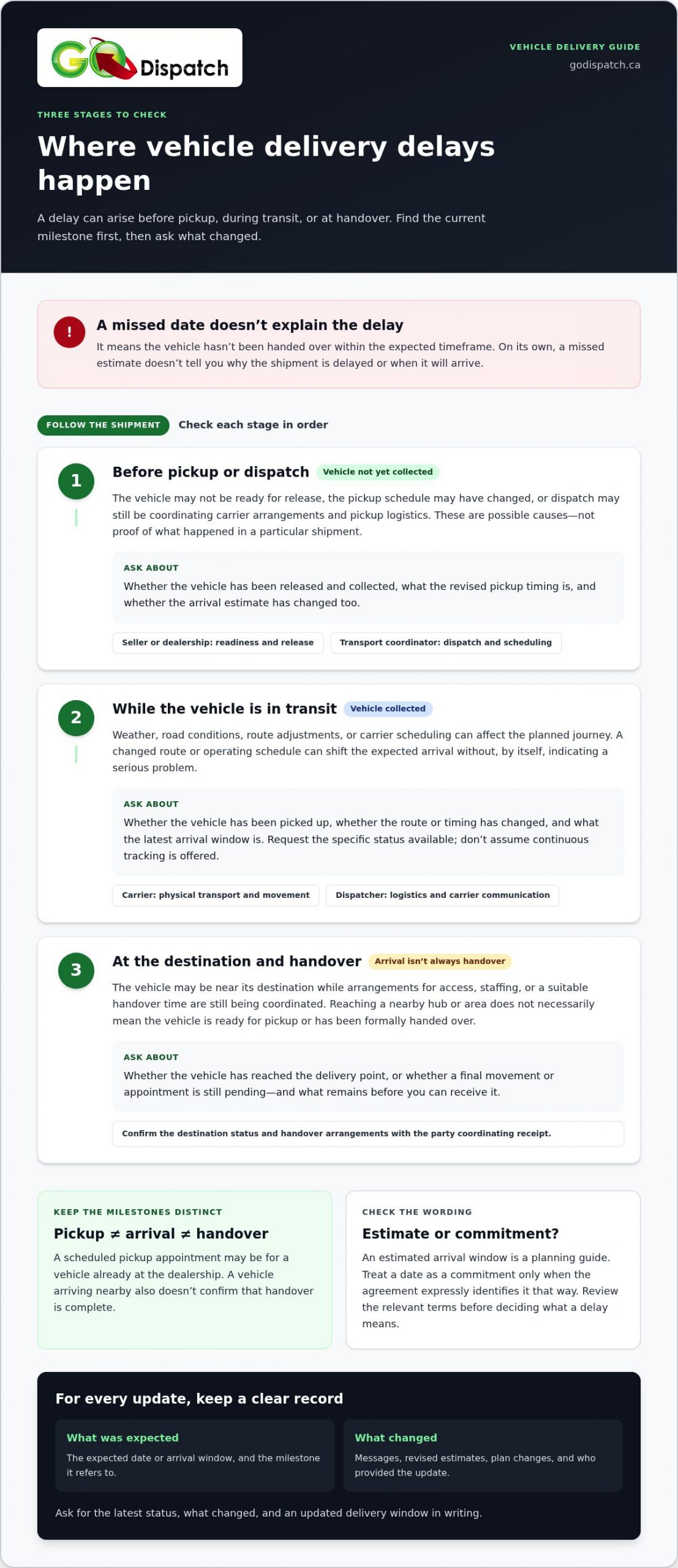
A vehicle delivery is late when the expected date has passed and the vehicle hasn’t been handed over. If you’re asking, “what happens if my vehicle delivery is late,” start with what the missed date tells you: delivery hasn’t happened within the expected timeframe. On its own, it doesn’t explain why the shipment is delayed or when the vehicle will arrive.
First, confirm which milestone you’re tracking. A vehicle transport delivery is the handover at the agreed destination. A dealership delivery may mean the vehicle has arrived at the dealership, while a scheduled pickup appointment is a time to collect a vehicle that may already be there. These are separate events, so a missed pickup appointment doesn’t necessarily mean transport is still underway.
The final stage involves coordinating the vehicle’s arrival and handover at its destination. This is sometimes called the last mile in transportation, the leg between a transport network point and the final destination. A vehicle reaching a nearby hub or area doesn’t necessarily mean it’s ready for pickup or has been formally handed over.
Is a delivery date an estimate or a commitment?
Check the wording in your purchase paperwork or transport agreement. An estimated arrival window gives you a target for planning; an expressly stated commitment uses clearer terms. Don’t assume a date described as “estimated” has the same meaning as one explicitly identified as guaranteed.
A delivery estimate is a planning guide; a guaranteed date is a commitment only when the agreement expressly says so. A missed estimate alone doesn’t establish an automatic right to cancel, receive a refund, or claim compensation. Review the relevant terms before deciding what the delay means for your purchase or transport arrangement.
Which parties may have delivery status information?
The seller or dealership is generally the contact for purchase readiness, vehicle release, and dealership pickup arrangements. A transport coordinator may manage dispatch, scheduling, and communication with the carrier. The carrier physically transports the vehicle and can provide information about its movement and handover. Since each party handles a different part of the process, identify the current stage before seeking an update.
If the vehicle hasn’t been released for pickup, the seller or dealership may have the relevant update. If it has been collected and is travelling, the carrier handles the physical move, while the dispatcher coordinates logistics and carrier communication. If arrival is expected but handover hasn’t happened, ask whether the vehicle has reached the destination and what remains before it can be received.
Keep these roles distinct: a dispatcher coordinates the move, while the carrier does the hauling. That helps you direct your question to the right person rather than treating every late arrival as the same kind of delay.
Why vehicle delivery delays happen during transport
A vehicle move has several stages, and a change at any one of them can shift the expected arrival window. A delay can arise before pickup, during transit, or at handover. The reason may not be clear right away, so separate what’s known from what’s still being checked before assigning blame.
A delayed vehicle transport is different from a dealership delivery or pickup appointment delay. The vehicle may be waiting for release, travelling with a carrier, or near its destination while handover arrangements remain unfinished. If you’re wondering what happens if my vehicle delivery is late, identifying the stage can help explain which part of the schedule may have changed.
Delays before pickup or carrier dispatch
Before transport begins, the vehicle needs to be ready for release and pickup. The seller or dealership may still be completing its part of the handover, or the pickup schedule may need to change. Dispatch timing can also shift while carrier arrangements and pickup logistics are coordinated. These are possibilities, not proof of what caused a particular delay.
If pickup moves, the estimated arrival window may move too. Get the revised pickup information and ask whether the arrival estimate has also changed. Until the responsible party provides an update, avoid assuming the seller, dispatcher, or carrier caused the delay.
Delays while the vehicle is in transit
Once the vehicle has been collected, weather, road conditions, route adjustments, and carrier scheduling can affect the planned journey. Conditions may change after an estimate is first provided. A route change or revised operating schedule can alter the expected arrival without indicating, by itself, that there’s a serious problem.
Ask whether the vehicle has been picked up, whether its planned route or timing has changed, and whether there’s a revised arrival window. An estimate is useful for planning only if it reflects the latest information. Don’t assume continuous tracking is available; request the specific status the transport parties can provide.
Delays at the destination and handover
Arrival near the destination and completed handover aren’t always the same milestone. The receiving location may need to coordinate access, staffing, or a suitable handover time. These arrangements can affect when the vehicle is ready to be received, even if the transport leg is nearly complete.
This final portion is sometimes described as the last mile. If the vehicle appears close but hasn’t been handed over, clarify whether it has reached the delivery point or whether a final movement or appointment is still pending.
Each stage affects the next: a late release can postpone pickup, a shifted pickup can affect transit planning, and an arrival change can require new handover coordination. For businesses planning vehicle moves, vehicle transport dispatch coordination can organize carrier selection, logistics, and delivery scheduling. A dispatcher coordinates the move; the carrier physically transports the vehicle.
What to clarify about a late vehicle delivery
Before deciding what a delay means, establish which stage is incomplete and who can provide that update. A vehicle awaiting release from a dealership is in a different position from one already picked up by a carrier. A dealership appointment change can also affect when you collect the vehicle without indicating that transport is delayed.
Use these questions to pinpoint where the schedule changed:
Purchase readiness: Has the vehicle been prepared and released for transport? Ask the seller or dealership, which can provide purchase and release updates.
Pickup: Has the carrier collected the vehicle, and has the pickup schedule changed? The seller or dealership can confirm release readiness; the transport coordinator can provide dispatch updates.
Transit: Has the vehicle been picked up, and is there a revised arrival window? The carrier handles physical transport, while the transport coordinator manages dispatch and carrier communication.
Final delivery: Has the vehicle reached the agreed destination, or is handover still being arranged? The carrier or transport coordinator may have transport details; the seller, dealership, or receiving contact may know about release or appointment arrangements.
This separates a shipping delay from a change to a retail appointment. If the vehicle hasn’t been released, a carrier’s transit update won’t answer the main question. If it has arrived but your pickup time changed, the issue may be the handover appointment rather than the transport schedule. Contact the party coordinating the outstanding stage and ask for a specific status instead of a general reassurance.
Transport delay or dealership delivery delay?
Start by asking whether the vehicle has been released and picked up. If it’s still at the dealership, ask about readiness or release. If it’s assigned to a carrier but hasn’t been collected, ask about pickup scheduling. If it’s in transit, request the latest transport status and revised arrival estimate from the carrier or coordinator. A postponed dealership appointment is a separate detail to clarify with the seller or dealership.
What the agreement and delivery details can tell you
Review the purchase and transport documents together. Look for the stated delivery date or window, named contacts, how the date is described, and any instructions for delay notifications. An estimated window, a scheduled appointment, and an expressly stated commitment may have different meanings under the agreement. The written wording is more useful than relying on a date repeated verbally.
The agreement also matters if you’re considering what happens if my vehicle delivery is late beyond receiving an update. It sets out any stated process, commitments, or remedies. Don’t assume a delay automatically creates a right to cancel or receive compensation. Consumer protections and contractual outcomes can vary by transaction and province, so another buyer’s experience may not apply to your situation.
For a broader view of the steps involved, the vehicle delivery logistics in Canada guide can help put purchase readiness, dispatch, transit, and handover in context.
What to do when your vehicle delivery is late
A missed delivery date is easier to manage when you replace guesswork with a simple status-check routine. Confirm the original window, find out which stage the vehicle has reached, and keep a written record of each update. This gives you a clearer basis for planning and follow-up.
A practical status-check sequence
- Confirm the expected date. Check the purchase or transport agreement for the original delivery window. Note whether it refers to arrival, completed handover, or a dealership pickup appointment.
- Identify the current stage. Find out whether the vehicle is awaiting release, has been picked up, is in transit, or has reached the destination. If pickup hasn’t happened, ask about release and pickup scheduling before seeking a transit update.
- Request the latest confirmed status. Contact the party coordinating that stage. Ask what has happened, what remains, and whether the expected window has changed. Request the updated information in writing, such as by email or message.
- Set a follow-up point. Ask when to check back if there’s no further update, or what event will trigger the next update. Treat this as a time to follow up, not as a promised delivery time.
Keep your questions focused. “Has the vehicle been picked up?” is more useful than “Where is it?” if dispatch hasn’t confirmed collection. Once it’s in transit, ask for the latest confirmed status and revised arrival estimate. If an update is still being checked, record that too rather than treating an unconfirmed estimate as final.
Keep a clear record and manage the handover
Keep the key details together so you can track changes and share accurate information with anyone relying on the vehicle. Include:
- The purchase or transport agreement and original delivery window.
- Pickup and dispatch details, if provided.
- Messages, call notes, and the date and time of each update.
- Any revised estimate, plus the name or role of the person who supplied it.
- Follow-up points and any confirmed changes to the handover arrangements.
If a dealership, receiving location, or fleet team is planning around the arrival, pass along confirmed changes promptly. This can help them adjust staffing, appointments, or vehicle allocation without relying on an outdated estimate. Remember that a follow-up date tells you when to seek another update, not when the vehicle will arrive.
At handover, follow the applicable delivery process and document the vehicle’s condition as directed. Note any concerns through the process used for the transfer, and keep a copy of the relevant delivery record with your other transport documents.
For a broader vehicle move, professional vehicle delivery logistics can include dispatch coordination for carrier selection, transport logistics, and delivery scheduling. GO DISPATCH coordinates third-party carriers; the carrier physically transports the vehicle.
How dispatch coordination can help keep a vehicle move organized
A vehicle move involves more than the trip itself. Carrier selection, pickup arrangements, transport logistics, delivery scheduling, and handover all need to connect. For a business managing purchases, transfers, or fleet changes, coordinating each detail separately can add administrative work and make it harder to see which stage needs attention.
GO DISPATCH provides one-stop vehicle transport dispatching for Canadian businesses. It coordinates third-party carriers and manages transport logistics and delivery scheduling for cars, trucks, SUVs, and vans. This helps organize the moving parts and clarify the planned steps. Dispatch doesn’t operate the carrier or physically haul the vehicle.
What a vehicle transport dispatch service coordinates
Dispatch coordination brings the planning together. It can involve organizing carrier selection, arranging pickup and delivery schedules, and managing the logistics that connect the origin, carrier, and destination. The carrier is responsible for physically transporting the vehicle; the dispatcher coordinates the move around that transport.
For a business, managing these logistics through one coordination process can reduce the need to organize each detail independently. It can also make it easier to understand what is scheduled and which part of a move may need an update. A dispatcher can support communication and scheduling, but that doesn’t promise a delay will be resolved or a specific arrival date will be met.
Planning the next vehicle move with GO DISPATCH
Planning starts with clear information about the move: the vehicle type, pickup and delivery requirements, and the timing the business is working toward. These details help organize carrier coordination and delivery scheduling. For multiple vehicle moves, a central dispatch process can help keep separate arrangements organized instead of treating each update as an isolated task.
This approach can support moves involving a car, truck, SUV, or van. GO DISPATCH coordinates third-party carriers across Canada and manages the logistics behind business vehicle transport. The carrier physically moves the vehicle. Dispatch coordination helps organize the process, not guarantee when transport or handover will be completed.
If you’re asking what happens if my vehicle delivery is late, organized dispatch can make transport stages and scheduling easier to follow. For a planned business move, vehicle transport coordination with GO DISPATCH brings carrier coordination, logistics, and delivery scheduling together.
Make your next vehicle move easier to plan
A late arrival can disrupt plans, but it can also show where clearer coordination would help on the next move. If you’re still weighing what happens if my vehicle delivery is late, focus on turning uncertainty into a practical plan: set expectations around the delivery window, keep updates connected, and make sure everyone involved knows who is coordinating each stage.
For Canadian businesses, GO DISPATCH manages transport logistics and delivery scheduling while coordinating third-party carriers. The carrier handles the physical transport; dispatch coordination helps keep the moving parts organized. This can give your team more time to prepare for what comes next instead of tracking separate arrangements.
Discuss your next vehicle move with GO DISPATCH and take a clear first step toward organizing the transport. Share your vehicle and delivery requirements to start planning coordination around your operation.
Frequently Asked Questions
Is a late vehicle delivery always a sign that something has gone wrong?
No. A missed date may mean the original estimate needs updating, not that the vehicle is lost or the purchase has fallen through. If you’re wondering what happens if my vehicle delivery is late, first establish whether the vehicle is awaiting release, has been collected, or is ready for handover. A delay is a reason to seek a clear update, but it doesn’t confirm a particular problem or outcome.
Can bad weather delay a vehicle delivery across Canada?
Yes. Snow, freezing rain, heavy rain, strong winds, or other difficult conditions can affect road travel and transport scheduling. Conditions can differ along a long route, so the weather at the destination may not reflect what a carrier encounters en route. Ask whether weather has affected the vehicle’s schedule and whether the delivery estimate has changed. Don’t assume weather is the cause unless the transport contact confirms it.
Can I refuse a vehicle if it arrives later than the expected date?
A late arrival alone doesn’t necessarily mean you can refuse the vehicle or cancel the purchase. Your options may depend on the purchase and transport agreements, the wording of the delivery commitment, and consumer protections that apply to your transaction and province. Before declining handover, review the relevant terms and get instructions from the seller or dealership in writing. Keep the transport arrangement separate from the vehicle purchase where the agreements treat them separately.
Can I claim rental car expenses because my vehicle delivery is late?
Rental expenses aren’t automatically reimbursed just because delivery is late. Whether you can recover them may depend on the agreement and the rules that apply to your transaction. Keep rental agreements, receipts, dates, and written delivery updates together, and note how the rental period relates to the delay. Review the contract’s process for raising a claim, and send your request to the party responsible under the relevant agreement.
How long can a vehicle delivery be delayed?
There isn’t one standard delay length that applies to every vehicle shipment. Revised timing can depend on when the vehicle is released, the route, transport conditions, and handover arrangements. Ask for the latest estimate and what information it’s based on, then check the agreement for any stated delay-notification process. If the estimate changes again, record the change and ask when another status update is expected.
Can I track my vehicle while it is being transported?
Tracking options vary by transport arrangement. Some updates may confirm key milestones, such as pickup or arrival, without providing a live map of the vehicle’s location. Ask the transport contact what status information is available and how updates are shared. A confirmed pickup time and the next expected update may help you plan even if continuous GPS tracking isn’t provided.
Does a late vehicle delivery automatically qualify for compensation?
No. A late delivery doesn’t automatically entitle you to compensation. The relevant purchase or transport agreement may explain what counts as a commitment and whether it describes a process for addressing delays or losses. Applicable consumer protections can also depend on the transaction and province. Keep records of the missed date, revised estimates, and any expenses, then review the agreement before deciding whether to submit a claim.