

The transport quote isn’t the whole payment plan. A deposit, an unclear due date, or uncertainty about who receives payment can disrupt a vehicle movement and your business workflow. Reviewing vehicle transport deposit and payment policies before booking helps clarify what is due, when it is due, and how to document each payment.
It’s reasonable to want clear answers before authorizing a shipment, especially when a carrier hasn’t yet been assigned or transport hasn’t started. Payment schedules vary, so compare more than the total: check what’s due at booking, what’s payable later, who collects each amount, and what the written terms say about changes or cancellations.
This guide explains the payment milestones to review, how to compare transport quotes consistently, and which details to document before approving a booking. It also covers how dispatch coordination fits into the paperwork and payment flow. With clear written terms, dealerships and fleet teams can plan vehicle transport alongside their approvals and invoicing, with fewer billing surprises.
Key Takeaways
- Learn what a deposit covers and how dispatch or brokerage fees differ from carrier charges.
- Use a clear booking-to-delivery sequence to map payment milestones without assuming every transport arrangement follows the same schedule.
- Compare vehicle transport deposit and payment policies by checking the payment recipient, balance trigger, documentation, and cancellation wording.
- Apply a practical checklist to align vehicle count, route, quoted services, due dates, and records before and after transport.
- See how GO DISPATCH coordinates third-party carriers and transport logistics for cars, trucks, SUVs, and vans.
Vehicle transport deposits and payments: what the terms actually cover
A transport quote gives you a price to review. The payment terms explain who pays whom, when money is due, and what each payment covers. Clear vehicle transport deposit and payment policies help prevent a booking payment from being mistaken for proof that a vehicle has been picked up or delivered.
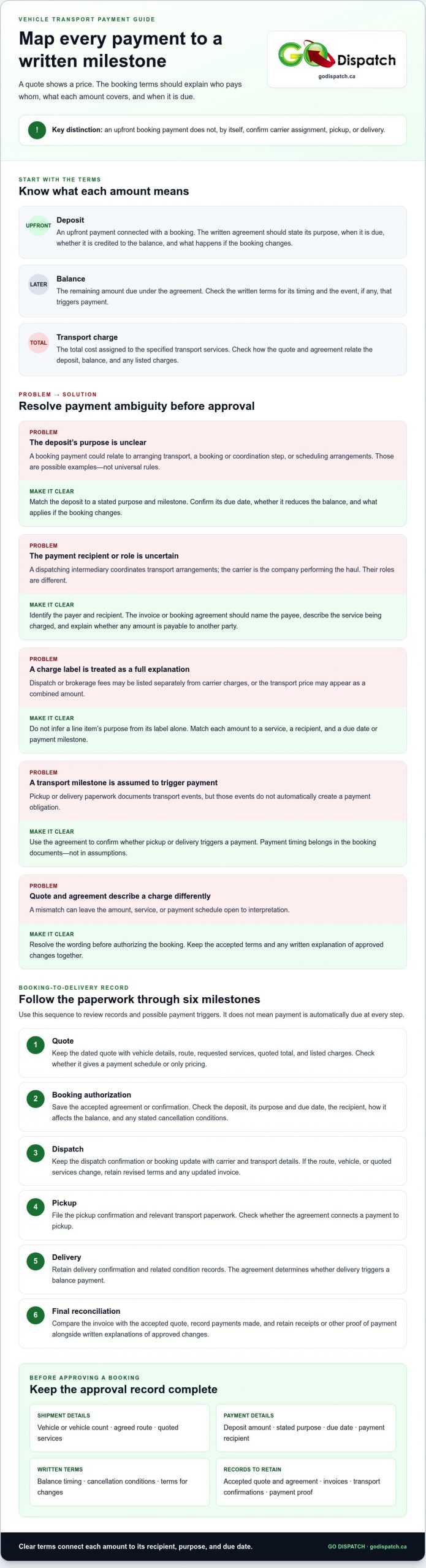
A deposit is an upfront payment connected with a booking. Its purpose depends on the written agreement. It might be applied toward the total transport charge, cover a booking or coordination step, or relate to scheduling arrangements. These are possible examples, not universal rules. The agreement should state whether the deposit is credited to the balance, when it is due, and what happens if the booking changes.
In short: a deposit is an upfront booking payment, the balance is the remaining amount due under the agreement, and the transport charge is the total cost assigned to the specified transport services. The terms should show how these amounts relate, rather than leaving you to infer the payment schedule from a quote.
What a vehicle transport deposit may represent
Before authorizing a payment, match it to a stated purpose and milestone. For example, a booking document might connect an upfront payment with arranging transport, while the remaining amount is tied to a later event. The details vary by transaction. An upfront payment alone doesn’t confirm that a carrier has been assigned, that pickup has occurred, or that delivery is complete. Use the written booking terms to understand what the payment triggers and what remains outstanding.
This matters for dealerships and fleet teams coordinating approvals. Record the vehicle or vehicle count, the agreed route, the services included, the deposit amount, the due date, and the person or business receiving payment. If a quote and agreement describe the same charge differently, resolve the wording before authorizing the booking.
Who may receive payment during a transport booking
A dispatching intermediary coordinates transport arrangements, while the carrier is the company performing the haul. An auto transport broker can help arrange the connection between a customer and a carrier. That coordination role is different from physically transporting the vehicle. The payment documents should make the parties and their roles easy to identify.
Depending on the agreement, dispatch or brokerage fees may be shown separately from carrier charges, or the transport price may be presented as a combined amount. Don’t assume a line item’s purpose from its label alone. The invoice or booking agreement should name the payment recipient, describe the service being charged, and explain whether any amount is payable to another party.
- Payer: Identify the person or business responsible for payment.
- Recipient: Match the payee on payment instructions to the agreement or invoice.
- Purpose and timing: Connect each amount to a service and a clear due date or milestone.
Keeping these details together gives your accounts team a useful record from authorization through reconciliation. It also makes it easier to compare quotes on more than the headline total, without assuming every dispatch arrangement uses the same payment structure.
How vehicle transport payment milestones can be structured
Payment dates should follow the written booking terms, not assumptions about what usually happens at a particular stage. Use the sequence below as a framework for reviewing records and possible payment triggers. It does not mean payment is automatically due at every milestone.
Payment timing belongs in booking documents so the payer, recipient, amount, and triggering event are clear before transport moves ahead. Use the documents to map each step:
- Quote: Keep the dated quote showing the vehicle details, route, requested services, quoted total, and any listed charges. Check whether it describes a payment schedule or simply provides pricing.
- Booking authorization: Save the accepted agreement or booking confirmation. It should identify any deposit, its purpose and due date, the payment recipient, how it affects the remaining balance, and any stated cancellation conditions.
- Dispatch: Keep the dispatch confirmation or booking update with the carrier and transport details. If the route, vehicle, or quoted services change, retain the revised terms and any updated invoice.
- Pickup: File the pickup confirmation and relevant transport paperwork. Check whether the agreement connects a payment to pickup, rather than assuming this milestone creates a payment obligation.
- Delivery: Retain delivery confirmation and any related condition records. These help document completion of the haul, but the agreement determines whether delivery triggers a balance payment.
- Final reconciliation: Compare the invoice with the accepted quote and record payments made. Keep receipts or other proof of payment, along with written explanations of any approved changes.
What to review before authorizing a deposit
Start with the shipment itself: confirm the vehicle details, vehicle count, route, and quoted services match what your team approved. Then compare the written terms with the invoice. Check the deposit’s purpose, recipient, due date, balance timing, and any stated cancellation conditions. If a document is silent or uses different wording, pause payment approval until the records clearly describe the same transaction.
For dealership and fleet workflows, save the approved quote and agreement with the internal authorization. That gives accounts payable a clear reference for matching the charge, while dispatch staff can use the same booking details to track the movement.
What delivery documents can clarify the final balance
Delivery confirmation supports the record that the vehicle reached its destination. A bill of lading is a transport record that can document shipment details and condition observations. It doesn’t, by itself, set payment terms. Keep it distinct from the invoice, which states the amount charged, and the receipt or payment confirmation, which records money received.
At reconciliation, match the delivered vehicle and shipment paperwork to the booking, then compare the invoice against the agreed charges and any documented changes. This makes discrepancies easier to identify without treating delivery evidence as proof that an invoice has been paid.
Clear vehicle transport deposit and payment policies make each milestone easier to track. For a coordinated booking involving cars, trucks, SUVs, or vans, GO DISPATCH vehicle transport coordination connects clients with third-party carriers and manages transport logistics.
Compare vehicle transport payment policies without relying on a headline deposit
A small deposit can look attractive, but it doesn’t show the full amount due, who receives each payment, or when the remaining balance becomes payable. Compare the complete written schedule instead. For vehicle transport deposit and payment policies, use the same criteria across quotes so your team can see how each structure affects cash flow, approvals, and shipment records.
The table is a comparison framework, not a statement that any one schedule is standard across Canadian vehicle transport. Exact obligations depend on the booking agreement and the transaction.
| Payment structure | Deposit timing and recipient | Balance trigger | Documents and cancellation wording |
|---|---|---|---|
| Upfront deposit | A booking payment is due at the point stated in the agreement. Identify the named recipient. | Check when the remaining amount is due and how the deposit is applied. | Match the accepted quote, agreement, invoice, and written cancellation conditions. |
| Staged payment | Payments are divided across specified booking or transport milestones. Each due date and recipient should be stated. | Confirm the event that triggers every instalment and the final balance. | Keep the milestone schedule and any revised invoices or booking terms together. |
| Payment at delivery | The agreement states whether an upfront payment is required or payment is deferred. | Check whether delivery triggers the balance, and who receives it. | Retain the agreement, delivery records, invoice, and any cancellation wording. |
Upfront, staged, and delivery-linked payment approaches
An upfront deposit can require funds before dispatch, which affects approval timing and cash flow. Staged payments spread out due dates, but create more checkpoints for accounts payable to manage. A delivery-linked balance may align payment with the completed haul, while still requiring a clear plan for the recipient and payment process. None is automatically best for every shipment. Compare the timing against your internal approvals and the written terms, not an assumed industry-wide practice.
Separate transport charges, dispatch fees, and applicable taxes
Review what the quoted total covers. A quote may show transport charges and dispatch or brokerage services separately, or present a combined price. The documents should identify included services and any additional charges clearly. GST/HST treatment can depend on the transaction, so review how applicable taxes appear on the quote or invoice and follow your organization’s accounting process rather than assuming the tax treatment.
Transport pricing can also reflect shipment details and service requirements. The 2026 Canadian vehicle transport cost guide outlines cost factors to consider alongside payment terms. Dealership teams coordinating recurring vehicle movements can also explore dealership auto transport logistics as they organize dispatch and payment workflows.
A practical checklist for reviewing vehicle transport payment terms
A quick review before approval can prevent payment records from becoming detached from the vehicles they’re meant to cover. Apply this checklist at three points: before booking, as dispatch details are confirmed, and after delivery. For a dealership or fleet, consistent records also help different teams track approvals, shipment progress, invoices, and receipts without relying on memory.
Written payment terms should identify the amount, the recipient, and the event or date that triggers payment. Keep that reminder close when reviewing vehicle transport deposit and payment policies.
Questions the written booking terms should answer
Before approving a booking, compare the quote, agreement, and invoice. They should describe the same shipment and clearly explain the payment arrangement. Check for:
- Shipment details: Confirm the vehicle count, vehicle descriptions, route, and quoted services match the planned movement.
- Payment breakdown: Identify what each charge covers, who receives each payment, and whether dispatch or brokerage services are itemized separately from transport charges.
- Payment schedule: Locate any deposit amount and purpose, remaining balance, due dates, and the event that triggers each payment.
- Changes and cancellations: Find the written cancellation and rescheduling language, plus instructions for documenting revised vehicle details, route changes, or additional charges.
- Approval record: Save the version of the quote and terms your team approved, with the approval date and relevant shipment reference.
If the documents use different descriptions or show conflicting amounts, don’t treat them as interchangeable. Keep the discrepancy visible in the approval record so the final invoice can be matched against the terms your business authorized.
Keep payment records aligned with vehicle movement
Once dispatch details are available, link the shipment reference to the quote, agreement, invoice, and internal payment approval. Record dispatch, pickup, and delivery updates in the same file or accounting workflow. For multiple vehicles, use a vehicle list or other clear identifier so a payment can be matched to the right units, rather than only to a broad transport booking.
After delivery, file the delivery confirmation and transport paperwork alongside the invoice. Keep the receipt or payment confirmation separate from delivery evidence: one documents the movement, the other records payment. If the shipment or charges changed, retain the revised document and approval so your reconciliation trail shows what changed and why. This broader coordination process is covered in the national vehicle delivery logistics guide.
A simple, consistent filing process makes vehicle movements easier to reconcile across operations and accounting. Coordinate your vehicle transport booking with GO DISPATCH for cars, trucks, SUVs, and vans.
How GO DISPATCH coordinates vehicle transport bookings and next steps
GO DISPATCH coordinates vehicle transport across Canada by connecting clients with third-party auto carriers and organizing transport logistics. The carrier performs the physical haul. GO DISPATCH brings the booking details, carrier arrangements, and delivery scheduling together in a coordinated process for cars, trucks, SUVs, and vans.
For dealerships and fleet teams, that distinction helps clarify which documents relate to dispatch coordination and which relate to the carrier’s transport work. Clear shipment details and written booking terms give everyone a shared reference. They also help your team route approvals and payment records to the right people without assuming that one party performs every part of the service.
Where dispatch coordination fits into the payment process
Dispatch coordination supports the arrangement of transport, but it isn’t the same as carrying a vehicle. Your booking paperwork should describe the agreed services and identify the relevant payment recipient and terms. This is especially useful when dispatch or brokerage services and carrier charges appear as separate items. Treat the written agreement and invoice as the records for the transaction, and avoid inferring deposit amounts, collection timing, payment methods, or refund conditions from the coordination process itself.
Accurate details help the booking move forward in an organized way. A complete vehicle list, route, and service description gives the transport arrangement a clear starting point. If those details change, keep the revised information connected to the booking record so operations and accounts teams are working from the same version. This makes it easier to match transport updates with the documents used for approval and reconciliation.
Prepare the details for a vehicle transport enquiry
A little preparation helps make the initial discussion practical. Gather the details that describe the movement and identify who will manage the business approval process. Include:
- Vehicle information: Type, quantity, and any details needed to distinguish each car, truck, SUV, or van.
- Movement plan: Origin, destination, and preferred timing for the transport.
- Business contacts: The person coordinating the booking and the contact responsible for approvals, invoices, or payment records.
- Documentation needs: Any internal reference number or record your dealership or fleet team uses to track the shipment.
With these details organized, GO DISPATCH can coordinate the transport arrangement with third-party carriers and manage logistics around the shipment. Keep your vehicle transport deposit and payment policies in view as you review the booking documents, so the payment process remains connected to the movement and your organization’s approval workflow.
Ready to plan a vehicle movement? Discuss your vehicle transport requirements with GO DISPATCH and share the shipment details your team has prepared.
Make your next vehicle movement easier to plan
Before your next booking, bring your operations and finance teams onto the same page. Decide who approves the shipment, who tracks payment records, and where the final documents will be stored. That simple handoff helps your team apply vehicle transport deposit and payment policies consistently, even as transport needs change.
GO DISPATCH coordinates third-party auto carriers across Canada and manages logistics for cars, trucks, SUVs, and vans. Share your shipment details and booking requirements to start a clear conversation about the transport arrangement. Discuss your vehicle transport requirements with GO DISPATCH. A well-organized next step can make the booking process feel far more manageable.
Frequently Asked Questions
Is a vehicle transport deposit refundable if I cancel?
It depends on the written booking terms and when the cancellation happens. There isn’t one refund rule that applies to every vehicle transport transaction. Before paying, look for the agreement’s cancellation, rescheduling, and refund wording, and save the version you accepted. If you need to cancel, notify the named booking contact in writing and keep their response with your records. Don’t assume a deposit is refundable or non-refundable based on its label alone.
Can I pay the carrier directly for vehicle transport?
Only if the booking arrangement says the carrier is the payment recipient. A dispatching company may coordinate a third-party carrier, and the payment instructions can name the dispatch intermediary, the carrier, or specify separate recipients for different charges. Check the invoice and agreement before sending funds. For a dealership shipment, record each payee against the relevant vehicle or shipment reference so your accounts team can match payments correctly.
What payment methods are commonly used for vehicle transport in Canada?
Payment methods vary by transport company and agreement. Cash, cashier’s cheque, and money order may be used for payment at delivery, while some companies accept credit cards and may charge a processing fee. Don’t assume a method is accepted just because it’s common elsewhere. Check the written payment instructions for the specific booking, including the required payee and any applicable fee, before arranging funds or authorizing a card payment.
Does paying a deposit guarantee a specific pickup date?
No. A deposit confirms only what the booking agreement says it confirms. It doesn’t automatically guarantee a particular pickup date. Review the booking documents for the pickup window, whether dates are estimates or commitments, and how schedule updates will be communicated. For inventory planning, avoid treating an estimated pickup as a confirmed arrival or sale date. Share any timing constraints early and keep revised scheduling notices with the shipment record.
Should I receive an invoice or receipt for a vehicle transport deposit?
Keep an invoice or written payment request that identifies the booking and amount, then obtain a receipt or payment confirmation after funds are sent. These records serve different purposes: an invoice requests payment, while a receipt helps show it was made. For a fleet shipment, include the booking reference and vehicle list in your filing system. If payment is approved internally before the invoice arrives, retain that approval separately.
Can a dealership arrange one payment process for multiple vehicles?
Yes, a dealership can use one internal approval workflow to track multiple vehicles, even if invoices or payment requests are issued separately. Set up a shared shipment reference and vehicle list, then record each charge, recipient, due date, and payment status against it. This makes it easier to catch a duplicate charge or a missing vehicle record. Don’t assume one invoice covers every unit unless the booking documents show that arrangement.
What should I do if an invoice differs from the written transport quote?
Pause payment approval and compare the documents line by line. Check whether the vehicle count, route, requested services, and shipment reference match, then look for a revised quote or written approval covering the difference. Keep a written explanation for any unmatched charge with the booking file. The keyword is reconciliation: the final record should show which terms your business approved and why the invoice changed.