
In the high-stakes world of Canadian logistics, a “guaranteed” delivery date is often just a polite suggestion if you haven’t mastered the scheduling process. You know the frustration of watching a delivery window vanish because of a sudden blizzard in the Rockies or a carrier delay you didn’t see coming. Managing inventory becomes a secondary task when you’re buried under the administrative weight of coordinating multiple carriers and chasing down updates that never arrive. It’s time to move past the guesswork.
We understand that unpredictable timelines aren’t just an inconvenience; they’re a threat to your bottom line. This guide helps you master the complexities of domestic transport by identifying the specific factors affecting vehicle shipping times Canada presents in 2026. You’ll learn how to implement expert scheduling strategies that turn chaotic dispatching into a predictable, repeatable process. We’re going to break down current transit estimates across every province, explain how to navigate the latest trade surtaxes, and provide a roadmap for reducing lead times so you can regain your peace of mind.
Key Takeaways
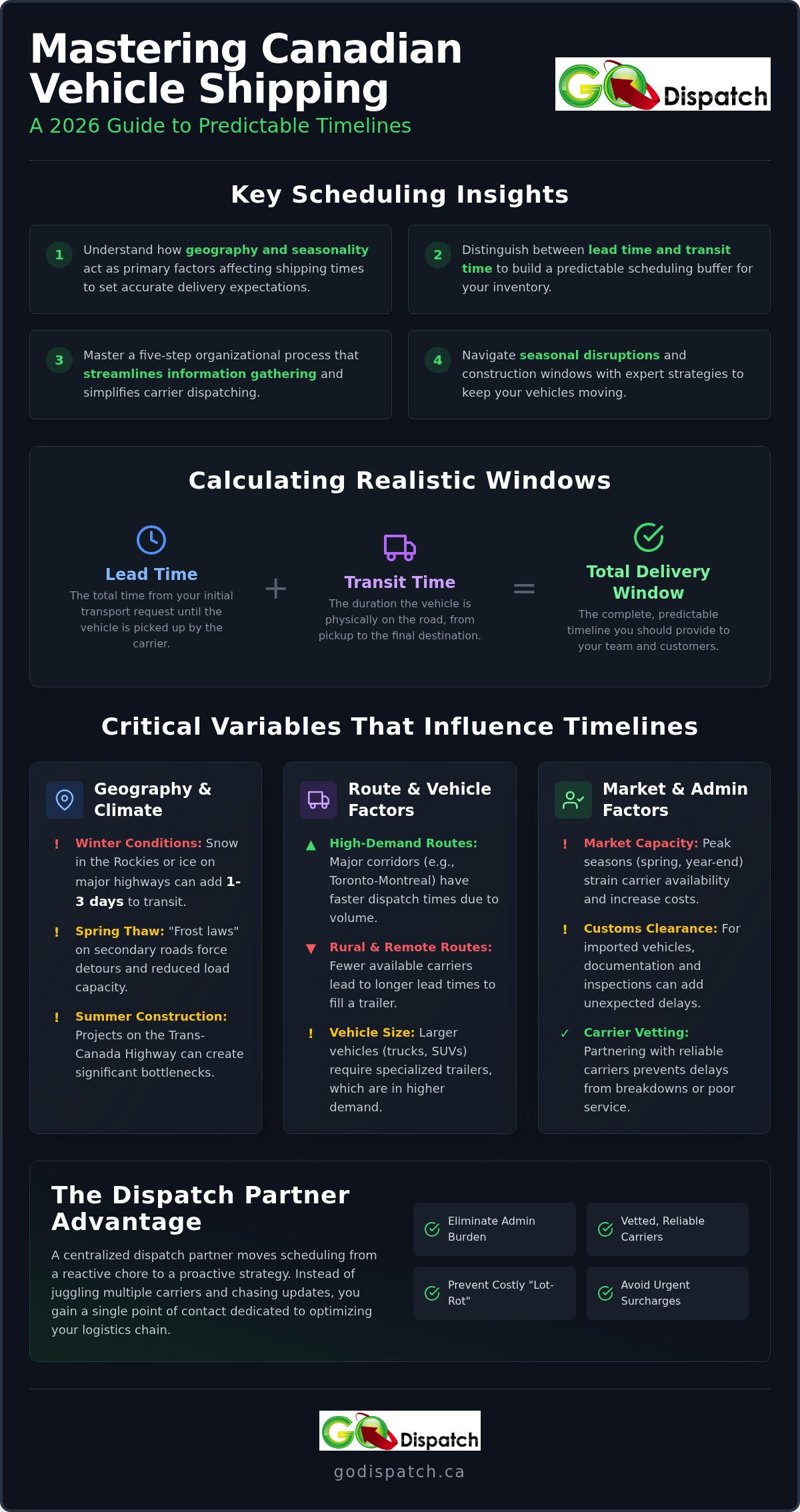
- Understand how geography and seasonality act as primary factors affecting vehicle shipping times canada to set accurate delivery expectations.
- Distinguish between lead time and transit time to build a predictable scheduling buffer for your inventory.
- Master a five-step organizational process that streamlines information gathering and simplifies carrier dispatching.
- Navigate seasonal disruptions and construction windows with expert strategies that keep your vehicles moving year-round.
- Leverage a one-stop dispatching partner to eliminate the administrative burden of managing multiple third-party carriers.
The Fundamentals of Vehicle Delivery Scheduling in Canada
Vehicle delivery scheduling is more than picking a date on a calendar. It’s the strategic coordination of carrier capacity and your specific business timelines. In a country as vast as Canada, this coordination is the difference between a smooth transition and a logistical nightmare. Unlike smaller markets where routes are dense and short, Canadian geography introduces unique challenges. Moving a fleet from one end of the country to the other involves traversing vast distances, diverse terrains, and multiple time zones. This complexity makes it essential to understand the various factors affecting vehicle shipping times canada before you book your first load. A single severe weather event or a major road closure can ripple through your entire timeline if you haven’t planned for it.
Many businesses treat transport as a reactive, on-demand task. They wait until a vehicle is sold or a lot is full before looking for a trailer. This reactive approach leads to higher costs and unpredictable arrivals. When you treat scheduling as the first vital link in your logistics chain, you gain control over your inventory flow. Professional scheduling turns transportation from a source of stress into a predictable business asset that keeps your operations running smoothly.
Why Professional Scheduling is a Business Necessity
Effective scheduling prevents lot-rot. This occurs when inventory sits idle, losing value and taking up space while waiting for a carrier. By organizing your transport in advance, you ensure vehicles move quickly between locations. This efficiency directly improves customer satisfaction. Your clients expect accurate delivery estimates, not excuses about carrier delays. Organized scheduling also protects your bottom line. It eliminates the need for urgent shipping surcharges that often apply to last-minute bookings during peak seasons.
The Role of a Dispatch Service in the Scheduling Process
A dispatch service acts as the strategic centre between your business and the professional carrier. While the industry often uses the term auto transport brokers, the role is focused on high-capacity coordination. GO DISPATCH vets carriers for schedule reliability and safety records. We don’t just look for the lowest price; we look for the best fit for your specific timeline. This management removes the heavy administrative burden from your team. You stop chasing drivers and start focusing on your core operations. We handle the vetting, the dispatching, and the follow-up so your inventory moves on time, every time.
Critical Variables That Influence Your Transport Timeline
Canadian logistics is a dance with the elements. In 2026, the primary factors affecting vehicle shipping times canada often come down to infrastructure and timing. For instance, the summer construction window on the Trans-Canada Highway is a double-edged sword. While these projects improve long-term transit, they create immediate bottlenecks that add hours or even days to a trip. Route demand also plays a massive role. High-demand lanes like Toronto to Montreal move faster than rural routes because carriers can fill their trailers more quickly, leading to faster dispatch times for your inventory.
Vehicle size is another essential variable. Size matters when you’re trying to fit into a tight schedule. Transporting a compact car is simpler than moving heavy-duty trucks, SUVs, or vans. Larger vehicles require specific trailer configurations and may face height or weight restrictions on certain secondary bridges. These physical constraints affect how quickly a carrier can be dispatched to your location, as specialized equipment is often in higher demand across the country.
Navigating the Canadian Climate and Geography
Winter is the most obvious variable in our national logistics chain. Snow in the Rockies or ice on the Coquihalla Highway can immediately add one to three days to a transit window. Beyond the cold, the spring thaw introduces weight restrictions on secondary roads. These “frost laws” limit the weight carriers can haul, often forcing drivers to take longer routes or reduce their load capacity to stay compliant. If you’re shipping to northern or remote regions, these geographic hurdles become even more pronounced. Understanding Canadian vehicle import regulations is also vital if your inventory originates outside the country, as customs documentation and inspections are common variables that can shift a national scheduling window without warning.
Market Capacity and Carrier Availability
Market demand shifts with the seasons, impacting how many trailers are on the road. Spring moves and year-end dealer trades create peak periods where carrier space is at a premium. During these times, securing a spot on a trailer requires more lead time. Smart logistics managers leverage back-haul routes to stay ahead. These are return trips where carriers have empty space after a primary delivery. Booking a back-haul is often more efficient and ensures your inventory moves without waiting for a full outbound load. Fuel prices in 2026 also influence route frequency. With the temporary suspension of federal fuel excise taxes in effect throughout the year, carriers are currently optimizing routes to maintain high efficiency. If you need a reliable dispatch partner to navigate these shifting capacity levels, professional coordination is your best tool for staying on schedule.
Lead Time vs. Transit Time: Calculating Realistic Windows
Understanding the difference between lead time and transit time is the first step toward a predictable schedule. Lead time is the period from the moment you book your shipment to the moment the carrier arrives at the pickup point. Transit time is the actual duration the vehicle spends on the trailer moving toward its destination. While many focus on the road time, your business depends on total delivery time. This is the only metric that truly matters for your bottom line. It’s the sum of the wait and the move.
When you calculate your windows, you must account for the specific factors affecting vehicle shipping times canada during high-risk seasons. For instance, winter conditions or spring weight restrictions require a scheduling buffer. We recommend padding your schedule by at least two to four days for cross-country moves during the shoulder seasons. This ensures that a minor delay at a mountain pass doesn’t derail your entire inventory relocation plan. Planning for these buffers creates a stress-free environment for your team and your customers.
The Scheduling Gap and How to Close It
The “scheduling gap” is the often-overlooked wait time between booking and pickup. Common causes for these delays include documentation errors or the vehicle not being ready when the driver arrives. Professional dispatchers close this gap by vetting carriers for their immediate capacity and prioritizing loads based on your specific deadline. In the carrier market, there is a direct relationship between price and scheduling priority. If your timeline is rigid, investing in a higher priority slot ensures a faster dispatch. We manage these carrier relationships so you don’t have to chase updates or negotiate priority levels yourself.
Standard vs. Express Scheduling Options
Standard hauling is the most cost-effective choice for routine inventory management. It relies on multi-vehicle trailers and established routes to keep costs low. This is ideal for dealerships moving bulk inventory where the exact hour of arrival is flexible. Express delivery, however, is built for speed. This often involves dedicated trailers or team drivers who can keep the truck moving almost 24 hours a day. It’s vital to set realistic expectations for express service. Even with team drivers, Canada’s massive scale means a trip from Toronto to Vancouver still takes several days. Express doesn’t change the geography; it simply removes the downtime usually found in standard routes.
A 5-Step Guide to Organizing Your Vehicle Delivery Schedule
Efficiency in Canadian logistics doesn’t happen by accident. It’s the result of a methodical approach that accounts for the various factors affecting vehicle shipping times canada. When you follow a structured process, you move from reactive fire-fighting to proactive inventory management. This five-step guide provides a repeatable framework to ensure your vehicles move on time, every time, regardless of the route or season.
Step 1 & 2: Setting the Foundation
The first step is moving beyond basic details like a VIN and a city name. For trucks and SUVs, precise dimensions are critical for organizing trailer space. Carriers need to know the exact height and length of larger vehicles to maximize their load efficiency and avoid height-clearance issues on secondary routes. Providing these details upfront prevents last-minute trailer rejections that can derail your entire schedule.
Step two involves defining your scheduling window. You must balance your ready date with your desired arrival date while considering your staff’s availability. Choose a ready date when someone is physically present to perform the initial inspection and sign off on the handover. This alignment ensures the carrier isn’t waiting on-site, which can lead to detention fees or missed pickup windows. To refine your strategy further, you can learn more about vehicle delivery logistics in Canada to see how these timelines fit into a broader national plan.
Step 3 to 5: Executing the Move
Once the foundation is set, the focus shifts to execution. Step three is carrier sourcing. We leverage a national dispatch network to find the best fit for your specific route. We vet carriers for their safety records and their historical reliability on specific corridors, such as the mountain passes of BC or the long stretches of the Prairies. This vetting process ensures your inventory is in professional hands.
Step four is pre-transport preparation. This is where the Bill of Lading (BOL) becomes your most important tool. The BOL serves as the official record of the vehicle’s condition at pickup and is the primary document used for scheduling and delivery coordination. Ensure it’s filled out accurately to avoid administrative delays at the destination. Finally, step five is the communication loop. Maintaining a clear line of sight on the delivery status allows you to manage the last-mile handover smoothly. When you’re ready to simplify this process, you can start your dispatch request today and let our experts handle the coordination for you.
Streamline Your National Logistics with GO DISPATCH
Managing a national fleet requires a partner who understands the ground-level reality of Canadian transport. GO DISPATCH acts as your high-capacity facilitator, bridging the gap between your inventory needs and the best available carriers. We specialize in the strategic relocation of cars, trucks, SUVs, and vans across every province. By centralizing your dispatching, you eliminate the need to manage dozens of individual carrier relationships yourself. We provide the professional confidence you need to move inventory without the administrative headache. Our goal is simple: we handle the logistics so you can focus on your core business.
The complexities of the industry mean that factors affecting vehicle shipping times canada are always shifting. Whether it’s a sudden change in market capacity or a seasonal weather event, you need a partner who stays ahead of the curve. We take pride in being a proactive problem-solver. We monitor the logistics chain in real-time, allowing us to adjust schedules and select carriers based on current performance data. This one-stop advantage ensures a streamlined, all-encompassing process that requires minimal effort from your team. You get peace of mind knowing a professional is handling the dispatching from start to finish.
Our National Reach and Carrier Network
Our strength lies in our extensive network of vetted third-party carriers. We don’t just find a driver; we find the right driver for your specific route. This is especially vital during peak seasons when trailer space is at a premium. While individual carriers may have limited availability, our dispatch service sources capacity from a broad pool of professionals. This allows us to secure priority scheduling even when demand is high. Our deep industry relationships give us the leverage needed to keep your inventory moving while others are stuck waiting for a spot. You can explore our dealership auto transport logistics solutions to see how this network supports large-scale operations.
Get Started with Professional Dispatching Today
Partnering with GO DISPATCH is a straightforward process designed for speed. You don’t have to navigate complex software or wait days for a response. You can reach our team through our toll-free line, via email, or by a simple phone call. We provide a human-centric approach that prioritizes clear communication and immediate action. When you partner with us for your 2026 transport needs, you can expect a service built on reliability and efficiency. We promise a predictable scheduling process that reduces lead times and delivers results. Let us take the burden of dispatching off your desk. We move your vehicles on time, every time, with the professional care your business deserves.
Master Your 2026 Canadian Logistics Strategy
Predictable vehicle transport is the result of deliberate planning and expert coordination. You’ve learned how to differentiate between lead time and transit time to build a reliable scheduling buffer. You also understand how geography and seasonality act as the primary factors affecting vehicle shipping times canada faces today. These complexities don’t have to be your burden. Organized scheduling protects your bottom line and ensures your inventory stays in motion.
We provide a one-stop dispatching solution for cars, trucks, SUVs, and vans with full national coverage across every province. Our team handles the professional logistics management on your behalf, removing the administrative weight from your daily operations. You can regain your peace of mind and focus on your core business while we manage the carriers. Ready to streamline your relocation process? Book Your National Vehicle Transport with GO DISPATCH today. Let’s get your inventory moving on time, every time.
Frequently Asked Questions
How far in advance should I schedule my vehicle delivery in Canada?
You should aim to schedule your vehicle delivery at least two to three weeks in advance. Booking early is one of the most effective ways to manage the factors affecting vehicle shipping times canada. During peak seasons like the spring move or year-end dealer trades, carrier trailers fill up quickly. Providing a longer lead time allows your dispatcher to source the most reliable carrier without compromising your inventory relocation deadlines.
What is the average transit time for cross-province car shipping?
Transit times vary based on the specific route across Canada. For 2026, prairie-to-Ontario routes typically take five to nine days; Atlantic Canada routes range from six to 13 days. Short prairie routes are faster, often requiring only one to four business days. You should always add a buffer of one to three days for winter conditions or potential highway construction delays to ensure your expectations remain realistic and your operations stay on track.
Can I schedule a specific pickup date and time for my transport?
You can request a specific target date, but exact pickup times are difficult to guarantee in the multi-car hauling industry. Carriers operate on complex schedules that involve multiple stops and varying traffic conditions. A professional dispatcher works to align your ready date with a carrier’s arrival window. We focus on providing a reliable timeframe rather than a specific hour to ensure the logistics process remains efficient and stress-free for your dealership staff.
How does winter weather affect vehicle delivery scheduling?
Winter weather is a major variable that can add one to three days to any Canadian shipping route. Heavy snowfall in the Rockies or ice on the Prairies often leads to mandatory highway closures or slower travel speeds. These conditions are significant factors affecting vehicle shipping times canada and can shift your delivery window unexpectedly. We proactively monitor weather patterns to adjust your schedule and keep you informed of any necessary changes.
Does the type of vehicle (SUV vs. Car) change the scheduling process?
Yes, the vehicle type significantly impacts the scheduling process. SUVs and vans require more physical space on a trailer and often have higher weight profiles than standard sedans. This means a dispatcher must source a carrier with the specific equipment and available slot to accommodate a larger vehicle. Providing precise dimensions during the booking phase is essential. It ensures the carrier can organize their load without facing height or weight restrictions.
What happens if the delivery schedule changes after I book?
If a schedule changes after booking, your dispatcher acts as the central hub to resolve the issue. Logistical shifts can happen due to mechanical breakdowns, weather, or road closures. We manage the administrative burden by coordinating with the carrier and finding the fastest alternative solution for your inventory. You don’t have to chase drivers for updates; we provide the human-centric support needed to keep your relocation on track despite any unforeseen delays.
How do I track my vehicle once it has been scheduled and picked up?
You can track your vehicle through regular updates provided by your dispatch partner. Once the Bill of Lading is signed and the vehicle is loaded, we maintain a communication loop with the carrier to monitor progress. This professional oversight ensures you have a clear line of sight on your inventory’s location throughout the trip. We prioritize transparency so you can prepare your destination team for the handover without having to guess the arrival time.
Are there surcharges for scheduling deliveries to remote Canadian locations?
Scheduling deliveries to remote or less-travelled national routes often involves additional fees or surcharges. These areas require carriers to divert from high-volume lanes, which increases fuel consumption and total travel time. While we work to find the most cost-effective solution, remote locations have lower carrier density, which can also extend your lead time. We provide clear information on these costs upfront so you can make informed decisions about your national logistics requirements.