
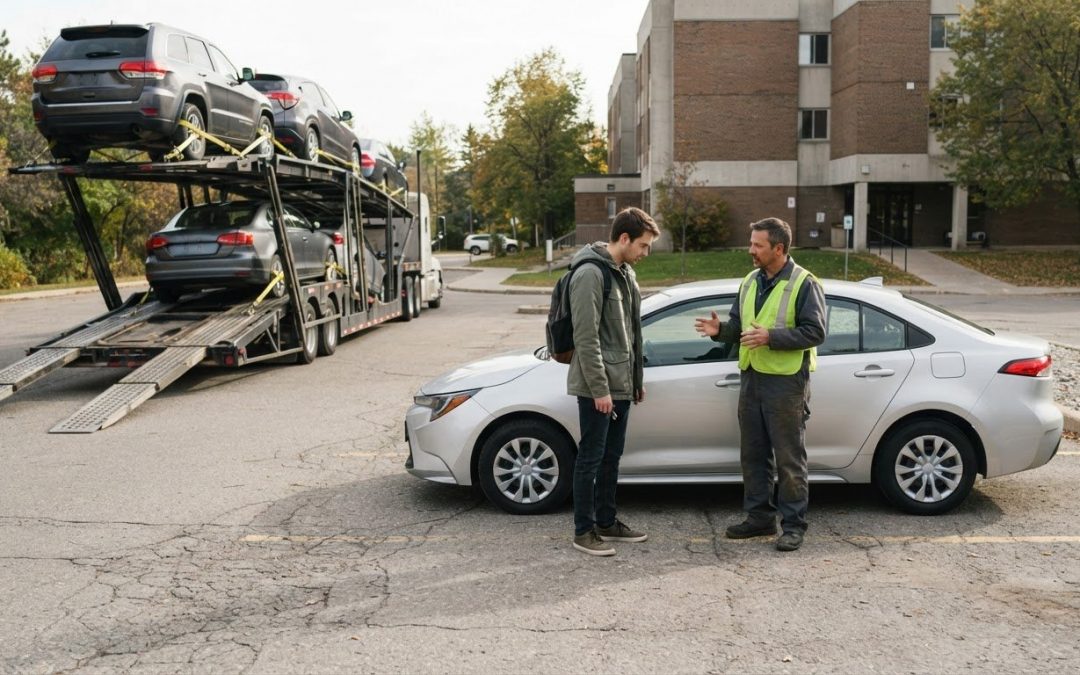
Distance is only one part of the cost of getting a car to campus. Sending a car to a student in another province can cost more or less depending on the route, vehicle, transport method, and access at pickup and delivery. Driving adds fuel, meals, possible lodging, and wear on the car. Shipping costs depend on the shipment details, so request a quote based on the specific route and vehicle.
It’s easy to focus on distance or fuel and overlook the handoff at each end. If a transport truck can’t reach the student’s residence, the carrier may need to meet them at an accessible nearby location. Plan the delivery arrangements from the start.
This guide explains what affects shipping costs, how driving compares with using a carrier, and what to prepare before the car moves. It also covers pickup and delivery, vehicle checks, insurance, and provincial registration, helping you plan the move with fewer surprises.
Key Takeaways
- Compare the full cost of driving with the convenience of shipping, not just fuel against a transport quote.
- Before the move, organize ownership documents and insurance details, and account for registration requirements in the destination province.
- Take clear photos of the vehicle at pickup and delivery to document its condition at each handoff.
- Plan the delivery date around route distance, carrier scheduling, and how easily the pickup and drop-off locations can be reached.
Driving a car home or hiring a car shipping company
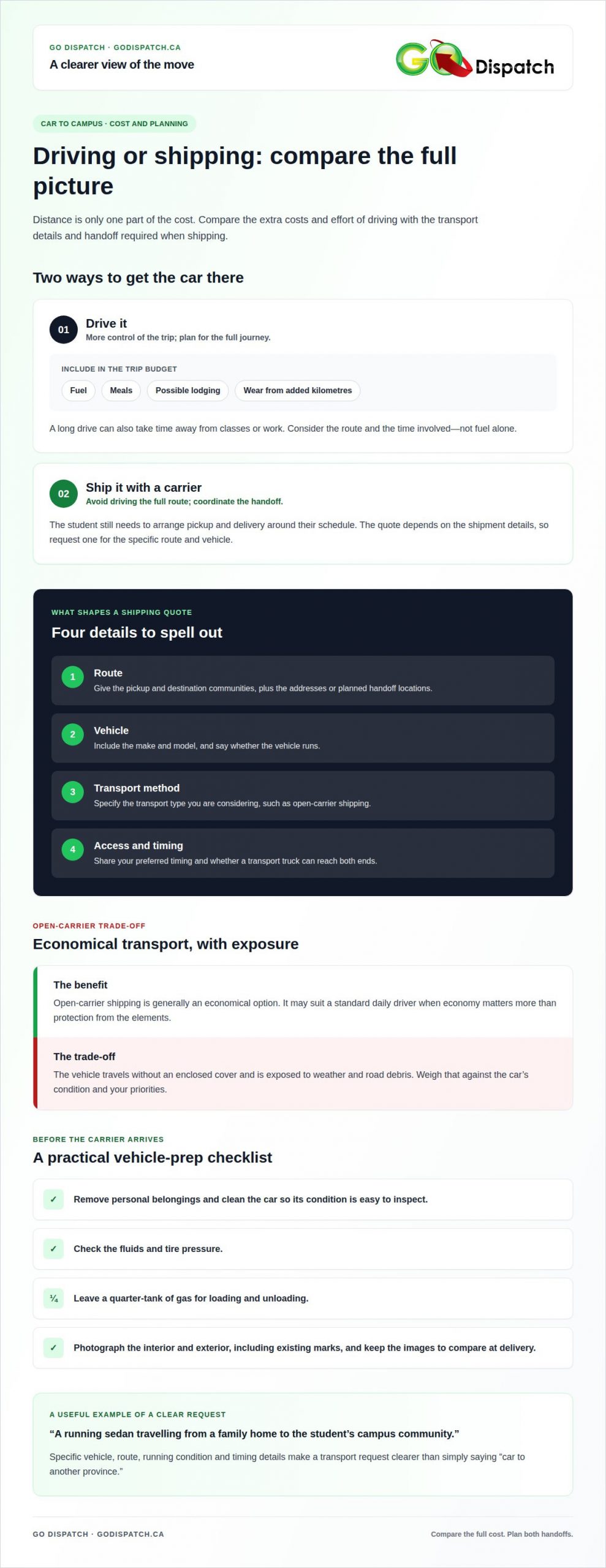
When sending a car to a student in another province, compare the full cost and effort of driving with shipping. Driving means planning the route and trip; shipping means coordinating pickup and delivery around the student’s schedule.
Driving gives the student control of the trip, but the budget should include fuel, meals, possible lodging, and wear from the added kilometres. A long drive can also take time away from classes or work. Shipping avoids driving the full route, though the student still needs to arrange a handoff. The quote depends on the route, vehicle details, transport type, and access at both ends.
Car-Shipping Listings
When requesting transport, describe the vehicle and route clearly. Include the pickup and destination communities, the vehicle’s make and model, whether it runs, and your preferred timing. For example, specify that a running sedan is travelling from a family home to the student’s campus community. These details make the request clearer than simply writing “car to another province.”
Open-Carrier Shipping
Open-carrier shipping moves vehicles on a multi-car carrier without an enclosed cover. It’s generally an economical option, but the vehicle is exposed to weather and road debris during travel. Weigh that trade-off against the car’s condition and your priorities. A standard daily driver may suit open transport when economy matters more than protection from the elements.
Before pickup, remove personal belongings and clean the car so its condition is easy to inspect. Check the fluids and tire pressure, then leave a quarter-tank of gas for loading and unloading. Photograph the interior and exterior, including any existing marks, and keep the images to compare at delivery. This gives the owner a record of the car’s condition and helps the student know what to expect at handoff.
Provincial taxes, insurance, and in-transit permits
Registration, insurance, and transport paperwork are separate tasks. Plan each one around the student’s destination and the car’s current registration.
What documents are needed to ship a car to a student in another province? Have proof of ownership, registration details, and insurance information ready. If the vehicle is being purchased, arrange the title transfer, registration, and insurance before transport.
Can a student drive a car registered in their parent’s province? A student may be allowed to keep the parent-province registration if the home province’s student rules and the destination jurisdiction’s requirements permit it. The student’s status and where the car will be used matter.
Does a car need to be registered where a student attends school? A vehicle moving to another province must be registered with the appropriate provincial authority within that province’s timeframe, often 30 to 90 days. The applicable deadline depends on the destination province.
What are the vehicle inspection and safety requirements for registering a car in another province? Some provinces require a safety inspection or emissions test before registration. An out-of-province inspection may also be needed to meet the destination province’s local safety standards.
Insurance after a move means updating the policy to reflect the car’s new home and use. Tell the insurer the student’s new address, then arrange coverage that meets the destination province’s requirements. Some provinces also charge registration fees and applicable taxes.
Transport coverage concerns whether the car is insured while travelling on a carrier. Ask the current insurer whether the policy covers the vehicle during transport, and keep the answer with the shipment documents.
An in-transit permit allows a vehicle to travel before regular registration is complete. If the student will drive an out-of-province purchase from the seller, arrange insurance and the permit before setting out. For carrier transport, organize ownership and registration paperwork separately from any permit needed for driving.
For the shipment itself, car transport coordination can help keep logistics distinct from provincial registration steps.
Pickup, drop-off, and delivery
Pickup and delivery arrangements determine where the carrier can collect and release the vehicle. Plan both locations with the transport truck’s access and the student’s schedule in mind.
For a car going to a campus residence, choose a practical meeting point with enough space for a carrier to stop. A transport truck may not be able to reach a narrow campus road, underground garage, or busy residential street. An accessible nearby parking lot can work as the handoff point.
Pickup and Delivery
Pickup and delivery are the agreed handoff points where the vehicle changes custody. Give the pickup contact and the student the location details, expected arrival window, and a way to coordinate on the day. If the truck can’t reach either address, choose an accessible nearby lot. Plan how the student will get there before the car is dispatched.
At each handoff, the person receiving the car should be ready to meet the driver and inspect the vehicle. If a parent arranges pickup, make sure the student knows who will receive the car and where. Clear instructions can prevent confusion if a residence entrance, campus gate, or parking area is difficult to find.
Interprovincial Shipping Time
Interprovincial shipping time is the period between carrier pickup and vehicle delivery. Distance matters, but timing also depends on the carrier’s schedule and the pickup and delivery locations.
When arranging transport, share the required arrival date and both addresses. A delivery to an accessible meeting point in a city centre may be simpler to coordinate than one to a remote address requiring extra routing. Long routes across Canada involve more distance and route planning than shipments between nearby communities.
Keep the student’s move-in plans separate from the expected vehicle arrival. Arrange transportation to campus without relying on the car being ready immediately. The student can attend classes or collect keys even if the car arrives later in the day.
Before the vehicle leaves, make sure the pickup contact can access the car and meet the carrier. At the destination, give the student the agreed meeting location and relevant contact details. For an out-of-province purchase, collecting the car may involve travelling several hundred kilometres or more, so planning delivery can save the student an unnecessary trip. This is a provincial transport arrangement, not an international import.
How long does interprovincial car shipping take?
Interprovincial shipping time is the interval between carrier pickup and vehicle delivery. Route distance is a major factor, while carrier routing and access at both ends also shape the schedule. A shipment between nearby cities involves a different journey from a cross-country route. The destination matters too: a central city address and a remote community can require different travel plans.
Carrier schedules affect when a vehicle is collected and delivered. A car may travel as part of a broader route, so pickup and delivery dates depend on how the shipment fits into that route. Share the student’s destination, preferred arrival date, and move-in plans when arranging transport. This gives the schedule a clear target without relying on an assumed delivery day.
Build the student’s arrival plan around the delivery window rather than a single fixed day. For example, if classes begin soon after move-in, arrange another way to reach campus until the car arrives. This separates essential travel from the carrier’s schedule and gives the student time to collect keys, settle in, and meet the carrier at the planned destination.
Access at pickup and delivery can affect coordination. If a truck can’t reach the residence, an accessible meeting point may be needed. The student should know where it is and be available to receive the car. A parent arranging transport can share the student’s contact details and confirm who will attend each handoff. Clear arrangements help prevent a missed meeting from disrupting delivery.
To organize the move, start with the student’s required arrival date. Then provide the route and vehicle details when arranging transport, and coordinate the handoff with the student. Keep registration and insurance on a separate checklist, since provincial requirements may involve steps after delivery. This approach gives the student a workable plan without assuming every interprovincial route takes the same amount of time.
GO DISPATCH: Car Transport
GO DISPATCH helps families arrange car transport through its one-stop transport dispatching service, which finds the right auto carrier and manages the logistics. It can be a practical next step when driving would add a long trip to the student’s move or when pickup and campus delivery need careful coordination.
Share the vehicle type, route, and delivery arrangements to start planning. GO DISPATCH also arranges transport for trucks, SUVs, and vans through its one-stop dispatching service. This support helps families organize a vehicle shipment while focusing on school dates, move-in plans, and provincial paperwork.
To discuss arranging a vehicle shipment, visit godispatch.ca.
Make the next move easier to plan
A vehicle handoff is one part of a student’s move, so include it in the wider arrival plan. Decide who will coordinate the shipment, who will receive the car, and how the student will get around until the handoff is complete. A clear plan gives the family a shared reference point as school and moving arrangements come together.
Planning to send a car to a student in another province starts with the route, vehicle details, and the student’s preferred arrival timing. GO DISPATCH can coordinate the transport logistics, leaving you to focus on the move itself. Share your shipment details with GO DISPATCH to take the next step.
Contact GO DISPATCH about car shipping. A little planning now can make the transition to campus feel more manageable.
Frequently Asked Questions
How much does it cost to ship a car in Canada?
Shipping cost depends on the route, vehicle, transport method, and access at pickup and delivery. There isn’t one price for every Canadian shipment. To get a useful quote, provide the exact origin and destination communities, along with the car’s make, model, and running condition. These details help account for the actual shipment rather than relying on a broad estimate for an entire province.
What’s the difference between open and enclosed transport?
Open transport carries vehicles on an uncovered, multi-car carrier; enclosed transport places them inside a covered carrier. Open transport is generally more economical, while an enclosure shields the vehicle from weather and road debris. For a standard car, weigh cost against exposure during travel. An owner who values added protection may prefer an enclosed option.
What’s the best way to ship your vehicle?
The best method depends on the route, your schedule, and how much protection the vehicle needs. A carrier can reduce the need for a long drive, while driving gives you direct control of the trip. Rail shipping uses specialized rail cars and can carry vehicles over long distances while protecting them from the elements. Match the method to your priorities and delivery plan.
How much does it cost to ship a car to another province in Canada?
The cost depends on the specific shipment, not just the distance between provinces. Pickup and delivery points, vehicle size and condition, and the transport method all affect the quote. For example, a route between remote communities may require different access arrangements from one between major centres. Provide accurate route and vehicle details to get a quote tailored to the trip.
What are the options for transporting a car between provinces in Canada?
Common options include driving, open-carrier transport, enclosed transport, and rail shipping. Driving suits someone able to make the trip and manage its travel costs. Open carriers move several vehicles together, while enclosed carriers protect them from weather and road debris. Rail uses specialized cars for longer-distance transport. Compare the vehicle, route, desired protection, and handoff arrangements when choosing a method.
How do you prepare a car for transport between provinces?
Prepare the car by removing personal belongings, cleaning it for inspection, and checking the fluids and tire pressure. Leave a quarter-tank of gas for loading and unloading. Before pickup, make sure the vehicle details and running condition match the transport arrangements, and have the keys ready for the handoff. These steps help make pickup more straightforward and ensure the carrier has the information needed to handle the vehicle.