

What if the most useful vehicle-tracking update isn’t a moving dot on a map, but a confirmed milestone and someone who can explain what’s happening? If you’re wondering how to track my vehicle during transport, it’s reasonable to want a reliable location and delivery estimate. Tracking may mean live GPS or updates at key stages, depending on the carrier. Knowing which to expect can make the wait easier and help you ask the right questions.
This guide explains what tracking information to request before pickup, which transport milestones to watch for, and how updates may be shared. You’ll also learn what to do if an expected update doesn’t arrive or delivery timing is unclear. A dispatch contact can request or clarify carrier updates, but GPS tracking isn’t available for every shipment. Asking a few clear questions upfront gives you a practical plan for staying informed while your vehicle is in transit.
Key Takeaways
- Before pickup, confirm your shipment reference, assigned contact, and the carrier’s tracking method.
- Learn how to track my vehicle during transport by checking confirmed milestones and asking when to expect the next update.
- Understand what GPS access, milestone updates, and direct status enquiries can each tell you.
- If an update is missed, contact the assigned person and ask for the latest confirmed status and a clear next step.
- GO DISPATCH can help coordinate questions between clients and third-party carriers. Tracking options depend on the carrier assignment.
How to Track Your Vehicle During Transport: What Updates Should You Expect?
Waiting for your vehicle can leave you wondering whether it’s moving, delayed, or close to delivery. Start by asking what information the assigned carrier can provide. Tracking may mean access to a live location, status messages at key stages, or an update requested through a carrier or dispatch contact. The available option depends on the carrier and your shipment arrangement.
What does vehicle tracking mean during transport?
Live GPS tracking shows a vehicle’s reported location as it travels, often through a tracking system or another tool provided for the shipment. A vehicle tracking system uses location technology and software to report where a vehicle is. Milestone-based updates work differently: they confirm an event, such as pickup or progress through transit, without showing the vehicle’s live position.
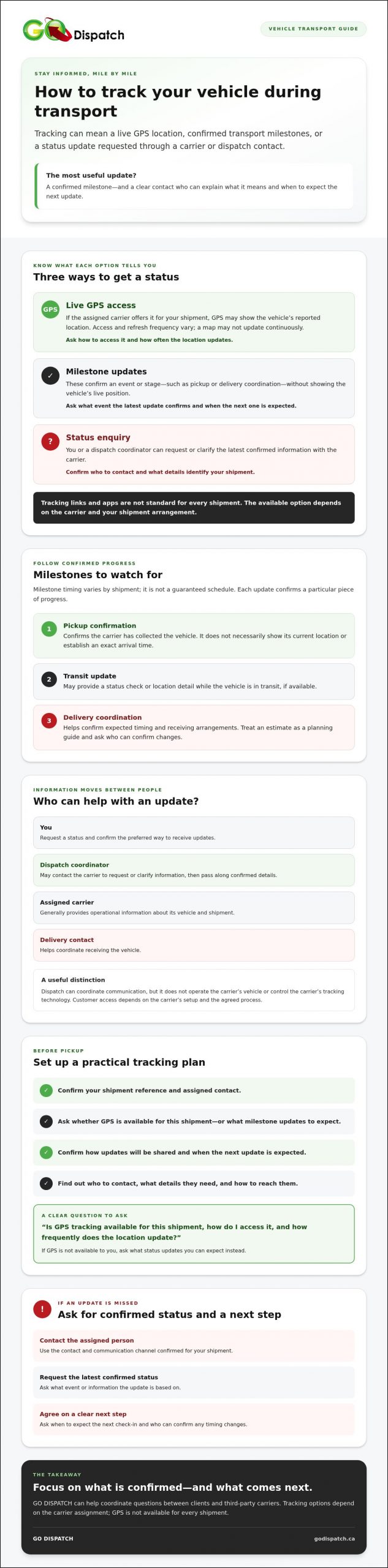
Updates may be sent on a schedule, shared when a milestone is reached, or provided after you contact the carrier or dispatch coordinator. A tracking link or app isn’t standard for every shipment, so ask which method applies to yours. Confirm who to contact, what details they need to identify your shipment, and when to expect the next update. This gives you a clear way to check progress without assuming a live map is available.
Which transport milestones can help you follow progress?
Even without live GPS, confirmed milestones can help you understand the shipment’s progress and prepare for delivery. Depending on the arrangement, updates may include:
- Pickup confirmation: Confirmation that the carrier has collected the vehicle.
- Transit update: A status check or location detail shared while the vehicle is in transit, if available.
- Delivery coordination: An update to help confirm expected delivery timing and receiving arrangements.
Milestone timing varies by shipment; it isn’t a guaranteed schedule. Ask what event the latest update confirms and when the next one is expected. Pickup confirmation, for example, tells you the vehicle has been collected, but it doesn’t necessarily show its current location or establish an exact arrival time.
A delivery update can help you arrange to be available, coordinate with the person receiving the vehicle, and plan around the expected timing. If the timing is an estimate, use it as a planning guide and ask who can confirm changes. Focus on confirmed information and the next agreed check-in, not just whether a live tracking screen is available.
How Vehicle Transport Tracking Works: GPS, Carrier Updates, and Dispatch
Transport updates pass between several people. Knowing who holds each piece of information makes it easier to get a useful answer. You request a status, a dispatch coordinator can request or clarify information, the assigned carrier provides operational details, and the delivery contact helps coordinate receiving the vehicle. The communication process depends on the shipment arrangement.
A dispatch company coordinates logistics and communication, but it doesn’t operate the carrier’s vehicle or control the carrier’s tracking technology. Confirm which contact can access current carrier information and how updates will reach you. For context, fleet management software can use tracking data to support the management of vehicle fleets, but customer access to shipment tracking depends on the carrier’s setup and agreed process.
Can you track a vehicle with live GPS?
If the assigned carrier offers customer-facing GPS for your shipment, it may show the vehicle’s reported location as it travels. Ask whether you’ll receive access directly or need to request location information through a contact. Confirm how often the information refreshes and whether access is available throughout the trip. A displayed position may not update continuously, and customer access can vary, so don’t treat a map as an uninterrupted view.
Get those details before pickup. Ask: “Is GPS tracking available for this shipment, how do I access it, and how frequently does the location update?” If GPS isn’t available to you, ask what status updates you can expect instead. A clear answer sets realistic expectations before the vehicle is in transit.
How dispatch and carrier updates reach the customer
The carrier is generally the source of operational information about its vehicle and shipment. A dispatch coordinator may contact the carrier to request a status or clarify an update, then pass along the confirmed information. This coordination can help you reach the right source without implying the dispatch company has its own live-tracking platform.
Before transport begins, confirm your primary contact and preferred communication channel. Don’t assume updates will arrive by text, email, phone, app, or tracking link. Ask whom to contact if an expected update doesn’t come through and what shipment details they’ll need to check it.
In practice, a carrier may confirm pickup and share transit information, a dispatch coordinator may help request or clarify a status, and the delivery contact may coordinate receiving arrangements. If you’re comparing options for vehicle transport coordination, ask how the assigned carrier’s updates will be handled for your shipment.
Live GPS vs. Transport Updates: What Tracking Can, and Cannot, Tell You
Different tracking methods answer different questions. A live map may show a reported location, while a milestone update confirms that an event has occurred. A direct status enquiry lets you ask the carrier or dispatch contact for information. None of these methods guarantees an exact arrival time.
| Tracking method | What it can confirm | What it may not confirm |
|---|---|---|
| Live GPS access | A reported vehicle location, if the carrier provides customer access. | Continuous movement, precise arrival time, or delivery details. |
| Milestone updates | That a shipment event, such as pickup, has been reported as complete. | The vehicle’s current position between updates. |
| Direct status enquiry | The latest information available from the carrier or dispatch contact. | Information that hasn’t yet been confirmed by the carrier. |
If there’s no map link, that alone doesn’t mean the shipment is off schedule. The carrier may not offer customer-facing GPS, or the agreed process may rely on milestone updates and enquiries. Confirm which method applies to your shipment before interpreting the absence of a tracking screen.
What live location can show, and what it cannot confirm
A GPS display is a location report, not a complete record of the delivery. It may show where the vehicle was reported at a particular time, but it can’t confirm the exact arrival time, the condition of the vehicle, or that delivery arrangements are finalized. Estimated timing can change as the carrier’s progress and schedule develop, so use location information as a planning aid rather than a promise.
For consumer questions about a promised delivery date, consult the government’s Consumer Protection Act guidance. Its relevance depends on your circumstances; don’t assume every vehicle transport arrangement is covered in the same way.
Why a tracking update may not arrive continuously
Some shipments have location access; others use updates at agreed stages or when a status is requested. Update frequency depends on the carrier’s process and the shipment arrangement. Before transport, ask when updates are expected and what a quiet period means. If you’re concerned, contact your confirmed point of contact and request the latest confirmed status and the next expected update. This is a practical way to track your vehicle without treating every gap as a delay.
How to Check Your Vehicle’s Transport Status: A Practical Checklist
A status request is easier to answer when it includes the right details and asks for one specific update. Keep your shipment information handy, use the contact confirmed for your transport, and distinguish confirmed progress from an estimate.
What information should you have ready when asking for an update?
Use this checklist to help the carrier or dispatch contact identify your shipment and understand what you need to know:
- Find your booking or shipment reference and the name of your assigned contact.
- Have basic vehicle details ready, such as the make and model, along with relevant pickup or delivery information.
- State your last confirmed update, including when you received it and which milestone it described.
- Ask for the latest confirmed milestone and the next expected update. If delivery timing is unclear, ask whether the estimate has changed.
- Share the VIN only if requested, and only through a communication channel you’ve confirmed is appropriate.
Be specific and courteous. For example:
Hello, my shipment reference is [reference]. My vehicle was picked up on [date], and my last update was [status]. Could you please confirm the latest milestone and when I should expect the next update? Thank you.
What should you do if an expected update is missing?
Start with the agreed communication channel and check any tracking instructions you received. If the update still hasn’t arrived, contact your confirmed dispatch or carrier contact with your reference number and a concise question. Ask for the latest confirmed status, not just whether the vehicle is “on track.”
Keep a simple record of when you contacted them, what information you received, and when they suggested following up if the status remained uncertain. Use that record to make your next enquiry clear and consistent. For any follow-up, refer to the last confirmed milestone and ask what has changed since then.
For help coordinating vehicle transport details, learn about vehicle transport coordination with GO DISPATCH.
How GO DISPATCH Can Help Coordinate Vehicle Transport Updates
Knowing whom to ask can make it easier to get a clear vehicle status. GO DISPATCH coordinates transport for cars, trucks, SUVs, and vans across Canada by matching clients with third-party carriers and managing logistics and delivery scheduling. It can help customers request or clarify carrier updates, while the carrier remains the source of operational information about the shipment.
What GO DISPATCH coordinates during a vehicle shipment
Dispatch coordination connects the transport arrangements with the carrier handling the shipment. GO DISPATCH helps manage logistics and delivery scheduling, but it doesn’t directly operate carriers or take custody of vehicles. It also doesn’t provide a proprietary live-tracking platform. Available tracking methods and shipment updates depend on the assigned carrier and the agreed process.
This distinction is a useful starting point when you’re asking how to track my vehicle during transport. A dispatch contact may be able to request the latest status from the carrier or clarify what an update means. That’s different from having direct access to the carrier’s GPS data, and it doesn’t mean live tracking or a specific delivery time is available for every shipment.
What to ask before your vehicle is picked up
Set expectations early. Before pickup, confirm the details that will help you get a useful answer later:
- Carrier and contact: Ask which carrier is assigned and whom you should contact for shipment updates.
- Tracking method: Find out whether information will be GPS-based, shared at milestones, or available by direct enquiry.
- Update expectations: Ask which shipment events may trigger an update and when to expect the next one. Timing depends on the arrangement.
- Missed updates: Confirm how to request clarification if a planned update doesn’t arrive and whom to contact.
Keep your shipment reference, vehicle details, and last confirmed status close at hand. These details help a dispatch contact identify the shipment and ask the carrier a focused question. For example, request confirmation of the latest milestone and ask when another update is expected, rather than relying on an unconfirmed estimate.
Clear expectations can reduce the effort of following up, even when there’s no live map to check. If you’re planning a shipment or want to discuss coordination for your vehicle, contact GO DISPATCH about vehicle transport.
Stay Informed Throughout Your Vehicle’s Journey
Clear expectations make the wait easier. Live GPS isn’t available for every shipment, so confirm the assigned carrier’s tracking options and whom to contact before pickup. Whether updates come through GPS, transport milestones, or a direct status enquiry, ask what the latest confirmed update means and when to expect the next one.
If you’re still wondering how to track my vehicle during transport, keep your shipment reference ready and contact the person responsible for updates if an expected check-in is missed. Tracking can help you plan, but it doesn’t guarantee an exact arrival time.
GO Dispatch coordinates vehicle transport across Canada by matching clients with third-party carriers and managing logistics for cars, trucks, SUVs, and vans. It can help coordinate carrier updates without replacing the carrier as the source of shipment information. Contact GO Dispatch to coordinate your vehicle transport and discuss the details that matter for your shipment.
With the right contact and a clear update plan, you can stay informed and prepare for delivery with greater confidence.
Frequently Asked Questions
Can I track my vehicle in real time during transport?
Real-time GPS tracking is available only if the assigned carrier offers customer access for your shipment. It can show reported location information, while milestone-based updates confirm events such as pickup or delivery coordination. Before pickup, ask which method applies, how to access it, and how often location information or status updates are expected. Don’t assume every shipment includes a tracking link or app.
How do I find out where my vehicle is during transport?
Contact the confirmed carrier or dispatch contact with your shipment reference and basic vehicle details. Ask for the latest confirmed milestone and when to expect the next update. If you’re asking how to track my vehicle during transport, the person coordinating your shipment can clarify who handles status enquiries and whether the carrier offers GPS access, milestone updates, or information by direct enquiry.
What should I do if my vehicle transport tracking has not updated?
First, check the agreed update channel and schedule, along with any tracking instructions you received. If the expected update is still missing, contact your confirmed point of contact with the shipment reference and last known status. Ask what’s been confirmed and when to follow up if the location or delivery timing remains unclear. A gap in updates alone doesn’t prove the vehicle is delayed or in trouble.
Do all car transport companies provide GPS tracking?
No, tracking options vary by carrier and shipment arrangement. A carrier may provide customer access to location information, while another may share updates at key milestones or respond to direct status enquiries. Before pickup, ask what tracking method is available for your specific shipment and how to use it. Don’t assume continuous GPS access unless the carrier has explicitly confirmed it.
How often should I receive updates while my vehicle is being transported?
There’s no single update frequency that applies to every shipment. The carrier’s process, route, and agreed communication plan all affect when information is shared. Before pickup, confirm which milestones may trigger an update, when to expect the next one, and whom to contact if it doesn’t arrive. Don’t rely on an assumed daily schedule unless that timing has been confirmed for your shipment.
Can GO Dispatch tell me where my vehicle is?
GO Dispatch coordinates vehicle transport with third-party carriers and can help clarify shipment status through the applicable coordination process. The carrier assignment determines which updates are available, and GO Dispatch doesn’t promise live GPS access or a specific update time. When arranging transport, confirm the assigned carrier, available tracking method, and best contact for status enquiries. This helps set clear expectations before your vehicle is picked up.
What information do I need to request a vehicle transport update?
Have your shipment or booking reference, vehicle details, and relevant pickup or delivery information ready. Include the VIN only if requested, and share it through an appropriate, confirmed communication channel. State when you last received an update and what it confirmed. Then ask one clear question, such as, “What’s the latest confirmed milestone, and when should I expect the next update?”