

Your vehicle is likely your second largest investment, yet many Canadians treat its cross-country journey like a standard courier delivery. Learning how to prepare a car for transport in Canada is the critical difference between a seamless arrival and an expensive insurance headache. It’s natural to feel uneasy about handing over your keys for a long-distance haul. You want to know your car is protected, your paperwork is airtight, and you won’t face surprise surcharges for personal items left in the trunk. We understand that your schedule is busy and your vehicle’s safety is non-negotiable.
This 2026 logistics checklist gives you total control over the process. We have mapped out every essential step to ready your vehicle for national hauling to ensure a damage-free and efficient delivery. You will gain peace of mind regarding insurance claims and learn how proper prep leads to faster pickup times. From managing fuel levels to documenting pre-existing conditions, this guide covers the practical details that keep your transport on track and your budget intact. Moving your car should be the easiest part of your transition, and we are here to make sure it is.
Key Takeaways
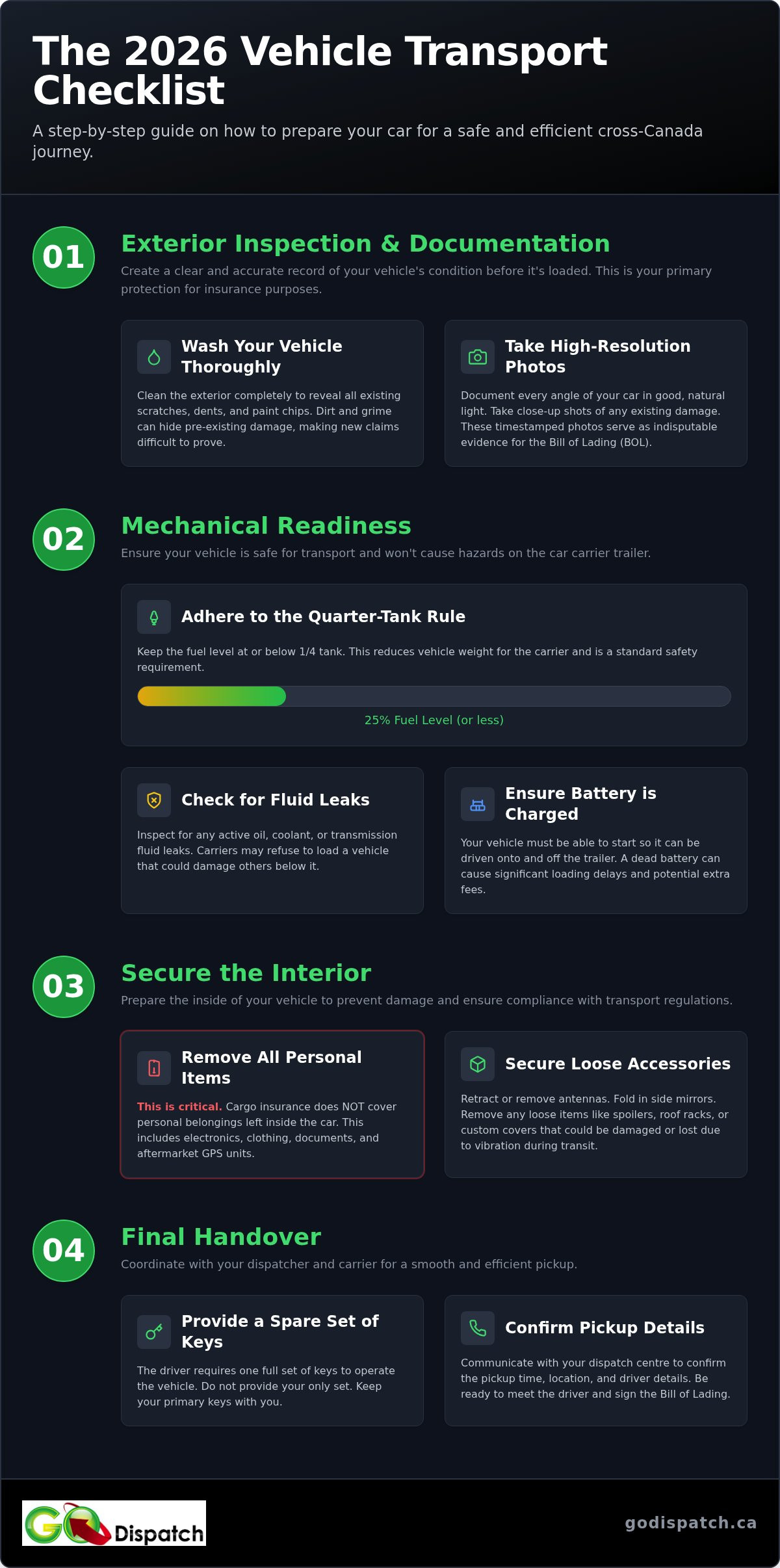
- Proper preparation reduces the risk of transit damage and keeps your delivery on schedule during multi-province hauls.
- Learn how to prepare a car for transport in canada by cleaning the exterior and taking high-resolution photos for a clear condition report.
- Stick to the quarter-tank rule and check for fluid leaks to keep the trailer safe and reduce transport weight.
- Remove all personal items and loose accessories because cargo insurance won’t cover belongings left inside the vehicle.
- Coordinate with your dispatch centre to confirm pickup details and provide the carrier with a spare set of keys.
Why Proper Preparation is Critical for Long-Distance Canadian Transport
Shipping a vehicle across thousands of kilometres is a major logistical undertaking. It isn’t just about moving an asset; it’s about ensuring that asset arrives in the same condition it left. When you learn how to prepare a car for transport in canada, you are doing more than just helping the driver. You are actively minimizing the risk of transit damage during multi-province hauls. A well-prepared vehicle allows carriers to stay on their precise schedules. This reliability ensures that every client on the route receives their vehicle as promised. Professional dispatchers require these preparation standards to match your car, truck, or SUV with the right equipment and the most qualified carrier for your specific route.
The Impact of Canadian Geography on Transit
Canada’s diverse landscape presents unique challenges for any car carrier trailer. A journey from the Maritimes to the West Coast involves navigating the rugged Canadian Shield, the unpredictable weather of the Prairies, and the steep grades of the Rockies. These environments subject your vehicle to constant vibrations and shifting temperatures. Proper preparation helps mitigate several geographic risks:
- Vibration protection: Long hauls on the Trans-Canada Highway can loosen non-secured parts or accessories.
- Weather resistance: Rapid changes in humidity and temperature across provinces can affect tire pressure and fluid levels.
- Inspection speed: Clean surfaces allow for rapid verification at provincial checkpoints or weigh stations.
Properly securing all components prevents unnecessary wear over these long stretches. Cleanliness also plays a logistical role. A clean car allows for faster and more accurate inspections. It ensures that any official checks don’t result in transit delays due to poor visibility of the vehicle’s exterior.
Understanding Your Liability and Insurance
Accurate documentation is your primary protection against potential liability claims. Knowing how to prepare a car for transport in canada ensures you meet the strict standards required for valid insurance coverage. Preparation creates an essential baseline for your vehicle transport insurance requirements. Carriers are typically only held responsible for damage that is clearly documented during the initial pickup inspection. If a vehicle is covered in mud or dust, small chips or scratches can easily be overlooked. A well-maintained car facilitates a faster Bill of Lading (BOL) process. This document is your legal receipt; it proves the condition of your vehicle at the moment of handover and protects your investment until the keys are back in your hand. This transparency is what provides true peace of mind during a long-distance move.
The Exterior Inspection: Documenting Condition for Peace of Mind
Your vehicle’s exterior condition is the baseline for your entire transport experience. A clean car is mandatory for a valid pre-transport inspection report. Without a thorough wash, dirt and road grime can easily mask existing paint chips or small dents. This makes it nearly impossible to prove when new damage occurs during transit. When you understand how to prepare a car for transport in canada, you realize that documentation isn’t just a chore; it’s your primary insurance policy. Carriers rely on the Bill of Lading to establish liability, and a clean vehicle ensures this document is accurate from the start.
Step-by-Step Exterior Cleaning and Assessment
Begin by washing the vehicle thoroughly. This reveals every surface imperfection and paint chip that might otherwise go unnoticed. Don’t just focus on the doors and hood. Inspect the undercarriage and bumpers for existing cracks or loose trim that could be aggravated by the vibrations of a long-distance haul. Clean the wheels and tires specifically to check for rim rash or sidewall damage. Once clean, walk around the vehicle and write a single sentence describing any existing damage with specific locations on the chassis. For example, “Small 2cm scratch on the lower passenger side rear door.” This clarity prevents disputes at the delivery point.
Photographing Your Vehicle Like a Professional
High-resolution photography provides indisputable evidence of your vehicle’s pre-shipment state. Take these photos in clear, natural light. Early morning or late afternoon sun usually provides the best clarity without harsh glares. Position your camera to capture the vehicle from all four corners and sides. Don’t forget the high-risk areas. Capture close-ups of the roof, hood, and trunk area specifically, as these are most exposed to the elements. Finally, include a time-stamped photo of the odometer. This verifies the mileage post-delivery and ensures your car wasn’t driven unnecessarily while in the carrier’s care. If you need help coordinating these details, our team can provide a professional transport dispatch service to guide you through the logistics.
The final step of the exterior inspection happens when the driver arrives. Note all chips, dents, and scratches on the inspection report, no matter how minor they seem. Ensure the carrier driver signs off on your findings before the vehicle is loaded onto the trailer. This signed agreement is your legal protection. It ensures that both you and the carrier are in total agreement about the vehicle’s starting condition. This simple step eliminates confusion and provides the peace of mind you deserve during a cross-country move.
Mechanical Readiness: Fluids, Battery, and the Quarter-Tank Rule
Your vehicle won’t be logging kilometres on the highway, but its internal systems must be in top shape for the journey. Mechanical readiness is a vital part of how to prepare a car for transport in canada. A car that fails to start or leaks fluids creates immediate logistical hurdles. It can delay the entire trailer and potentially damage other vehicles. Carriers expect a vehicle that is safe to handle and compliant with weight regulations. Taking these steps ensures your car is ready for the rigours of national hauling.
Active fluid leaks are a significant mechanical concern in vehicle hauling. If your car drips oil, transmission fluid, or coolant, it poses a risk to the vehicles positioned below it on the carrier. Check your driveway or garage floor for spots several days before the pickup date. If you find a leak, have it repaired immediately. Ensure all caps are tightened and sealed to prevent leaks caused by the constant motion of the truck. If your vehicle has a known issue that cannot be fixed, you must inform the driver so they can place your car on the bottom deck.
Managing Fluids and Mechanical Health
Top up your essential fluids, including oil and coolant, but don’t overfill them. Mechanical health also extends to your dashboard. Address any “Check Engine” lights or persistent mechanical warnings before the driver arrives. If your vehicle is inoperable, you must notify your auto transport dispatch service in advance. Shipping a non-running car requires specialized equipment like a winch. Failing to mention this can lead to a cancelled pickup or significant extra fees at the curb.
The Logistics of Fuel and Weight
The “Quarter-Tank Rule” is a standard industry requirement for two main reasons. First, a full tank of gas adds significant weight to the vehicle. When multiplied across a multi-car trailer, this excess weight can put the carrier over legal provincial limits at highway weigh scales. Second, it’s a safety hazard. Less fuel means less flammable material on the road during long-distance national hauling. Ensure your fuel level is at approximately one-quarter tank. This provides enough fuel for the driver to load and unload the vehicle without adding unnecessary bulk to the shipment.
Finally, focus on the battery and tires. Ensure your battery is fully charged. Carriers often start and move vehicles to reorganize the trailer during the trip. A dead battery causes frustrating delays for everyone involved. Check that your tires are at the correct pressure to ensure a smooth load-in. If your car has a specialized starting procedure or an anti-theft system, communicate this clearly to the driver. Disable alarms to prevent them from triggering during transit. This prevents the alarm from draining your battery before the car reaches its destination.
Securing the Interior: Personal Items and Loose Accessories
Once your vehicle’s exterior and mechanical systems are ready, you must turn your attention to the cabin. Clearing out the interior is a step many owners overlook, but it’s a vital part of how to prepare a car for transport in canada. A car moving across provinces experiences constant motion. Anything left loose inside can become a projectile, damaging your upholstery or dashboard. Most Canadian carriers strictly prohibit personal items because cargo insurance, which typically covers between C$100,000 and C$250,000 per vehicle, only applies to the car itself. Your belongings are moved at your own risk and are not part of the carrier’s liability.
Before the truck arrives, remove all non-permanent exterior accessories. This includes bike racks, roof boxes, and specialized antennas. These items can snag on the trailer structure or other vehicles during the loading process. Fold in your side mirrors and retract any manual antennas to create the smallest possible profile. Inside the car, take down your GPS units, dash cams, and phone chargers. Even if they are suction-cupped to the glass, the vibrations of a long-distance journey can shake them loose, potentially cracking a screen or scuffing your trim.
The Risk of Leaving Items Inside
Leaving goods in your car creates three major problems. First, loose items shift during transit. A heavy box in the backseat can easily tear leather or leave permanent indentations on your seats. Second, personal items add unnecessary weight. Carriers must manage their total load to pass provincial weigh scales; excess weight can lead to significant fines or delays for the driver. Finally, items left in plain sight may attract unwanted attention during terminal stops or overnight stays. As of 2026, carriers have become even stricter about the “no personal items” rule to ensure safety and regulatory compliance.
Securing Toll Tags and Parking Passes
Electronic transponders, such as those for various regional toll systems, should be removed or deactivated. Car carrier trailers often pass through toll gantries, and the sensors may accidentally charge your account as if you were driving. Beyond tolls, remove garage door openers and parking fobs for security reasons. You don’t want these sensitive items out of your possession for several days. Do a final sweep of the glove box and centre console for forgotten valuables like sunglasses or spare keys. If you are ready to move your vehicle, you can request a car transport quote to get started with a professional coordinator.
Taking thirty minutes to properly secure your interior ensures a stress-free delivery. By removing these variables, you allow the carrier to focus entirely on the safe movement of your vehicle. It’s a simple trade-off: a little extra effort now prevents a lot of frustration later. When your car arrives at its destination, you want to open the door to a clean, undamaged interior that’s ready for the road.
Final Handover: Working with a Professional Dispatch Service
The final phase of your logistics plan is the actual handover of the keys. All the effort you put into cleaning and mechanical checks leads to this moment. Understanding how to prepare a car for transport in canada culminates in this final interaction with the carrier. This is where professional coordination replaces guesswork. By working with a dedicated dispatch service, you ensure that every detail, from the pickup window to the delivery address, is confirmed and managed with precision. This final step is about transition and trust.
The Role of One-Stop Transport Dispatching
A professional dispatch service acts as your primary advocate in the logistics chain. We vet carriers to ensure they meet the highest safety and insurance standards required for 2026 operations. You don’t have to worry about verifying provincial registrations or cargo insurance limits yourself. We handle those complex tasks behind the scenes. For businesses, you can realize the efficiency of professional car hauling dispatch when managing multi-vehicle dealership moves. Having a single point of contact reduces your workload and provides a direct line for updates throughout the journey.
When the carrier arrives, provide the driver with a spare set of keys. This should include keys for all doors, the trunk, and the ignition. Never hand over your only set. Carriers need these to move the vehicle on and off the trailer as they optimize their load. Before the truck departs, review the Bill of Lading (BOL) with extreme care. This document is your official contract. It must accurately reflect the condition of the vehicle you documented in your earlier inspections. Signing this document at both pickup and delivery is your primary protection for any potential insurance claims.
Final Checklist Before the Driver Departs
Efficiency at the curb leads to faster transit times for everyone. Before the driver pulls away, run through these final checks:
- Contact Verification: Confirm the driver has your correct mobile number for real-time delivery updates.
- Vehicle Access: Ensure the vehicle is unlocked and the alarm system is completely deactivated to prevent battery drain.
- Record Keeping: Keep a physical or digital copy of the signed inspection report and the BOL for your personal records.
- Delivery Window: Re-confirm the estimated arrival time at the destination centre.
A successful move depends on clear communication and thorough documentation. Trust GO DISPATCH to manage the carrier logistics on your behalf so you can focus on your move. When you follow this 2026 checklist, you aren’t just shipping a car. You are ensuring a professional, damage-free experience that respects your time and your investment. Your vehicle is ready for the road, even if it isn’t the one doing the driving.
Ready Your Vehicle for a Seamless National Move
Mastering the details of vehicle preparation turns a complex cross-country haul into a predictable success. By following these 2026 standards, you ensure your car is compliant with carrier safety rules and fully protected by accurate documentation. Remember that a clean exterior and a quarter-tank of fuel are the foundations of a smooth inspection process. Knowing how to prepare a car for transport in canada gives you the confidence to hand over your keys without the stress of hidden fees or transit delays.
You don’t have to manage these logistical hurdles alone. GO DISPATCH provides comprehensive national Canadian coverage and professional auto carrier sourcing for cars, trucks, and SUVs. We act as your expert dispatching partner, managing every communication and vetting detail behind the scenes. Our goal is to provide a streamlined, reliable service that respects your time and your investment. Simplify your vehicle logistics with GO DISPATCH today. We are ready to help you get your vehicle wherever it needs to be with total peace of mind.
Frequently Asked Questions
Can I leave personal items in my car during transport in Canada?
No, you should remove all personal belongings from your vehicle before it is loaded. Most Canadian carriers prohibit interior items because cargo insurance only covers the vehicle itself, not its contents. Items left inside can shift during transit, causing damage to your upholstery or dashboard. Additionally, personal goods add weight that can lead to fines for the carrier at provincial weigh scales.
How much fuel should be in the tank when shipping a car?
You should maintain a fuel level of approximately one-quarter tank. This provides enough fuel for the driver to safely load and unload the vehicle while minimizing unnecessary weight on the trailer. A full tank adds significant mass, which can put the carrier over legal provincial limits at highway scales. Keeping the fuel level low also reduces the amount of flammable material on the road.
Does insurance cover my car while it is being transported across provinces?
Yes, professional carriers provide cargo insurance that typically ranges from C$100,000 to C$250,000 per vehicle. This coverage protects your investment against transit-related damage during multi-province hauls. When you learn how to prepare a car for transport in canada, you’ll see that a signed Bill of Lading is your primary legal protection for any insurance claims that may arise during the journey.
What happens if my car is damaged during the shipping process?
You must document any new damage on the Bill of Lading immediately at the time of delivery. Compare the vehicle’s current state to the high-resolution photos you took during your initial inspection. If you find a discrepancy, note it on the report and ensure the driver signs it. This signed document is the essential evidence needed to file a successful claim with the carrier’s insurance provider.
Do I need to be present for the pickup and delivery of my vehicle?
You or a designated representative over the age of 18 must be present for both pickup and delivery. This person is responsible for walking around the vehicle with the driver to complete the inspection report. Because the signature on the Bill of Lading confirms the vehicle’s condition, it is vital that the person present is thorough and understands the documentation process before the truck departs.
Should I wash my car before the transport carrier arrives?
Yes, washing your car is mandatory for an accurate pre-transport inspection. Dirt and road grime can easily hide paint chips, scratches, or small dents, making it difficult for the driver to record the vehicle’s true state. A clean exterior ensures that all existing imperfections are documented before the car is loaded. This simple step prevents disputes regarding the vehicle’s condition when it reaches its destination centre.
Can I ship an inoperable vehicle to another province?
You can ship an inoperable vehicle, but you must inform your dispatch coordinator during the booking process. Transporting a car that doesn’t start requires a carrier equipped with a winch or specialized loading equipment. Not all trailers have these capabilities. Disclosing the vehicle’s mechanical state in advance ensures the right equipment is sent to your location and prevents failed pickup attempts or unexpected extra fees at the curb.
How do I handle toll transponders during vehicle shipping?
Remove or deactivate all toll transponders, such as Ontario’s 407 ETR, before the carrier arrives. If left active, these devices can be triggered as the transport truck passes through toll gantries, resulting in accidental charges to your account. Removing the device is a simple but essential part of how to prepare a car for transport in canada to avoid frustrating billing errors and unnecessary administrative work after your move.