

A car shipping estimate isn’t a promise that your vehicle will arrive on a specific day. If you’re comparing estimated transit times for car shipping, first check whether the window starts at pickup or after the carrier has collected your vehicle. Those are different parts of the schedule, and mixing them up can make planning difficult.
It’s understandable to want a firm arrival date, especially when you’re coordinating a move, vehicle handover, or business schedule. But delivery timing can shift with route distance, carrier schedules, weather, road conditions, and multi-stop routing. A longer route may have a different transit window from a shorter one, but the route alone doesn’t determine the full booking-to-delivery timeline. Treat any estimate as a planning window, not a guaranteed date.
This guide explains what a car shipping time estimate includes, what it leaves out, and which details can change the delivery window. You’ll also learn how to compare estimates using the same route and scheduling information, what to share when arranging transport, and how to prepare for possible delays. With clear expectations and coordinated scheduling, it’s easier to plan without treating an estimate as a fixed arrival day.
Key Takeaways
- Use estimated transit times for car shipping as planning windows, and check which stages of booking, pickup, transport, and delivery coordination are included.
- Compare estimates with consistent details, including the route, vehicle information, pickup timing, and transport method.
- Ask how route availability, carrier routing, loading sequence, and pickup coordination could affect your shipment’s schedule.
- Share accurate vehicle details, confirm the delivery contact, and clarify how you’ll receive schedule updates to reduce avoidable delays.
- Dispatch coordination can help manage carrier selection, logistics, and delivery scheduling. GO DISPATCH coordinates with third-party carriers rather than operating its own fleet.
What Estimated Transit Times for Car Shipping Actually Include
Estimated transit time is an expected window for moving a vehicle, not a guaranteed arrival date. It usually describes one part of the process, so check the starting point and endpoint before using it to plan a handover or business schedule. The most useful source is the carrier’s written estimate or the dispatch coordinator’s confirmation. It should state what event starts the clock and what event ends it.
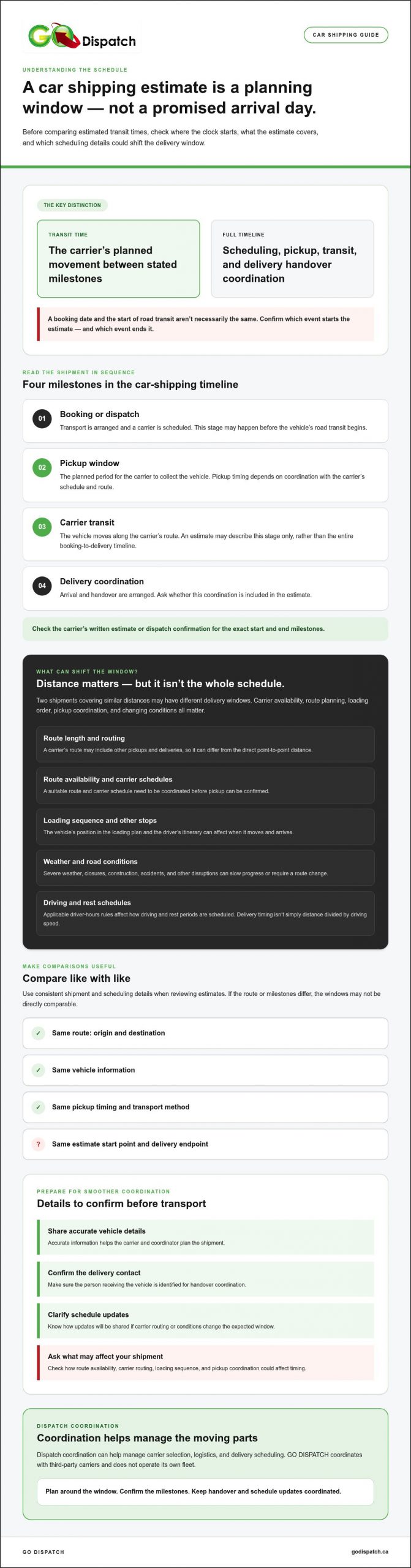
Think of the shipment as four milestones: booking or dispatch, the pickup window, carrier transit, and final delivery coordination. Booking and dispatch cover arranging transport and scheduling a carrier. Pickup is the planned period when the vehicle is collected. Transit refers to its movement along the carrier’s route. Delivery coordination covers arranging the arrival and handover.
Vehicle transit time measures the carrier’s planned movement between stated milestones; the complete booking-to-delivery timeline also includes scheduling, pickup, and handover coordination.
Transit time versus pickup and delivery windows
A vehicle may wait for carrier scheduling after transport is arranged, so the booking date and the start of road transit aren’t necessarily the same. Pickup and delivery windows allow time to coordinate collection and arrival around the carrier’s route and schedule. Ask whether the estimate starts at booking, carrier assignment, or vehicle pickup, and whether final delivery coordination is included.
Why estimates are expressed as windows
Carriers plan routes and loading sequences around multiple vehicle pickups and deliveries. That means the vehicle’s position in the loading plan and route can affect when it moves and arrives. Road conditions, closures, weather, and operational changes can also shift the expected schedule. A window reflects these variables; it isn’t a fixed service standard.
Car shipping is part of the broader logistics system known as freight transport, where movement depends on coordinated routes and handling, not distance alone. For a useful estimate, ask the carrier or coordinator to confirm the route, the milestone used to start transit, and the event used to mark delivery. Compare estimates only when those details match. That gives you a clearer view of what’s included and helps you plan around the full timeline, rather than relying on a transit figure that may cover only the journey itself.
How Route Distance, Carrier Schedules, and Conditions Shape Car Shipping Time
Distance matters, but kilometres alone can’t tell you when a vehicle will arrive. An estimate also depends on when a carrier can be scheduled, how its route is arranged, where your vehicle fits in the loading sequence, and how pickup is coordinated. That’s why two shipments covering similar distances may have different delivery windows.
Route availability, carrier scheduling, loading order, pickup coordination, weather, and road conditions are the main variables that can shift an estimated delivery window.
How route length and carrier routing affect estimates
A map shows the direct distance between two points. A carrier’s actual route may include other pickups and deliveries, so the vehicle may travel farther or take longer than the point-to-point comparison suggests. A shorter regional movement and a coast-to-coast shipment involve different route planning and scheduling needs. Ask whether your estimate reflects the carrier’s planned route or only the broad distance between the origin and destination.
Route demand and scheduled carrier movements can also affect dispatch timing. A carrier may need to coordinate a suitable route and loading sequence before pickup can be confirmed. The driver’s itinerary is shaped by multiple stops, not just your vehicle’s journey. For federally regulated motor carriers, the federal Motor Vehicle Transport Act forms part of the operating framework; applicable driver-hours rules also affect how driving and rest periods are scheduled. A delivery estimate therefore isn’t a simple calculation of distance divided by driving speed.
Weather, road conditions, and seasonal planning
Severe weather, road closures, construction, accidents, or other disruptions can slow progress or require a route change. Conditions may affect safe travel and the timing of stops, pickups, and deliveries. Their impact depends on the route and circumstances, so don’t assume a fixed seasonal delay. Instead, ask how the coordinator will communicate schedule changes and build flexibility into plans that depend on the vehicle’s arrival.
To make estimated transit times for car shipping more useful, confirm the pickup milestone, ask whether the route includes multiple stops, and clarify how updates will be shared if conditions change. Provide accurate pickup details and keep the delivery contact reachable. These steps can’t remove factors outside your control, but they can reduce avoidable coordination delays.
If coordinating carrier options and delivery scheduling is adding to your workload, vehicle transport dispatch coordination is one option to consider. GO DISPATCH coordinates with third-party carriers and manages logistics and delivery scheduling; it doesn’t operate its own carrier fleet.
How to Compare Estimated Car Shipping Times Across Canadian Routes
Compare the same stages, not just the number of days. An estimate that begins when a carrier collects the vehicle isn’t directly comparable with one that includes the wait for dispatch and pickup. For estimated transit times for car shipping, confirm the start and end milestones first, then check the route, vehicle, transport arrangement, and scheduling assumptions.
A fair framework for comparing route estimates
Use the table to organize estimates before choosing one. The route categories are broad planning labels, not promises of a specific duration. Ask the carrier or coordinator to confirm a current window for your shipment. Don’t treat an estimate as comparable if it leaves out pickup timing or doesn’t say what its window measures.
| Route category | What to compare | Confirm with the carrier or coordinator |
|---|---|---|
| Shorter regional route | Dispatch timing, pickup window, carrier transit, and delivery coordination | Whether the estimate starts at booking or pickup, plus planned stops and delivery milestone |
| Long-distance route | The same four stages, with attention to the route and scheduled carrier movements | Planned routing, loading sequence, pickup window, and how changes will be communicated |
| Complex or multi-stop route | Whether other pickups or deliveries affect the vehicle’s place in the carrier’s schedule | Which stages are included and whether the timing is a current route-specific estimate |
Why two estimates for similar distances can differ
Similar kilometre totals don’t mean identical carrier plans. One estimate may reflect a route with scheduled movements and a compatible loading plan, while another may depend on different carrier timing or pickup coordination. Vehicle type and dimensions can also affect how a carrier plans loading. Share accurate details, including the make, model, and year, and explain any special handling requirements when requesting an estimate.
Keep your comparison consistent. Record the origin and destination, vehicle details, transport arrangement, requested pickup timing, and the estimate’s start and end points. If any of these differ, ask what accounts for the difference before judging one window as faster or more reliable. Avoid assuming a universal timeline for a route category; get the current estimate confirmed for the shipment itself.
Transit is only one planning variable. If you’re also weighing transport arrangements and other factors that affect your decision, consult the guide Vehicle Transport Cost in Canada as a companion resource.
How to Plan Around a Car Shipping Estimate and Reduce Avoidable Delays
A useful estimate helps you plan, but complete information and clear communication make it easier to act on. Start by confirming the milestones it covers. Then share accurate shipment details, allow room for schedule changes, and agree on how you’ll receive updates. This gives you a practical plan without relying on an exact arrival date.
Information to provide for a useful estimate
Give the transport coordinator the exact pickup and delivery locations, not just broad destination areas. Include the vehicle’s make, model, and condition. Mention size or access considerations, such as limited space for carrier access, that could affect pickup or delivery coordination. Share your preferred timing and flag any business or personal deadlines so the coordinator understands what matters most.
Before the vehicle is collected, review How to Prepare Your Car for Professional Transport for vehicle-readiness guidance. Follow any instructions that apply to your vehicle and transport arrangement, and raise questions with the coordinator before pickup.
Questions to ask before confirming a timeline
Get the estimate’s start point in writing. Ask whether the window begins at booking, carrier assignment, or pickup, and whether it includes the time needed to schedule collection. Confirm the expected pickup window, who will receive the vehicle at delivery, and how you’ll hear about changes. Knowing who to contact and how updates will be shared prevents confusion if the schedule shifts.
- Confirm the milestones: What starts the estimate, and does the window include pickup coordination and final delivery?
- Confirm the contacts: Who is the delivery contact, and how should they be reached?
- Confirm updates: How will schedule changes and delivery updates be communicated?
- Raise fixed-date needs early: If you need the vehicle by a particular date, ask what can be planned and what flexibility may still be necessary. Don’t treat the estimate as a guaranteed arrival date.
Build a buffer into plans that depend on the vehicle, especially if a handover, work schedule, or onward journey is involved. Keep contact details current and respond promptly if the coordinator requests clarification. Complete information can help avoid preventable back-and-forth, but it can’t eliminate delays caused by route or operating conditions. Use estimated transit times for car shipping as a planning guide, and check for updates rather than assuming the schedule is unchanged.
If you’d like help coordinating carrier selection, shipment details, and delivery scheduling, coordinate your vehicle transport with GO DISPATCH. GO DISPATCH arranges transport with third-party carriers and manages logistics on your behalf.
Get a More Reliable Shipping Window Through Coordinated Dispatch
A clear estimate depends on more than a route and a vehicle. Someone needs to coordinate carrier selection, shipment details, logistics, and delivery scheduling. For businesses arranging vehicle movements alongside daily operations, one-stop dispatch coordination can bring these steps together and reduce the time spent managing separate details.
GO DISPATCH coordinates transport with third-party auto carriers. It doesn’t operate its own carrier fleet, and dispatch coordination can’t guarantee a specific arrival date. It can help organize the information and scheduling conversations behind a delivery window, so you know what the estimate is based on and how updates will be handled.
When dispatch coordination can help
Coordinating several vehicle movements can take attention away from other work. A single dispatch contact can help manage carrier selection, logistics, and delivery scheduling for cars, trucks, SUVs, and vans. Businesses planning inventory movements may also find the guide Dealership Auto Transport Logistics useful for considering transport within dealership operations.
What to share when asking about a delivery window
Provide enough detail for the coordinator to assess the shipment and discuss a relevant window. Be specific about:
- Vehicle: make, model, year, condition, and any dimensions or handling details that could affect carrier planning.
- Route: exact pickup and delivery endpoints, shared directly with the transport coordinator.
- Timing: preferred pickup period and any firm business deadline, such as when the vehicle is needed for inventory or operations.
Then ask how carrier selection will be coordinated, which milestones the estimate covers, and how you’ll receive schedule updates. Clear answers help you assess whether the proposed window fits your plans. They also make it easier to compare estimates on consistent terms, rather than focusing on a transit figure without knowing what it includes.
Use estimated transit times for car shipping as a planning tool, not a fixed promise. If a date is critical, raise it before confirming arrangements and ask what flexibility the schedule may require. A coordinator can help manage the logistics, but carrier schedules and conditions can still change.
For help coordinating vehicle transport and discussing a realistic delivery window, discuss transport coordination with GO DISPATCH.
Plan Your Vehicle Shipment with Clear Expectations
A useful shipping estimate is a planning window, not a guaranteed arrival date. Check which milestones it covers, from dispatch and pickup through carrier transit and delivery coordination. Then compare estimates using the same route details and scheduling assumptions.
Route planning, carrier schedules, loading order, and road conditions can all affect timing. Share accurate vehicle and location information, flag important deadlines, and confirm how you’ll receive updates. These steps make estimated transit times for car shipping easier to use when organizing a vehicle handover or business schedule.
GO DISPATCH coordinates vehicle transport nationally across Canada for cars, trucks, SUVs, and vans. Carrier selection, logistics coordination, and delivery scheduling are handled through one service, using third-party carriers. That coordination can simplify the process, while arrival timing remains subject to carrier schedules and conditions.
Have a shipment to plan? Discuss your vehicle shipping timeline with GO DISPATCH and get your transport details organized. With clear information and realistic expectations, you can plan the next steps with greater confidence.
Frequently Asked Questions
How long does it take to ship a car across Canada?
Coast-to-coast car transport may take an estimated 10 to 14 days in transit, but the complete booking-to-delivery timeline can be longer. That estimate may not include carrier scheduling or the pickup window. Route planning, loading sequence, weather, and road conditions can also affect timing. Ask the coordinator for a current estimate based on your exact route and confirm which milestones it includes before planning around the arrival.
Does a car shipping estimate include the pickup window?
Not always. Some estimates describe carrier transit after pickup, while others may include time for dispatch or pickup scheduling. Ask what event starts the estimate and whether it covers the wait for carrier assignment, the pickup window, transit, and final delivery coordination. Confirming these milestones helps you compare estimates fairly and avoid mistaking a transit estimate for the full time between arranging transport and receiving the vehicle.
Can weather delay car shipping in Canada?
Yes. Severe weather can slow safe travel, disrupt roads, or require schedule changes, which may affect pickup or delivery timing. Conditions vary by route and date, so there isn’t one fixed weather-related delay to expect. Keep some flexibility in plans that depend on the vehicle’s arrival, and ask the coordinator how changes and delivery updates will be shared if conditions affect the schedule.
Is an estimated car delivery date guaranteed?
No. An estimated delivery date is a planning guide, not a guaranteed arrival date. Carrier routing, loading plans, road conditions, and operational changes can shift the expected window. Check whether the estimate refers to carrier transit only or also includes pickup scheduling and delivery coordination. If the vehicle is needed by a firm date, raise that deadline before confirming arrangements and ask what flexibility may be required.
What information do I need to get a car shipping time estimate?
Provide the exact pickup and delivery locations, vehicle make, model, year, and condition. Mention any size, access, or handling considerations, along with your preferred timing and any important deadline. These details help the coordinator assess the shipment and discuss a relevant window. Also ask when the estimate starts, what stages it includes, and how you’ll receive updates if the schedule changes.
Can I speed up the car shipping process?
You can help avoid preventable delays, but you can’t control carrier schedules or guarantee faster delivery. Share complete vehicle and route details promptly, respond to questions, prepare the vehicle for pickup, and be flexible about timing where possible. Ask the coordinator whether your preferred dates fit available carrier arrangements and how the shipment will be scheduled. Accurate information and clear communication make planning smoother, even when the transit time itself can’t be shortened.