
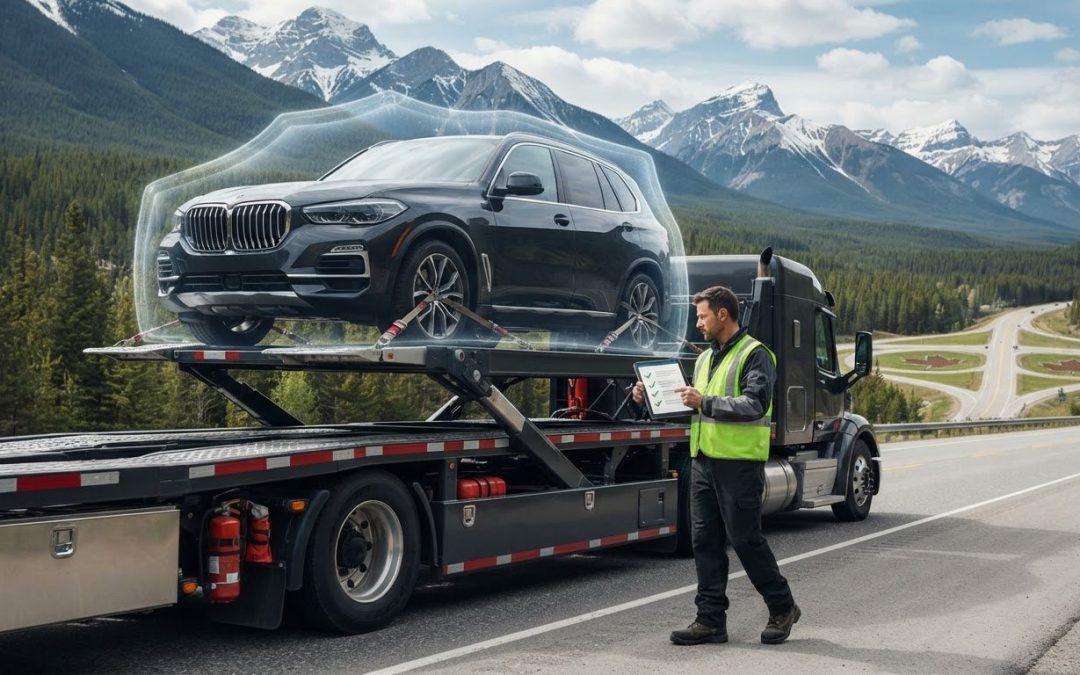
What if your $60,000 SUV is suddenly only worth $7,000 the moment it rolls onto a transport truck? It sounds like a nightmare, but under Canadian statutory liability laws, a carrier’s default coverage is often capped at just C$2.00 per pound. You’re likely asking yourself, do i need insurance to ship my car, or will the transport company handle everything? It’s a valid concern. You want your vehicle protected without the stress of hidden fine print or unexpected deductibles.
We understand that handing over your keys requires trust. You shouldn’t have to decode complex logistics jargon just to ensure your investment is safe. This 2026 guide clears up the confusion surrounding carrier cargo insurance, broker liability, and the vetting process that keeps your vehicle secure. We’ll show you how to verify a carrier’s policy and why your personal auto insurance might take a back seat during transit. You’ll get the clear facts needed to move your car across Canada with total peace of mind.
Key Takeaways
- Understand the three layers of protection and answer the question “do i need insurance to ship my car” by identifying the gaps in standard personal auto policies.
- Learn which specific risks are covered by carrier cargo insurance, including theft and transit damage, and which are excluded, like personal items left inside the cabin.
- See how expert dispatching services eliminate the “insurance headache” by rigorously vetting every carrier’s policy status and expiry dates.
- Identify the red flags of inadequate coverage and hidden deductibles that often hide within low-cost transport quotes.
- Gain a step-by-step checklist for completing a professional pre-transport inspection and securing a valid Bill of Lading for your legal protection.
Understanding the Basics of Car Shipping Insurance in Canada
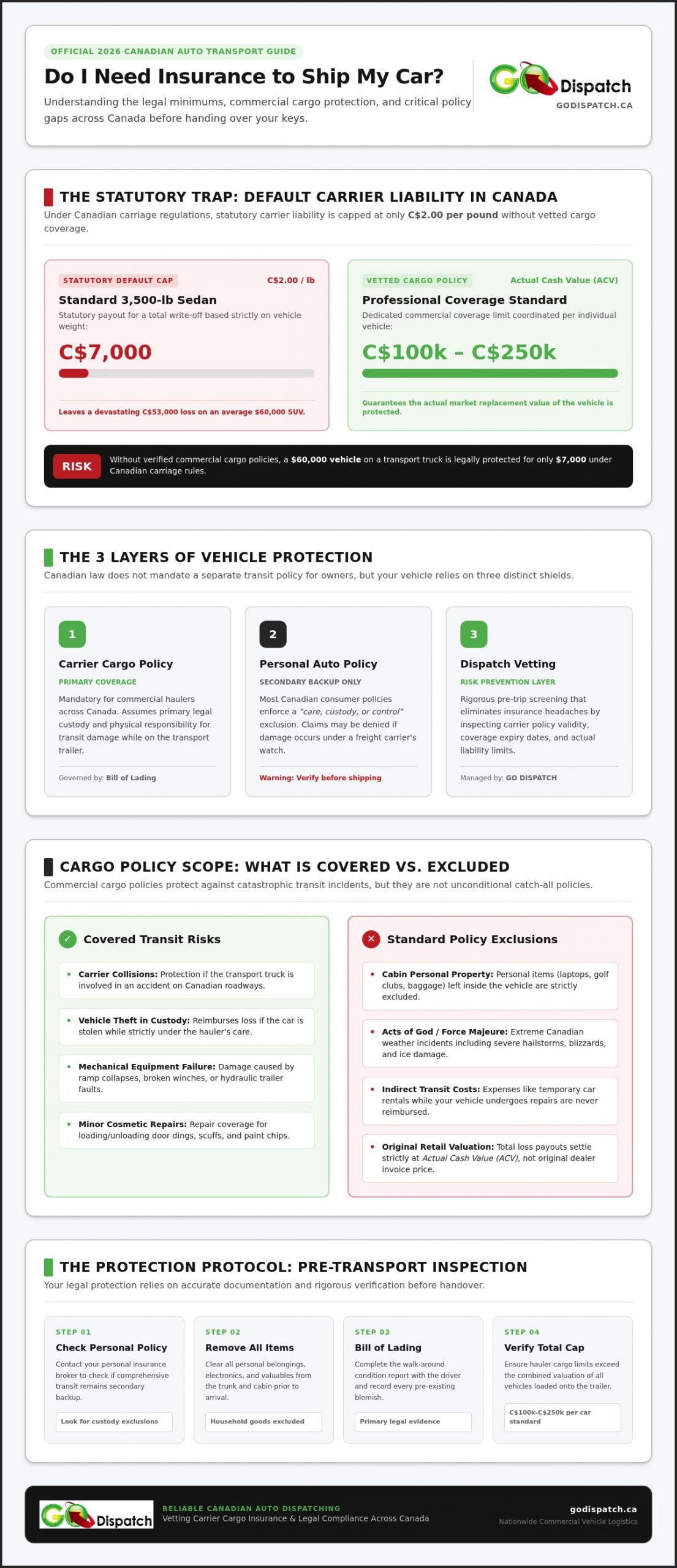
Handing over your keys to a transport driver feels like a major leap of faith. You’ve invested a lot in your vehicle, so it’s natural to ask: do i need insurance to ship my car? In Canada, you aren’t legally required to buy a temporary policy for the trip, but you must understand the three layers of protection that keep your investment safe. These layers include your personal insurance, the carrier’s commercial cargo policy, and the dispatcher’s rigorous vetting standards.
Cargo Insurance is the primary protection for vehicles in the custody of a professional hauler. This coverage is mandatory for any commercial carrier operating across the country. While your car is on the trailer, the carrier assumes legal responsibility for its physical condition. This responsibility is governed by national transport regulations and the details noted on your bill of lading condition report.
Personal Policy vs. Commercial Transit
Most Canadian drivers assume their standard auto policy covers them in every situation. This is a common misconception. Most consumer policies contain a “care, custody, or control” exclusion. This means your insurance provider may deny a claim if the damage occurs while the vehicle is being handled by a commercial freight company. If you’re wondering, do i need insurance to ship my car to cover these specific gaps, the answer lies in your existing policy’s fine print. It’s best to call your insurance broker before the pick-up date. Tell them your vehicle is being transported nationally. They can confirm if your comprehensive coverage remains active during the trip, though it usually acts only as a secondary backup to the carrier’s policy.
The Legal Minimums for Canadian Haulers
Every professional hauler in Canada must carry active cargo insurance, but the amount of coverage varies. Under national carriage regulations, a carrier’s statutory liability is often capped at C$2.00 per pound. For a standard 3,500-pound sedan, that only totals C$7,000 in protection. This is why “Full Coverage” is so important. A professional carrier should have a policy that covers the actual cash value of your vehicle, often ranging from C$100,000 to C$250,000 per car. GO DISPATCH ensures every carrier we coordinate meets these high standards so you aren’t left with a massive financial gap if an accident happens on the road.
Evaluating Carrier Cargo Insurance and Liability Coverage
Standard cargo insurance is designed to protect your vehicle against major transit risks. If a transport truck is involved in a collision or if the vehicle is stolen while in the carrier’s possession, the cargo policy triggers. It also covers damage caused by equipment failure, such as a faulty winch or a loading ramp collapse. However, this coverage isn’t a “catch-all” safety net for every possible scenario. Understanding the boundaries of these policies helps you answer the question, do i need insurance to ship my car, or if you should seek additional protection.
Most commercial policies in Canada operate on an Actual Cash Value (ACV) basis. This means if a total loss occurs, the insurer pays out the current market value of the car, not the original price you paid at the dealership. For minor cosmetic issues, like a small door ding or a paint chip, the carrier’s policy usually covers the cost of repair. It’s vital to distinguish between these minor repairs and a total loss, as the claims process and documentation requirements differ significantly. Professional car transport dispatching ensures your carrier’s policy is active and sufficient for your specific vehicle’s value before the trip begins.
Cargo Insurance Exclusions to Realize
Carriers are licensed to move vehicles, not household goods. Any personal items left inside the cabin or trunk are strictly excluded from cargo insurance. If a laptop or a set of golf clubs is stolen from the backseat, the carrier’s insurance will not reimburse you. Additionally, most policies include “force majeure” or “Acts of God” clauses. These often exclude damage from extreme Canadian weather, such as hailstorms or ice. For a deeper look at how these policies differ from your daily driver coverage, consult the Insurance Bureau of Canada’s breakdown of auto coverage types. You should also be aware that indirect costs, such as car rentals while your vehicle is being repaired, are almost never covered by a transport company.
The Importance of Valuation
Before your car is loaded, the carrier must have a policy limit that exceeds the total value of every vehicle on their trailer. If a hauler is carrying nine luxury SUVs, a C$500,000 policy might not be enough to cover a total loss. This is why do i need insurance to ship my car is such a critical question for owners of classic cars or high-end electric vehicles. For these specialized loads, we verify that the carrier has specific riders or higher aggregate limits. Always ensure your vehicle’s value is clearly understood and that the carrier’s insurance certificate reflects a high enough limit to protect the entire load during its journey across the country.
How Dispatch Services Verify and Manage Insurance Risks
Many people asking do i need insurance to ship my car are actually looking for a guarantee that their vehicle is in safe hands. This is where a professional dispatcher becomes your greatest asset. GO DISPATCH doesn’t just find a truck; we act as a rigorous filter for the entire industry. By the time a carrier arrives at your door, they’ve already passed a multi-point verification process that most individual shippers simply don’t have the time or resources to perform. Our role is to stand between you and the logistical complexities of the transport world, providing a layer of oversight that individual carriers often lack.
Our primary job is to eliminate the “insurance headache” by monitoring carrier status in real-time. We keep digital records of every hauler’s cargo and liability certificates. If a policy is set to expire or if a carrier’s safety rating drops, they’re immediately removed from our active rotation. This proactive approach prevents you from accidentally hiring an “insurance-light” hauler who might be operating with inadequate limits or a lapsed policy. You get the benefit of a high-capacity partner that handles the complex vetting behind the scenes.
The Vetting Process for National Carriers
Selecting a reliable partner involves more than just checking a box. We look for carriers with proven track records across Canada’s diverse terrain. Our vetting criteria include verifying minimum liability limits, which typically range from C$1,000,000 to C$5,000,000, alongside active Motor Truck Cargo insurance. We only maintain a network of safe vehicle transport services that demonstrate consistent professionalism. This level of scrutiny provides you with immediate trust, knowing that your vehicle is backed by a legitimate, verified commercial policy for the duration of its journey. We also examine safety ratings and carrier history to ensure that every driver assigned to your load is a vetted professional with a history of safe deliveries.
Streamlining Logistics for Dealerships and Fleets
For businesses moving dozens of vehicles, the paperwork can quickly become overwhelming. Managing insurance documentation for a fleet requires precision and speed. Our one-stop dispatching solution simplifies this inventory relocation by centralizing all carrier certificates and inspection reports. We handle the complex logistics, allowing your team to focus on sales rather than tracking down insurance binders. You can learn more about how we support high-volume moves in our guide on Dealership Auto Transport Logistics: The Power of Professional Auto Carrier Dispatch. This streamlined coordination ensures that every car, truck, or SUV in your shipment is fully protected from the moment it leaves the lot until it reaches its final destination. When you’re managing a large inventory, having a partner that understands the question do i need insurance to ship my car from a commercial perspective is essential for your bottom line.
Avoiding Common Pitfalls: Personal Policies and Hidden Gaps
Cheap quotes often hide expensive risks. When you see a price that seems too good to be true, it’s usually because the hauler is cutting corners on their insurance premiums. You might wonder, do i need insurance to ship my car through a low-cost provider, but the real question is whether that provider has enough coverage to pay out if things go wrong. A carrier with a high deductible or a lapsed policy puts your entire investment at risk. You should always cross-reference any quote with a reliable vehicle transport cost Canada guide to ensure you’re paying for quality and security.
Deductibles are a major source of confusion in the industry. Most commercial cargo policies have deductibles ranging from C$2,500 to C$7,500. Under a standard professional contract, the carrier is responsible for paying this amount, not you. However, some “discount” haulers try to slip clauses into their fine print that pass the first C$500 or C$1,000 of a claim back to the customer. Always request a Certificate of Insurance (COI) before your vehicle is loaded. This document is your proof that the carrier is currently insured and shows exactly what their limits are. If a hauler hesitates to provide a COI, it’s a massive red flag.
The “Personal Items” Misconception
Packing your car with boxes might seem like a great way to save on moving costs, but it’s a dangerous mistake. Carriers are licensed to move vehicles, not household goods. If you pack the trunk or backseat, those items are not covered by the carrier’s cargo insurance. Shifting cargo can also damage the car’s interior or even break windows from the inside. Even worse, extra weight can put the trailer over its legal gross vehicle weight rating. This violation can void the carrier’s insurance entirely, leaving you asking do i need insurance to ship my car because the carrier’s policy is no longer valid. Keep your vehicle empty to ensure your coverage remains fully intact.
Verifying the Carrier Directly
Checking an insurance document isn’t always easy for the untrained eye. You need to look for “real-time” verification to ensure the policy hasn’t been cancelled for non-payment. Red flags include blurred text on a PDF, expired dates, or a policy limit that doesn’t match the value of the vehicles on the trailer. We take this burden off your shoulders by handling all policy verifications on your behalf. Our team monitors these certificates daily to ensure every hauler in our network is fully compliant with 2026 safety standards. You can book your transport with confidence knowing that we’ve already done the hard work of vetting the paperwork for you.
The Protection Process: From Inspection to Final Delivery
The carrier’s insurance policy is your safety net, but the Bill of Lading (BOL) is the trigger that activates it. Even if you’ve answered the question, do i need insurance to ship my car, the protection is only valid if you follow a strict documentation protocol. This document acts as a contract, a receipt, and a condition report all in one. Without a properly completed BOL, proving that damage occurred during transit becomes nearly impossible. It’s the foundation of your legal protection from the moment the driver arrives for pick-up until the keys are back in your hand.
The process begins and ends with a thorough inspection. You shouldn’t rush this step. A professional driver will walk around the vehicle with you to note any existing issues. This isn’t just about big dents. You need to look for small paint chips, glass cracks, and undercarriage scuffs. Once the car arrives at its destination, you’ll perform the exact same walk-around to ensure nothing has changed. This “before and after” snapshot is what insurers use to verify a claim, making it the most critical part of the delivery day protocol.
Mastering the Bill of Lading
During the initial walk-around, make sure every scratch and chip is clearly marked on the BOL. Modern carriers often use digital versions with timestamped, high-resolution photos. These are incredibly effective for eliminating disputes over pre-existing road rash versus transit damage. If you’re using a paper form, ensure the markings are legible and accurate. Both you and the driver must sign the document before the vehicle is loaded. Never let a vehicle leave without receiving a copy of the signed BOL. This is your primary evidence if you ever need to ask, do i need insurance to ship my car to cover a new scratch found after delivery.
Reporting and Resolving Claims
If you spot damage during the delivery inspection, you must act fast. First, note the specific damage directly on the Bill of Lading before you sign for the delivery. Signing a “clean” BOL without noting defects can lead to an immediate claim denial because it acts as prima facie evidence that the vehicle was received in good condition. Most carriers require transit damage to be reported within a 24 to 48 hour window to avoid repudiation. Gather your evidence immediately by taking clear photos with timestamps and geotags.
GO DISPATCH supports our clients through this entire coordination process. While we aren’t the insurer, our team acts as a facilitator to ensure the carrier and their insurance provider receive the necessary documentation to resolve the claim quickly. We understand that damage is rare, but when it happens, you need a partner who can navigate the paperwork for you. This human-centric support provides the peace of mind you need when navigating the rare event of a transit claim.
Secure Your Vehicle with Confidence
Protecting your vehicle during a national move doesn’t have to be a source of stress. You now know that while you often ask, do i need insurance to ship my car, the real security comes from a combination of verified carrier cargo policies and a bulletproof Bill of Lading. Your personal policy likely has gaps during commercial transit. A professional transport setup ensures those holes are filled before your car ever leaves the driveway.
Since 2020, we’ve provided expert dispatching that puts client security first. Our human-led logistics support manages the heavy lifting of vetting carriers so you don’t have to. We maintain a national network of vetted carriers who meet strict safety and insurance standards. This ensures your car, truck, or SUV is always in the hands of a professional who is fully covered for the journey ahead.
Ready to move your vehicle without the insurance headache? Get a Professional Quote for Your Insured Vehicle Move today. We’re here to make your next transport simple, safe, and entirely reliable.
Frequently Asked Questions
Do I need to buy a separate insurance policy to ship my car?
You don’t need to purchase a separate insurance policy to move your vehicle across the country. Every licensed commercial carrier in Canada is legally required to maintain active cargo insurance. This coverage protects your car while it’s in their care and control. While you don’t need a new policy, it’s a smart move to call your own provider. Confirm if your existing comprehensive coverage remains active during professional transport as a secondary backup.
What happens if my car is damaged during transport in Canada?
If you notice damage at the time of delivery, you must document it immediately on the Bill of Lading. This is your primary legal protection. Take high-resolution photos with timestamps to prove the condition of the vehicle. Once the damage is noted on the signed document, you can begin the formal claims process with the carrier’s insurance provider. We facilitate this coordination to ensure the carrier handles your claim professionally and quickly.
Will my personal car insurance cover damage during shipping?
Most personal Canadian auto policies won’t act as the primary coverage during commercial transport. Standard policies often contain a “care, custody, or control” exclusion that triggers when a professional hauler takes possession. While your policy might provide secondary protection in rare cases, the carrier’s cargo insurance is designed to be the first line of defence. If you’re asking, do i need insurance to ship my car, rely on the carrier’s verified commercial policy first.
Does the carrier’s insurance cover my personal belongings inside the car?
No, the carrier’s cargo insurance strictly excludes personal belongings, household goods, or electronics left inside the vehicle. Licensed auto haulers are only insured to transport the vehicle itself. Any items left in the cabin or trunk are moved at your own risk. Shifting items can also cause interior damage that isn’t covered. For the safest experience, remove all valuables and personal effects before the driver arrives for the initial pick-up.
How do I verify if a car transport company is actually insured?
You can verify a company’s status by requesting a current Certificate of Insurance (COI) directly from the carrier. This document should list their cargo and liability limits along with an expiry date. Verifying this on your own can be time-consuming and complex. We take the guesswork out of the process by vetting every carrier in our network. We monitor their insurance status in real-time to ensure they meet national safety and coverage standards before any loading.
Is there a deductible for car shipping insurance claims?
Commercial cargo policies do have deductibles, but these are typically the responsibility of the transport company. You shouldn’t have to pay a deductible for a valid claim under the carrier’s insurance. Some low-cost haulers try to shift this cost to the customer in their fine print. We only work with professional carriers who maintain standard industry practices. This means you get full protection without worrying about unexpected out-of-pocket expenses if an incident occurs during transit.
What is a Bill of Lading and why does it matter for insurance?
The Bill of Lading (BOL) is the most important legal document in the shipping process. It serves as your contract of carriage and a detailed receipt of the vehicle’s condition. If you don’t note damage on the BOL during the delivery inspection, the insurance company will likely deny your claim. It provides the “before and after” evidence required to prove that damage happened while the car was in the carrier’s possession.
Does insurance cover weather-related damage like hail or snow?
Standard carrier liability often excludes “Acts of God,” which includes extreme weather events like hailstorms or heavy snow. If you’re shipping on an open trailer, your vehicle is exposed to the Canadian climate. This is a key reason why many owners ask, do i need insurance to ship my car, when moving high-value vehicles. For total protection against the elements, we recommend enclosed transport. This option neutralizes weather risks by keeping your car in a fully sheltered environment.