

The lowest quote you receive for cross-country vehicle transport is often the one that ends up costing you the most in hidden surcharges and transit delays. Moving a vehicle over 4,300 kilometres is a massive logistical undertaking that requires absolute precision. It’s natural to feel anxious about unpredictable fuel costs or whether your car will arrive safely at its destination. You want a process that’s simple, not a second job managing carriers. You realize that your time is valuable and you need a solution that just works without the headache.
One of the first questions on your mind is likely how much to ship a car from toronto to vancouver in the current 2026 market. This guide reveals the primary factors that influence long-haul transport costs and shows you how to secure the most efficient rate for your move. You’ll gain a clear understanding of what actually drives pricing and see how professional dispatching provides the peace of mind you deserve. We will break down transport methods and explain how to streamline your search for a reliable carrier to help you organize a seamless relocation.
Key Takeaways
- Identify the specific market factors and seasonal shifts that dictate how much to ship a car from toronto to vancouver.
- Compare the benefits of standard open-carrier hauling against the added protection of premium enclosed transport for high-value vehicles.
- Learn how to properly document your vehicle’s condition and organize a thorough cleaning to ensure a successful pre-shipment inspection.
- Understand why vehicle size, weight, and operational status are critical variables that directly influence your final transport quote.
- Discover how professional dispatching acts as a one-stop solution to vet carriers and manage complex logistics on your behalf.
Understanding the Costs of National Vehicle Transport
Shipping a vehicle across Canada involves a complex set of variables that go far beyond a simple odometer reading. When you ask how much to ship a car from toronto to vancouver, you want a figure that reflects distance, equipment type, and current market demand. These rates aren’t static. They fluctuate based on seasonal fuel surcharges and the availability of specialized trailers. Moving a car over thousands of kilometres requires significantly more coordination than a local tow. Crossing provincial lines introduces different regulations and logistical hurdles. Professional dispatching helps stabilize these expenses by sourcing the best-fit carrier for your specific timeline and vehicle type.
The Role of Distance in Your Shipping Quote
Distance is the primary driver of cost, but the relationship isn’t linear. Generally, the price-per-kilometre decreases as the total distance of the route increases. Long-haul routes allow carriers to maximize their time on the road without frequent stops. However, “deadhead” kilometres can drive prices up unexpectedly. These represent the empty miles a carrier must drive to reach your vehicle or their next pickup location. Shipping along major national corridors helps mitigate this risk. These high-volume routes have a constant flow of active carriers. This leads to more competitive rates and more reliable scheduling options for your move.
Brokerage Fees and Value-Added Logistics
Understanding the difference between a base transport fee and a brokerage fee is essential for a clear budget. A base fee covers the physical movement of the vehicle. A fee paid to an Auto transport broker or dispatch service covers the professional coordination that happens behind the scenes. Budgeting for how much to ship a car from toronto to vancouver requires looking at more than just the fuel. You aren’t just paying for a spot on a truck; you’re paying for a managed process that includes:
- Vetting carriers for active insurance and safety compliance
- Coordinating pickup and delivery windows across multiple time zones
- Managing communication between the client and the carrier
- Handling the complex paperwork required for cross-province transport
Professional coordination prevents costly delays and safety issues. It ensures your vehicle is placed with a carrier that has the correct equipment for your specific car or truck. For dealerships and individuals alike, a one-stop dispatch point removes the burden of managing multiple drivers. You get a single point of accountability. This streamlined approach reduces your daily workload. It ensures the logistical heavy lifting happens without your constant intervention. You can focus on your move while experts handle the dispatching details.
Key Variables that Determine Your Final Transport Rate
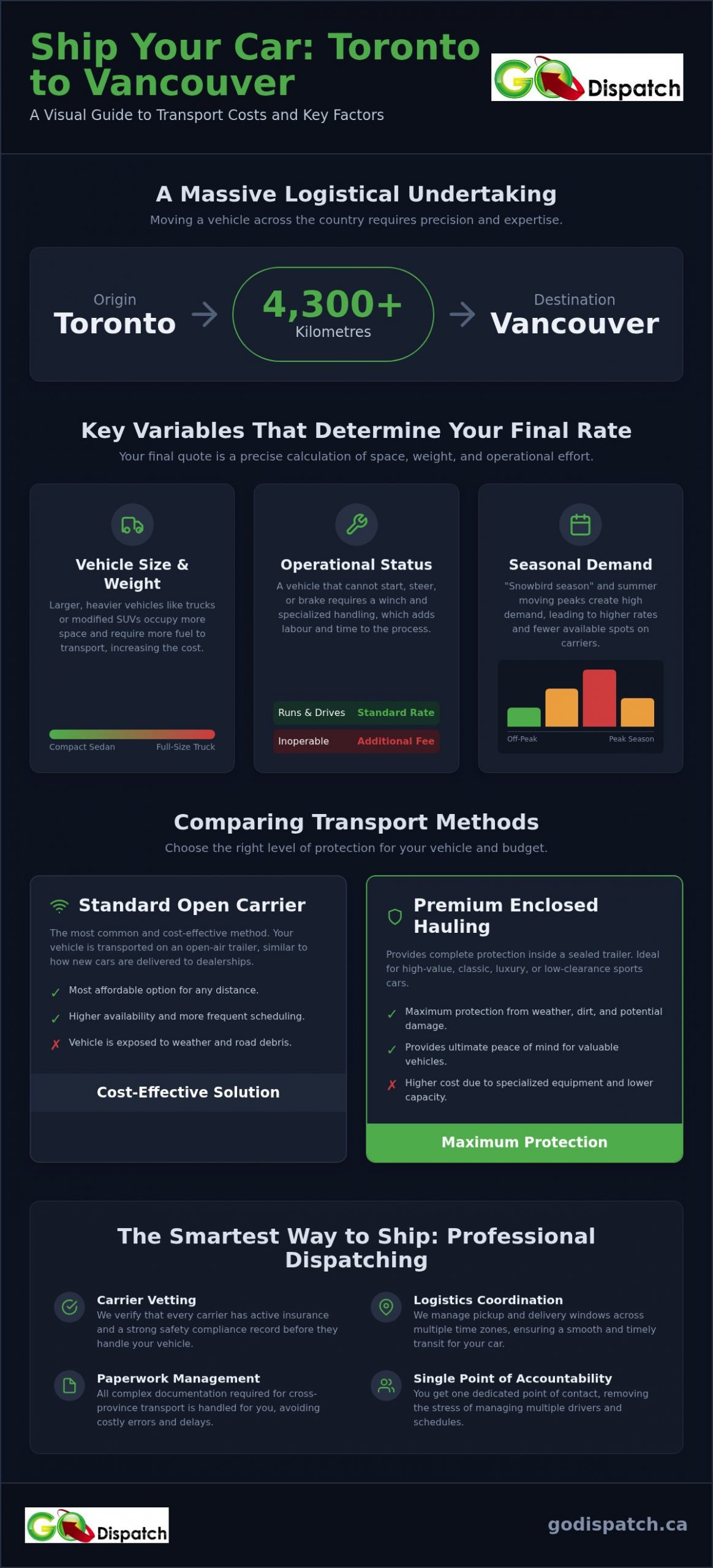
Your final quote is a precise calculation of physical space and operational effort. When you research how much to ship a car from toronto to vancouver, you’ll see that carriers prioritize the specific footprint of your vehicle. A compact sedan takes up less room and adds less weight than a heavy-duty pickup truck. This matters because every kilogram impacts the transport truck’s fuel efficiency. Beyond size, your vehicle’s operational status is a major factor. If a car doesn’t start or steer, it requires specialized equipment like a winch to load and unload. This adds time and labour to the process. You can find detailed breakdowns of how much it costs to ship a car to better understand these logistical components.
Vehicle Dimensions and Weight Considerations
Trailer real estate is limited. Height and width are just as important as length. If your vehicle has a lift kit or a permanent roof rack, it might not fit on a standard multi-car carrier. These modifications must be disclosed early to avoid delays at the pickup point. Heavier vehicles like electric SUVs or full-size vans require more power to haul. This increased demand on the carrier’s equipment is reflected in your final rate. Providing accurate dimensions ensures you get an honest quote without surprise adjustments later. If you have questions about your specific vehicle type, our team can help you organize your transport details efficiently.
Seasonal Impacts on National Hauling
Timing affects availability and pricing. Canada’s “snowbird” season creates a massive surge in demand as vehicles move south or west for the winter. This high volume can lead to higher rates and longer wait periods for a spot on a trailer. Planning ahead for how much to ship a car from toronto to vancouver allows you to avoid the peak pricing of the busiest moving months. Winter weather also introduces risks. Icy roads and heavy snow in the mountains can slow down transit times significantly. Carriers often face higher insurance premiums during these months due to increased road hazards. To secure the most cost-effective rates, try to book during the late spring or early autumn. These windows typically offer more stable weather and better carrier availability. Understanding these cycles helps you plan a move that fits your budget and your timeline.
Comparing Transport Methods: Open vs. Enclosed Hauling
Choosing between open and enclosed transport is a pivotal decision that dictates how much to ship a car from toronto to vancouver. Most standard vehicles move via open carriers. This is the same method dealerships use to receive new inventory. It’s efficient and reliable. For luxury, classic, or high-value assets, enclosed transport provides a physical barrier against the elements. Rail transport is another high-volume alternative often used for cross-country routes. While rail can be cost-effective, it often involves longer transit times and requires additional logistics for the final delivery to your door.
When to Choose Open-Carrier Hauling
Open-carrier transport is the industry standard for a reason. It’s the most common method for daily drivers and fleet vehicles. Because these trailers are widely available, they offer more frequent departures and faster scheduling. You won’t wait as long for a spot to open up. A common misconception is that open hauling is unsafe. In reality, carriers use sophisticated tie-down systems and strategic loading to protect vehicles. While your car is exposed to weather and road dust, it remains securely fastened throughout the 4,300-kilometre journey. This method provides the best balance of speed and value for the majority of moves.
The Benefits of Enclosed Transport for High-Value Assets
Enclosed-carrier transport is a premium service designed for total peace of mind. It protects your vehicle from road debris, dust, and the extreme weather shifts common during a cross-country transit. This is the recommended choice for:
- Exotic or luxury vehicles with sensitive paint finishes
- Classic cars that require protection from moisture and grit
- Vehicles with low ground clearance that need specialized ramps
This level of protection comes with a higher price point. Enclosed transport typically carries a 30% to 60% premium over open-carrier rates. This increase reflects the specialized equipment and the lower capacity of enclosed trailers. It’s an investment in preservation. If you’re calculating how much to ship a car from toronto to vancouver for a collector item, this premium is often worth the extra cost. It ensures your asset arrives in the exact condition it left. You can rest easy knowing your vehicle isn’t exposed to the grit of the road during its long journey.
Essential Preparation for National Vehicle Delivery
Proper preparation is the foundation of a stress-free move. While you focus on how much to ship a car from toronto to vancouver, don’t overlook the physical steps needed to protect your asset. Start with a thorough cleaning. A clean car allows for a precise pre-shipment inspection where every existing scratch or dent is clearly visible. Document the vehicle’s condition by taking high-resolution photos from every angle, including the roof and lower panels. This visual record is your best protection in the rare event of a claim. You should also reduce your fuel tank to roughly one-quarter full. This reduces the total weight of the load. It helps the carrier manage their fuel efficiency across the long trek west, which ultimately impacts how much to ship a car from toronto to vancouver during peak seasons.
The Inspection Process and Bill of Lading
The Bill of Lading is your most vital document. It serves as your contract and your formal receipt. When the carrier arrives, you must conduct a joint inspection. Walk around the car together and ensure every mark is noted on the report. If you realize there is a discrepancy between the car’s condition and the report at the destination, you must document it immediately on the Bill of Lading before the driver leaves. This document is the primary evidence used for insurance purposes. Being meticulous during this stage ensures you maintain total peace of mind. Our team can help you organize your delivery documents to ensure everything is in order before the truck arrives.
Managing Personal Items and Loose Parts
It is a common mistake to treat a vehicle as a moving van. Auto carriers are not insured to transport personal household goods. Items left inside the cabin or trunk can shift during the 4,300-kilometre journey, potentially causing interior damage. You must remove all personal belongings to ensure a safe transit. This includes:
- Toll tags and parking passes
- Loose chargers and sunglasses
- Aftermarket GPS units or tablets
- Custom bike racks or removable spoilers
Securing or removing exterior modifications is equally important. High-profile accessories can catch the wind or interfere with the trailer’s clearance. By stripping the car down to its factory state, you minimize the risk of loss or damage. This preparation ensures the carrier can focus on the safe movement of the vehicle itself. Taking these simple steps allows you to realize a smoother, more efficient transport experience from start to finish. You can focus on your own move while the professionals handle the heavy lifting behind the scenes.
Why Professional Dispatching is the Smartest Way to Ship
Managing a move across 4,300 kilometres is a massive burden. While you are focused on how much to ship a car from toronto to vancouver, the logistical reality is often more complex than a single quote. GO DISPATCH acts as your professional advocate. We remove the stress by managing the entire process from start to finish. Instead of you hunting for a carrier manually, we use our vetted network to find the most efficient route. This saves you time and protects your investment. Our role is to simplify the complex. We turn a high-stakes move into a predictable, managed outcome that fits your schedule.
Vetting Carriers for Safety and Compliance
Safety is not a luxury. We perform a rigorous vetting process for every carrier in our network. This includes checking active insurance policies and verifying operating authorities. We monitor carrier performance continuously to ensure reliable service. This layer of protection is essential for high-value national moves. You realize that your vehicle is a significant asset. Entrusting it to a professional dispatch service ensures it stays in safe hands. We handle the background checks so you don’t have to. We maintain high standards because we know your peace of mind depends on it. This proactive approach prevents common industry pitfalls like under-insured carriers or unreliable scheduling.
Streamlining Communication and Scheduling
Professional dispatchers handle the constant back-and-forth with drivers. You won’t spend your afternoon chasing updates or managing delivery windows. We provide a single contact point for all your logistics needs. This clear communication is vital to avoid unnecessary storage fees at either end of the journey. Accurate scheduling ensures your car arrives when you are ready to receive it. We manage the timing so you can focus on your life. For a deeper look at the industry, see our Vehicle delivery logistics in Canada: A 2026 Strategic Guide. We act as the bridge between your needs and the carrier’s operations. This results in a faster, more transparent experience that requires minimal effort from you.
Logistics shouldn’t be your second job. By choosing a one-stop shop, you gain peace of mind and professional results. We understand the nuances of how much to ship a car from toronto to vancouver and work to stabilize those variables for you. Our network allows us to source the best-fit carrier for your specific needs, whether you are moving a daily driver or a luxury SUV. We take pride in handling the details behind the scenes. Contact GO DISPATCH today to organize your cross-country transport.
Secure Your Cross-Country Move with Confidence
Moving your vehicle across the country is a significant milestone that requires more than just a search for the lowest price. You now realize that while distance is the main driver, vehicle dimensions and seasonal shifts are equally critical factors. By organizing a thorough cleaning and documenting your car’s condition, you ensure a transparent and safe delivery process. Determining how much to ship a car from toronto to vancouver doesn’t have to be a source of anxiety when you have the right logistical partner by your side.
GO DISPATCH provides one-stop transport dispatching for cars, trucks, and SUVs. We handle the expert logistics management that both dealerships and individuals rely on for total peace of mind. Our team connects you with a national network of vetted auto carriers to ensure your vehicle is always in professional hands. You can focus on your new beginning while we manage the complex scheduling and carrier coordination behind the scenes. Efficiency and reliability are the standards you deserve for your next move.
Get a Professional Quote from GO DISPATCH today and experience a streamlined move that puts your needs first. Your vehicle’s journey is our priority.
Frequently Asked Questions
How much does it cost to ship a car across Canada in 2026?
Pricing depends on distance, vehicle size, and the chosen transport method. When calculating how much to ship a car from toronto to vancouver, you’ll see that rates fluctuate due to fuel surcharges and seasonal demand. Shipping a standard sedan over several thousand kilometres typically involves higher costs than local transport. You should realize that market capacity and specialized trailer availability also play a role. It’s best to request a personalized quote to understand the specific variables for your move.
How long does it take to transport a vehicle from one province to another?
Transit times vary based on the total distance and the carrier’s route schedule. A cross-country journey usually takes between one and three weeks, depending on whether you choose road or rail transport. Factors like weather conditions and the number of stops the carrier makes can also influence the timeline. We manage the scheduling to ensure your vehicle arrives as efficiently as possible while keeping you informed throughout the process. This coordination helps you plan your move with confidence.
Is my vehicle insured while it is being hauled by a professional carrier?
Professional carriers are required to carry cargo insurance to protect your vehicle during transit. We perform a rigorous vetting process to verify that every carrier in our network maintains active and sufficient insurance coverage. This layer of protection is vital for your peace of mind. You should always review the specific coverage limits and terms provided on the Bill of Lading during the pickup inspection to ensure you are fully protected against any unforeseen issues during the haul.
Can I leave personal items inside my car during transport?
You should remove all personal belongings and loose items from your vehicle before shipping. Auto carriers are generally not insured to transport household goods or personal property inside the cabin or trunk. Items left inside can shift during the long journey, potentially causing damage to the interior. Stripping the car down to its factory state ensures a safer transit and prevents any issues with the carrier’s weight limits or insurance policies. This preparation helps organize a smooth delivery.
What is the difference between an auto transport broker and a direct carrier?
An auto transport dispatch service acts as an intermediary that connects you with a network of vetted carriers. A direct carrier owns the trucks and performs the physical hauling. Using a dispatch service provides you with an advocate who manages the entire logistics process, vets carriers for safety, and finds the most efficient route. This one-stop approach removes the burden of dealing with multiple drivers and ensures a more streamlined experience for both individuals and businesses across the country.
What happens if my vehicle is damaged during the shipping process?
If you notice damage upon delivery, you must document it immediately on the Bill of Lading before the driver leaves. Take high-resolution photos of the new damage to compare with your pre-shipment inspection photos. You should then contact the dispatch service or the carrier’s insurance provider to initiate a claim. Having a detailed condition report from the start is the most effective way to resolve any discrepancies quickly and fairly. This documentation provides essential peace of mind during your move.
Do I need to be present for the pickup and delivery of my vehicle?
You or a designated representative must be present at both the pickup and delivery points. This is necessary to perform the joint inspection and sign the Bill of Lading, which is the official record of your vehicle’s condition. If you cannot be there personally, you can appoint a friend or family member to act on your behalf. They will need to carefully review the vehicle and sign the legal documents to finalize the transport. This ensures accountability for all parties.
Can I ship a non-running vehicle across the country?
Yes, you can ship a non-running vehicle, but it requires specialized equipment. Carriers must use a winch to safely load and unload cars that do not start or steer. When researching how much to ship a car from toronto to vancouver, you should realize that non-operational vehicles often incur additional fees due to the extra labour and equipment involved. Always disclose the vehicle’s status early to ensure the carrier arrives with the correct tools for the job.