
A cheap shipping quote is often just a down payment on a logistical nightmare. When you are moving high-value inventory across provincial lines, the stakes are far higher than a simple delivery. You need to know exactly who is behind the wheel before the keys change hands. Vetting auto transport carriers in Canada is no longer just a choice; it is a mandatory step for protecting your business in 2026. You deserve to work with professionals who respect your timelines and your property.
We know the frustration of chasing down unreliable drivers or wondering if a carrier’s insurance actually covers a total loss. It’s a waste of your time and a constant risk to your reputation. This guide provides the clear framework you need to verify Canadian carriers with total confidence. We will walk through the latest 2026 regulatory updates, from Ontario’s residency requirements for commercial licences to mandatory Electronic Logging Device standards. You’ll gain the peace of mind that comes from a secure, professional transport process that keeps your business moving forward.
Key Takeaways
- Protect your assets by understanding the legal “standard of care” required for moving vehicle inventory nationwide.
- Master the process of vetting auto transport carriers in Canada by verifying safety ratings and active insurance status.
- Identify industry red flags, such as unauthorized double-brokering, to avoid expensive delays and liability.
- Use a simple framework to cross-reference carrier data with provincial ministries for guaranteed legitimacy.
- Discover how a professional dispatch partner removes the vetting burden so you can focus on your business.
Why Rigorous Carrier Vetting is Essential for Canadian Logistics
Moving vehicle inventory across the vast Canadian landscape is a high-stakes operation. Whether you are transporting a single luxury SUV or a fleet of work trucks, these are capital-intensive assets that require more than just a trailer and a driver. Vetting auto transport carriers in Canada is the first line of defence against operational failure. It’s about more than just checking a box; it’s about protecting your bottom line and ensuring your business remains legally compliant. You need partners who understand that your inventory is the lifeblood of your business.
In Canada, the “standard of care” is a legal principle that businesses must take seriously. If you hire a carrier without performing due diligence, you could be held liable for damages or accidents occurring during transit. The Canadian Transportation Agency (CTA) plays a role in the broader regulatory environment, but the immediate responsibility for verifying a carrier’s legitimacy falls on you. Beyond legalities, Canada’s geography and climate present unique risks. A carrier that’s unprepared for a blizzard on the Coquihalla Highway or the rough terrain of Northern Ontario puts your inventory at risk of total loss. Proper vetting ensures your chosen partner has the equipment and experience to handle these specific challenges safely.
The Financial Risks of Inadequate Vetting
The direct costs of vehicle damage are often just the beginning. If an unvetted carrier lacks proper insurance or has a history of denied claims, recovering your losses becomes an uphill battle. You might find yourself stuck with repair bills that exceed the value of the transport itself. Indirect costs are equally damaging. Delays in inventory turnover can stall your sales cycle, and a single late delivery can ruin a hard-earned customer relationship. Just one failed transport can erase months of profit, turning a routine shipment into a financial disaster.
Navigating the Canadian Regulatory Landscape
Legitimacy in the Canadian market is defined by the National Safety Code (NSC). This code standardizes safety requirements across the country, but provincial boundaries still add layers of complexity. A carrier might be compliant in Alberta but lack the necessary CVOR certificate for Ontario operations. Verifying these details is a critical part of your role in the vehicle delivery logistics in Canada framework. Without a clear vetting process, you’re essentially gambling with your business’s future every time a truck leaves your lot. It’s much easier to verify a carrier now than to litigate a loss later.
Essential Vetting Criteria for Auto Transport Carriers
Vetting auto transport carriers in Canada involves more than a quick glance at a business card. You need to dig into the carrier’s profile, safety records, and operational history. This ensures they can safely move your specific vehicle inventory across provinces. It’s about building a relationship with a legitimate partner that values your assets as much as you do. A thorough check now prevents a costly disaster later.
Decoding Carrier Insurance Requirements
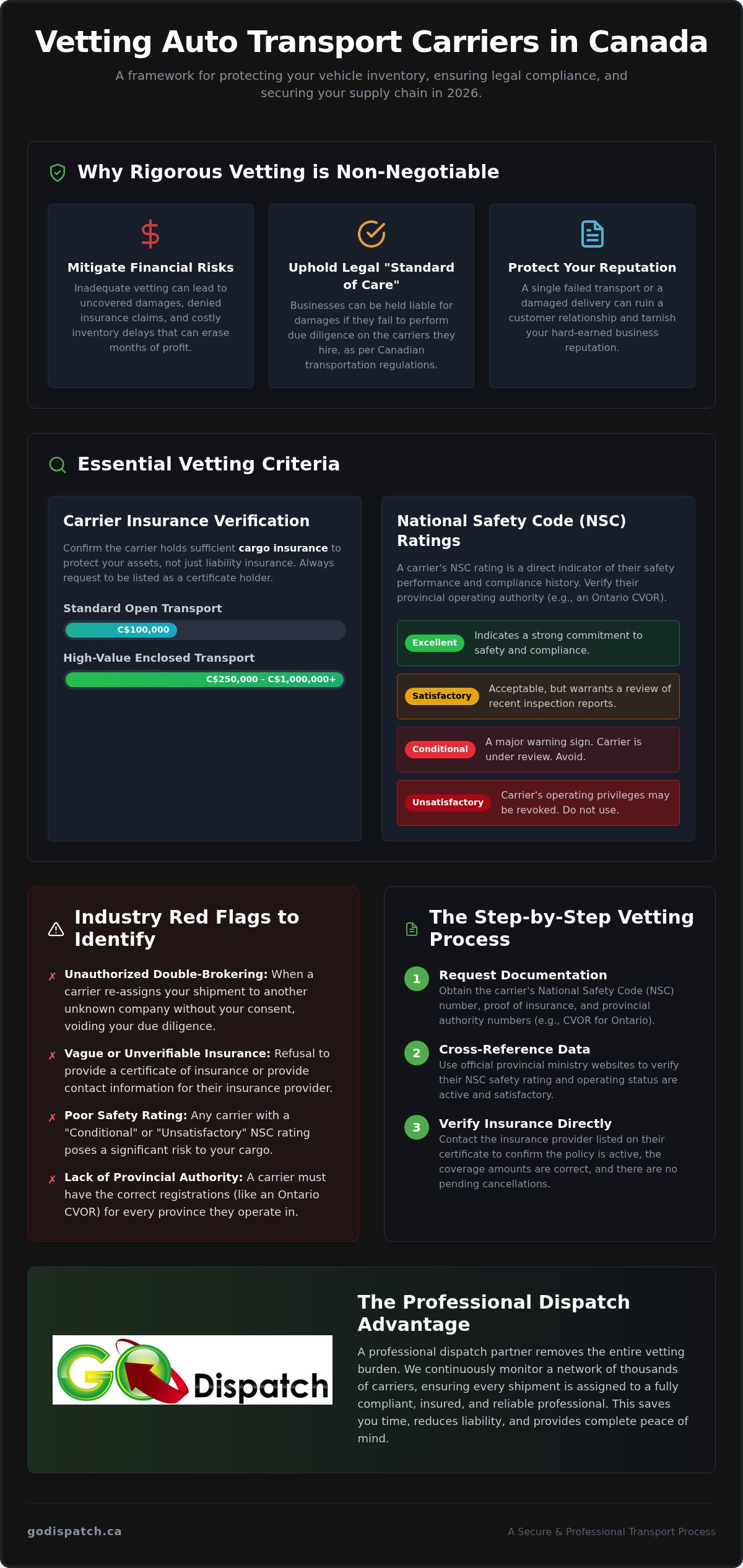
Insurance is your first line of financial defence. In Canada, you must understand the difference between liability and cargo insurance. Liability protects the carrier against claims from third parties, but cargo insurance is what protects your actual vehicles on the trailer. For 2026, standard open transport carriers usually offer liability coverage up to C$100,000. Enclosed carriers, which often handle luxury cars or high-value SUVs, typically maintain coverage between C$250,000 and C$1,000,000. Always insist on being listed as a certificate holder. This simple step ensures you receive real-time notifications if the carrier’s policy is cancelled or altered while your inventory is in transit.
Safety Ratings and the National Safety Code
Safety ratings under the National Safety Code (NSC) offer a clear look at a carrier’s performance. An “Excellent” rating shows a commitment to safety that goes beyond the basics. A “Satisfactory” rating is acceptable but requires closer scrutiny of recent inspection reports. Avoid carriers with “Conditional” or “Unsatisfactory” ratings. Look for patterns of mechanical failures or violations of federal Hours-of-Service (HOS) rules. You also need to confirm their authority to operate in specific regions. A carrier moving cars into Toronto, for instance, must maintain a valid Ontario CVOR certificate. This provincial registration is mandatory for vehicles over 4,500 kg.
Equipment standards cannot be ignored. The Canadian Transportation Equipment Association (CTEA) promotes the safety and compliance of transport gear across the country. You should verify that a carrier’s trailers are properly maintained and suited for your specific vehicle types, whether you’re moving vans or heavy-duty trucks. A long-haul track record in Canada proves a carrier can navigate our unique geography and harsh winter conditions. Managing these details is time-consuming. You can save hours of administrative work by using professional dispatching services that pre-vet every driver for you. This keeps your inventory moving safely while you stay focused on your core business goals.
Identifying Red Flags in the Car Hauling Industry
Vetting auto transport carriers in Canada requires a sharp eye for inconsistencies. While most operators are professional, the industry attracts some bad actors who cut corners to save money. Recognizing red flags early saves you from the stress of damaged inventory or lost capital. Some warnings are subtle; others are glaring. If a quote arrives that is significantly lower than the industry average, be wary. These “too good to be true” prices often lead to hidden fees or unvetted drivers. A legitimate carrier provides a transparent cost breakdown from the start. You should also verify their physical address and Canadian business registration. If they only have a mobile number and no verifiable office, they might lack the infrastructure to support your business during a crisis.
How to Spot and Avoid Double-Brokering
Double-brokering is one of the most dangerous practices in logistics. It happens when a carrier accepts your load and then hands it off to another company without your consent. This creates a massive insurance risk. If the unauthorized driver has an accident, the primary carrier’s insurance policy will likely refuse the claim. You are left with damaged vehicles and no clear path for recovery. You can spot this by asking if the company owns the trucks they use for national routes. Ask for the driver’s direct contact information before the pick-up date. If the carrier is evasive about who is actually behind the wheel, it’s a clear signal to walk away. Transparency is the only way to ensure your inventory is actually covered by the insurance policy you verified.
Evaluating Professionalism and Communication
Communication is the backbone of reliable logistics. A professional dealership auto transport logistics partner prioritizes clear data and frequent updates. Warning signs often appear during the initial scheduling phase. If a carrier is slow to return calls or provides vague answers about delivery windows, expect more trouble once the vehicle is in transit. Professionalism is also reflected in the quality of their paperwork. A clear, standardized Bill of Lading (BOL) is non-negotiable. This document serves as your legal receipt. It must detail the vehicle’s condition at both pick-up and delivery with high-resolution photos or detailed notes. If a carrier suggests skipping the BOL or using an informal handwritten note, they are not a professional partner. Inconsistent updates and vague paperwork are indicators of operational trouble that will eventually cost you time and money.
The Step-by-Step Vetting Process for Your Business
Establishing a repeatable framework for vetting auto transport carriers in Canada is the only way to ensure consistent safety for your inventory. You don’t want to leave your logistics to chance. A structured process removes the guesswork and builds a wall of protection around your capital. Follow these five essential steps before you hand over the keys to any driver. It’s about creating a standard that every partner must meet to earn your business.
- Step 1: Request the carrier’s NSC number and insurance certificate. Every legitimate Canadian carrier must have a National Safety Code (NSC) number. This is their primary identifier for safety compliance.
- Step 2: Cross-reference data with provincial transportation ministries. Use provincial databases, such as Ontario’s Carrier Company Profile, to verify that their operating status is active and their safety rating is satisfactory.
- Step 3: Verify the cargo insurance policy directly with the underwriter. Don’t just look at the PDF they email you. Call the insurance company to confirm the policy is currently in force and covers the total value of your specific load.
- Step 4: Review carrier performance through industry references. Ask for a list of current clients or check established industry ratings. A carrier with a long history of successful national hauls is always a safer bet.
- Step 5: Finalize a written agreement with clear delivery and safety terms. Ensure your contract specifies the expected delivery window, loading procedures, and exact insurance responsibilities.
Documentation Checklist for Every Move
You need a “must-have” file for every vehicle transport. This includes the carrier’s NSC certificate, an active insurance policy naming you as a certificate holder, and a signed Bill of Lading (BOL). Organize these records digitally so they are easily accessible for internal audits. It’s a best practice to keep these records for at least seven years to protect your business during future tax reviews or legal disputes. Having a complete paper trail proves you exercised the required standard of care for your business assets.
Leveraging Industry Tools and Databases
Modern logistics relies on real-time data. You can use provincial carrier profile systems to see up-to-date safety data and violation histories. Some third-party monitoring services can even alert you the moment a carrier’s insurance status changes. Managing this level of detail for every single load is a massive administrative burden. Professional dispatchers centralize this data for you, maintaining a pre-vetted network of high-performance haulers. If you want to skip the paperwork and move straight to reliable transport, you can outsource your carrier vetting to our expert team today.
How GO DISPATCH Handles the Vetting for You
Vetting auto transport carriers in Canada is a full-time job. You shouldn’t have to sacrifice your productivity to verify insurance certificates or check NSC ratings. GO DISPATCH acts as your dedicated logistics partner, handling the heavy lifting so you don’t have to. We’ve built a national network of verified third-party carriers that meet our strict standards for safety and reliability. You get the peace of mind that comes with professional oversight without the administrative headache. Our goal is to make your transport experience as simple and secure as possible.
Our carrier selection process is uncompromising. We don’t just look for an available truck; we look for a professional partner. This means every hauler in our system has undergone a deep dive into their safety history and operational capacity. We verify their ability to handle cars, trucks, SUVs, and vans across every province. By the time a driver arrives at your lot, they have already passed our rigorous internal audit. You can trust that the person behind the wheel is qualified to move your high-value assets.
Vetting isn’t a one-time event at GO DISPATCH. We provide continuous monitoring for every single load we dispatch. This means we verify insurance and safety status in real-time. If a carrier’s coverage lapses or their safety rating drops, they are immediately removed from our active rotation. This proactive approach ensures your inventory is always in the hands of a legitimate, fully insured professional. We manage the risks of vetting auto transport carriers in Canada so you can stay focused on your daily operations.
The GO DISPATCH Advantage for National Hauling
We act as your internal logistics department. Our team manages the entire coordination process, from initial booking to final delivery. This commitment to transparency means you always know where your vehicles are without having to chase down drivers. We reduce your operational burden significantly. You can stop worrying about transport and start focusing on selling more vehicles and growing your business. Our national reach is balanced by local expertise, ensuring every carrier is fit for the specific Canadian routes they travel.
Get Started with Professional Dispatching
Requesting a quote is simple and direct. Whether you need to move a single sedan or coordinate a multi-vehicle fleet, our Leduc-based team is ready to help. During your first coordination, you’ll experience our streamlined approach to communication. We provide clear data and professional support every step of the way. You deserve a partner that respects your time and your inventory. Simplify your logistics with GO DISPATCH today and let us handle the complexities of national transport for you.
Secure Your Vehicle Inventory with Professional Verification
Protecting your bottom line requires more than just finding a truck. It requires a commitment to safety and a deep understanding of the Canadian regulatory environment. By following a structured process, you can avoid the financial and legal pitfalls of unvetted transport. You now have the tools to identify red flags, verify insurance underwriters, and ensure every driver meets the 2026 National Safety Code standards. Vetting auto transport carriers in Canada is a critical business function that eliminates uncertainty and builds long-term reliability.
You don’t have to manage this complex process alone. Our team provides a national carrier network and rigorous safety and insurance verification for every load. We offer expert dispatching for cars, trucks, and SUVs so your team can focus on what they do best. Stop wasting hours on administrative paperwork and start enjoying the peace of mind that comes with professional logistics management. Let GO DISPATCH handle your carrier vetting and logistics today. Your inventory is in good hands.
Frequently Asked Questions
What is the National Safety Code (NSC) and why does it matter?
The NSC is a set of 16 federal standards designed to ensure commercial carriers operate safely and consistently across all Canadian provinces. It matters because it provides a unified safety record for every carrier, allowing you to track their compliance with vehicle maintenance and driver qualifications. A valid NSC number is a legal requirement for any carrier operating commercial vehicles across provincial boundaries.
How do I verify if a car carrier’s insurance is currently active?
You must verify active status by contacting the insurance underwriter listed on the carrier’s certificate of insurance directly. A PDF certificate can be easily altered or may have lapsed due to non-payment. Request to be added as a “Certificate Holder” so the insurance company notifies you automatically if the policy is cancelled or changed while your inventory is in transit.
What are the risks of using a carrier that double-brokers my load?
The biggest risk of double-brokering is a total loss of insurance coverage if an accident occurs. Most carrier policies specifically exclude claims for loads that were sub-contracted to an unauthorized third party. This practice also breaks the chain of communication, making it impossible for you to track your vehicles or confirm the actual driver’s safety credentials.
Do I need different vetting for cross-province vs. local transport?
Yes, because cross-province transport requires compliance with federal regulations and specific provincial registrations like Ontario’s CVOR. Vetting auto transport carriers in Canada for national routes requires checking their authority in every province they enter. Local transport might only require basic provincial licensing, but long-haul moves demand higher insurance thresholds and strict adherence to federal Hours-of-Service rules.
What specific safety ratings should I look for in a Canadian carrier?
You should look for an “Excellent” or “Satisfactory” rating within the provincial carrier profile systems. Avoid any company with a “Conditional” or “Unsatisfactory” status, as these labels indicate a history of mechanical failures or safety violations. A high rating is a clear signal that the carrier prioritizes equipment maintenance and follows all Canadian safety protocols.
How often should I re-vet a carrier I use regularly?
You should re-verify a regular carrier’s insurance and safety status at least every six months. Safety ratings can change quickly after a roadside inspection, and insurance policies are subject to annual renewals or mid-term cancellations. Regular checks ensure you aren’t relying on outdated data when moving high-value assets like trucks or SUVs.
What documents should a driver provide at the point of pickup?
A driver must provide a valid commercial driver’s licence and a professional Bill of Lading (BOL) before any vehicle is loaded. The BOL is your primary legal receipt and must include a detailed pre-trip inspection report with photos of the vehicle’s current condition. Using a professional dispatch service simplifies vetting auto transport carriers in Canada by ensuring all paperwork is verified before the truck arrives.