
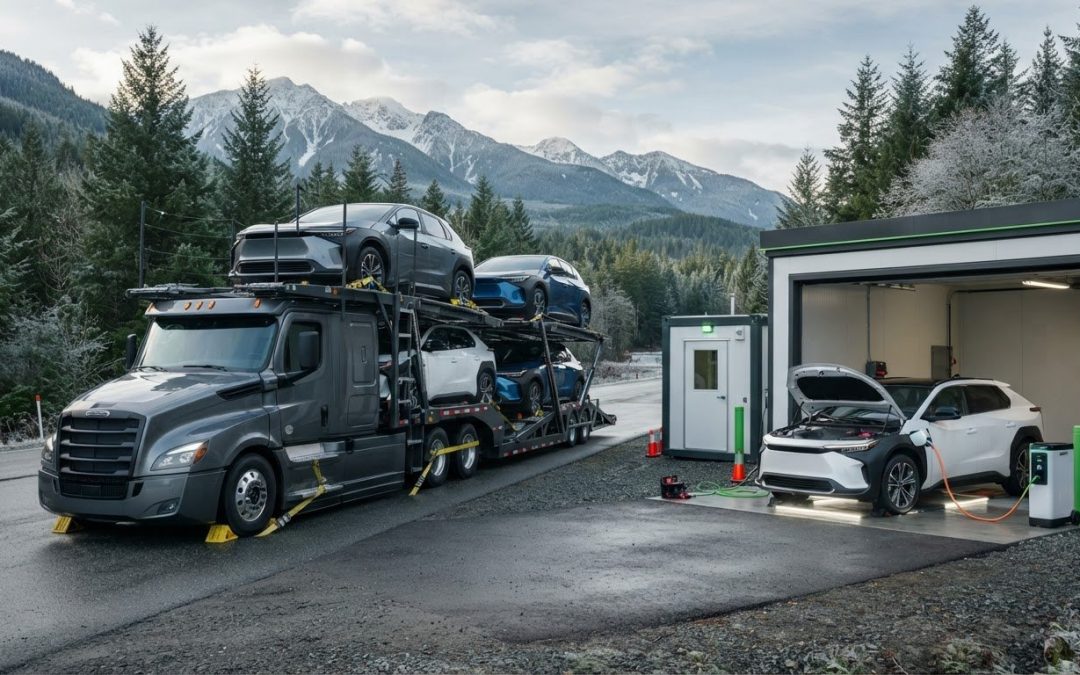
A vehicle test and a purchase incentive answer different questions. Transport Canada tested two Mitsubishi i-MiEVs in government facilities and real-world conditions in 2010. In 2026, eligible light-duty EV buyers and lessees may receive up to C$5,000 at the point of sale. Some provinces and territories also offer incentives for used-EV purchases or shipping costs, so electric vehicle (EV) transport in Canada can involve both vehicle testing and location-specific support.
It’s easy to assume a government-tested EV automatically qualifies for a rebate, or that a purchase incentive also covers shipping. These are separate questions. Eligibility depends on the vehicle, the incentive and the province or territory involved.
This article explains what Transport Canada’s testing covers, how zero-emission vehicles and plug-in hybrids are classified, and which incentives may apply when buying or shipping a used EV. Understanding the rules and logistics can help you plan your next step.
Key Takeaways
- Learn how zero-emission vehicle categories distinguish battery-electric vehicles from plug-in hybrids, and why the distinction matters.
- See what Transport Canada’s electric-vehicle testing has involved, including real-world conditions.
- Explore how federal and regional incentives can differ for new EV purchases, used vehicles and shipping costs.
- Understand how GO DISPATCH’s car transport and one-stop transport dispatching can help coordinate moving a vehicle.
How does Transport Canada define zero-emission vehicles, including plug-in hybrids?
A zero-emission vehicle (ZEV) produces no tailpipe emissions while driving in its zero-emission mode. In Canada, the ZEV category includes battery-electric vehicles and plug-in hybrid electric vehicles. The distinction matters: a battery-electric car runs on electricity, while a plug-in hybrid can also use a combustion engine.
A battery-electric vehicle (BEV) runs on electricity stored in a rechargeable battery and has no combustion engine. When planning transport for a used BEV, distinguish it from a plug-in hybrid so the vehicle’s powertrain is clear. The term describes how the vehicle is powered; it does not confirm eligibility for a purchase incentive or determine the conditions of a shipment.
A plug-in hybrid electric vehicle (PHEV) can be charged externally and can also run on a combustion engine. It belongs to the ZEV category used in Canadian policy, even though its engine can produce tailpipe emissions. “Zero-emission” is therefore a category label, not a claim that every trip in every PHEV produces no emissions. A PHEV and a BEV are both plug-in vehicles, but they have different powertrains.
A ZEV policy target is a government goal for the share of new vehicle sales made up of qualifying zero-emission vehicles. Canada’s regulation required at least 20% of new vehicles sold to be ZEVs by 2026. It set targets of at least 60% by 2030 and 100% by 2035. Canada’s EV mandate was paused for review in September 2025, so those targets should be read alongside that later policy development.
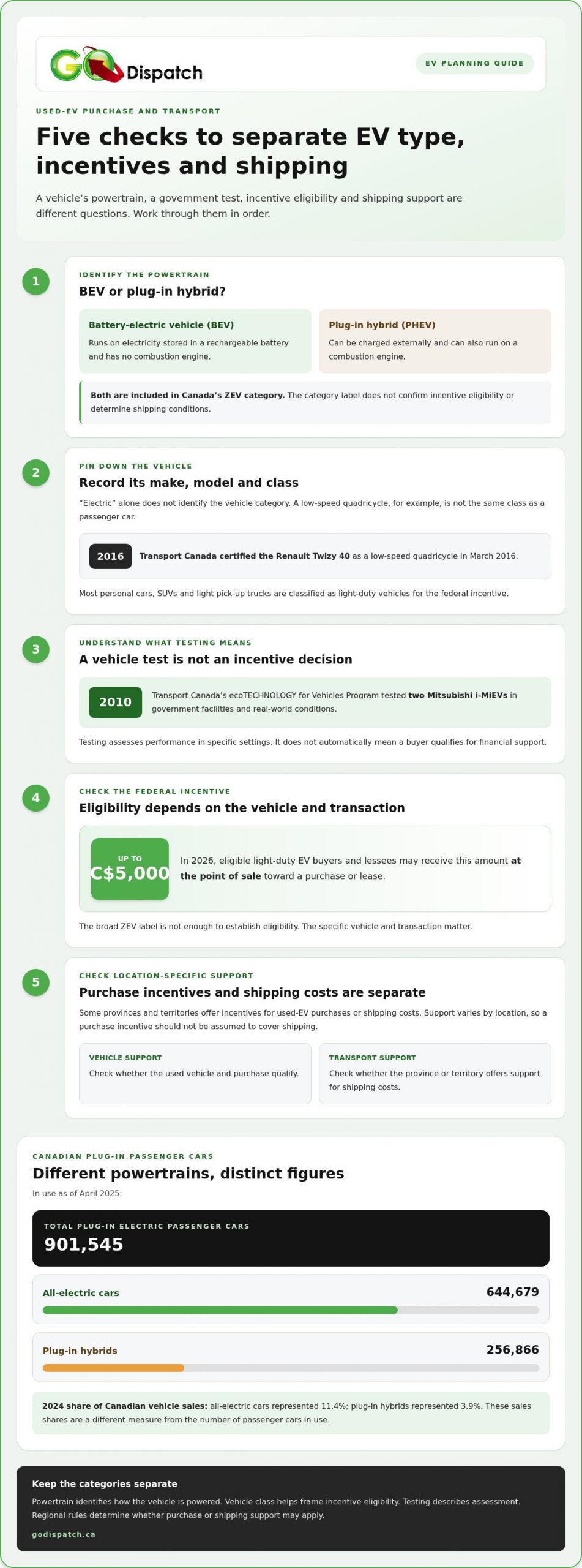
Transport Canada vehicle testing examines how vehicles perform in specific test settings and real-world conditions. In 2010, Transport Canada’s ecoTECHNOLOGY for Vehicles Program tested two Mitsubishi i-MiEVs in government facilities and real-world conditions. That example shows that the department’s work has included assessing electric vehicles beyond a definition or policy target. A government test, however, is not the same thing as a buyer’s incentive decision.
Vehicle certification is an official determination that a vehicle meets applicable requirements for its class. Transport Canada certified the Renault Twizy 40 low-speed quadricycle in March 2016. The example also shows why vehicle type matters: a low-speed quadricycle is not the same vehicle category as a passenger car, even though both use electric power. A model’s name, powertrain and vehicle class help clarify what is being discussed.
Incentive eligibility is the set of conditions that determine whether a specific vehicle and transaction qualify for financial support. In 2026, eligible light-duty EVs can qualify for up to C$5,000 at the point of sale toward purchase or lease. Most personal cars, SUVs and light pick-up trucks are classified as light-duty vehicles for the federal incentive. This makes the vehicle’s class and eligibility worth separating from the broader ZEV label.
Used-EV transport planning starts with identifying the specific vehicle, rather than relying on the broad term “electric.” Note its make, model, vehicle class and whether it is a BEV or PHEV. These details keep discussions about ZEV definitions, incentive rules and shipping focused on the same vehicle. Classification identifies the powertrain; it does not establish incentive eligibility or mean shipping costs are covered.
Understanding the category also helps put its scale in context. More than 700,000 fully electric and plug-in hybrid electric vehicles are on the road in Canada. Plug-in electric vehicles represented 3.4% of all light-duty vehicles in Canada as of April 2025, while plug-in electric vehicles had a 15.3% share of Canadian vehicle sales in 2024. These figures describe different measures: vehicles in use, the share of the light-duty fleet, and sales during a year.
Transport Canada’s Zero-Emission Vehicle Council includes industry and government members and is tasked with setting the agenda to accelerate ZEV adoption in Canada. Earlier sales were concentrated geographically: Quebec accounted for 45% of Canadian plug-in electric car sales in 2015. Separately, driving an electric vehicle can reduce a Canadian driver’s vehicle emissions by as much as 90%. That potential reduction does not change the distinction between a battery-electric vehicle and a plug-in hybrid: the latter still has a combustion engine, and emissions can occur when it operates. Vehicle type, fleet presence and sales share therefore provide different context for understanding the ZEV category.
Electric cars
Electric cars are passenger vehicles powered fully or partly by electricity. Canada had 901,545 plug-in electric passenger cars in use as of April 2025. That total included 644,679 all-electric cars and 256,866 plug-in hybrids. These figures show that a used-EV listing can describe different powertrains. Identify the actual vehicle type before comparing models, considering incentives or arranging its movement.
An all-electric car uses a battery and electric motor for propulsion. In 2024, all-electric cars represented 11.4% of Canadian vehicle sales. A plug-in hybrid combines electric drive with a combustion engine, and represented 3.9% of sales that year. For a buyer, the distinction affects how the vehicle is used: a battery-electric model depends on charging, while a plug-in hybrid also has an engine.
Model availability refers to the range of electric cars offered to Canadian buyers. More than 110 EV models are available for sale in Canada. Many new 2026 models offer more than 400 kilometres of range on one charge. Those figures describe new-model options, not the remaining range of a used car. For a particular used vehicle, battery condition, charge level and route all matter.
Charging access means the ability to connect an EV to a charging point. Canada has more than 40,000 public charging ports, and more than 80% of the country’s electricity comes from non-greenhouse-gas-emitting sources. For a buyer, charging access is part of daily-use planning. For electric vehicle (EV) transport in Canada, it’s useful context, but public charging availability doesn’t replace clear pickup and delivery arrangements.
A federal EV purchase incentive is financial support for an eligible vehicle purchase or lease. In 2026, eligible light-duty EVs can qualify for up to C$5,000 at the point of sale. Most personal cars, SUVs and light pick-up trucks fall within the light-duty category for this incentive. A buyer considering a used vehicle should distinguish eligibility for a purchase program from any support tied to moving the vehicle.
A provincial or territorial incentive is a program offered within a specific jurisdiction. Manitoba, Quebec and Yukon currently offer EV-related incentives. Some provinces and territories also offer incentives for buying new or used EVs, and regional support may be combined with federal incentives. Conditions vary by program, so the vehicle, transaction and location are important when assessing a potential benefit.
A shipping-cost incentive may help cover the cost of moving a purchased used EV. Some provinces and territories offer this type of assistance. It serves a different purpose from a purchase rebate, so don’t treat the two as interchangeable. When arranging delivery of a used EV, assess purchase eligibility separately from shipping support.
A practical EV purchase check means reviewing the vehicle and transaction before committing. Record whether the car is all-electric or a plug-in hybrid, whether it’s new or used, and where it will be registered. Then compare those details with the relevant incentive conditions. For electric vehicle (EV) transport across Canada, have the vehicle’s make, model and destination ready when organizing its move.
That starting-price figure is not a quote for a particular used vehicle, nor does it show what a buyer will pay after any applicable support. When comparing purchases, keep the asking price separate from possible incentives and transport expenses. Those figures alone cannot determine the cost of a specific car or transaction.
Quebec had about 11,000 plug-in electric cars registered as of September 2016, and plug-in hybrids accounted for 55% of Quebec’s registered plug-in electric cars as of September 2016. Quebec registered 3,100 plug-in electric cars in 2015, when plug-in electric cars represented 0.7% of new car sales in Quebec. Canada had 18,451 highway-legal plug-in electric cars registered as of December 2015. These historical registration and sales figures offer context for the market at those times; they do not describe today’s available stock or the condition of an individual used car. For a buyer, the age and scope of each figure matter when using it as background rather than as a measure of a particular vehicle’s value, suitability or transport needs.
GO DISPATCH: Car Transport
GO DISPATCH coordinates car transport when you’ve bought an EV and need it moved to its destination. Its one-stop transport dispatching service connects clients with auto carriers and manages the logistics. Share the vehicle details, pickup point and delivery location to organize the move. This is a practical option when driving the car yourself isn’t convenient.
GO DISPATCH also handles truck, SUV and van transport. Whether your vehicle is a battery-electric car or a plug-in hybrid, clear vehicle and route details help keep transport arrangements focused. For help coordinating your vehicle move, visit godispatch.ca.
Plan your EV’s next move
Before arranging transport, bring the purchase and delivery details together. Note the EV’s make and model, pickup and delivery locations, and any timing needs. Having these details ready gives the transport conversation a clear starting point and helps you identify the next practical step.
Keep incentive decisions separate from shipping arrangements. A purchase rebate and support for moving a used vehicle may have different eligibility conditions. For electric vehicle (EV) transport in Canada, knowing the vehicle and destination helps you discuss the move without assuming one program covers every part of the transaction.
GO DISPATCH can help coordinate transport for your vehicle. Contact GO DISPATCH about EV shipping to discuss your move. A clear plan can make the next step feel more manageable.